|
Class 90 electric locomotives were built
by BREL at Crewe Works between 1987 and 1990, they weigh 84.5 tonnes. Class 90
electric locomotives have
a maximum tractive effort of 258 kN (3700 kW, 5000 bhp, 58000 lbf). The maximum design
speed of Class 90 electric locomotives is 110 mph. Class 90 locomotives are
powered by a 25 kV AC overhead-pantograph system. Class 90 electric
locomotives are used on passenger trains and often double-headed in
working freight trains.
but not anymore! Contemporary and Heritage-Preserved, Diesel, Diesel-Electric and Electric Locomotives My Archive Steam Photos from the 1960s Class 90 electric locomotives featured: 90001 Royal Scot, 90002 Wolf of Badenoch, 90003 Raedwald of East Anglia, 90005 Vice-Admiral Lord Nelson, 90009 Diamond Jubilee, 90015 Colchester Castle, 90019, 90024, 90026, 90029, 90036, 90037 (ex 90137 Spirit of Dagenham), 90042, 90044, 90046
A pair of Greater Anglia Class 90 electric locomotives at Liverpool Street Station, London. 90009 "DIAMOND JUBILEE" in Greater Anglia trains livery, and, 90015 "Colchester Castle" in National Express livery.
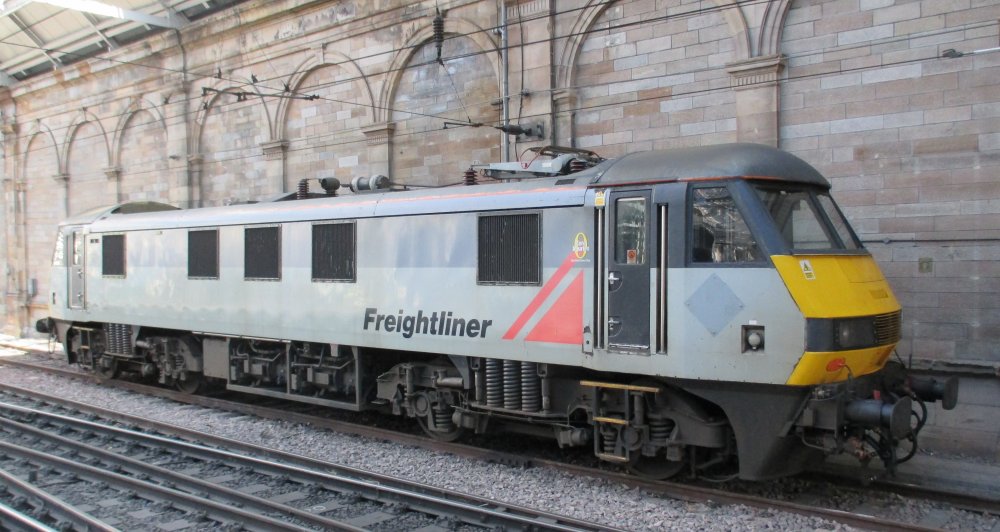
Freightliner Class 90 electric locomotive 90042 at Edinburgh Waverley station (July 2016)
Portraits of Class 90 loco 90042
Class 90 electric locomotive 90009 " Diamond Jubilee" in Liverpool Street station, London
A Great Anglia Train hauled by Class 90 90003 "Raedwald of East Anglia" entering Stratford Station with a train from ? to London Liverpool Street.
Freightliner Class 90 electric locomotive 90044 parked in Edinburgh Waverley station
An intermodal Freightliner freight trained passing east through Stratford Station (East London), hauled by a Class 90 electric locomotive 90047. Freightliner Grey livery (two tone Grey with black cab doors & window surrounds.
Mark 3B Driving Brake Van (110 mph) 82127 heading a Great Anglia train east-bound into Stratford Station (Class 90 90005 electric locomotive in the rear - see below).
Class 90 electric locomotive 90005 "Vice-Admiral Lord Nelson" with the Abellio GreaterAnglia legend on the side.
90003 "Rædwald of East Anglia" returning from Liverpool Street with an express train for ?
Greater Anglia liveried carriage 11082
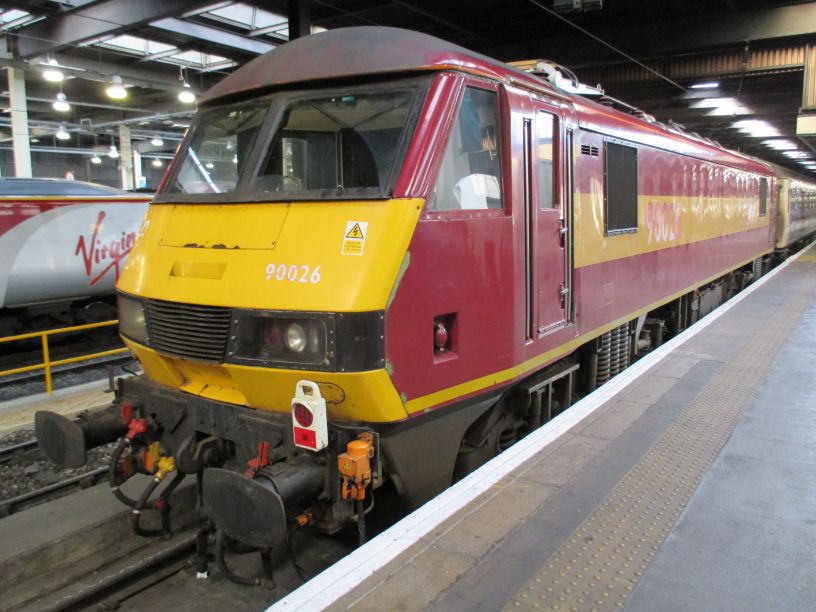
Ex EWS, DB Schenker DBS Class 90 electric locomotive 90026 at Euston Station, London, with the recently arrived Caledonian Sleeper train from Scotland (Glasgow, Edinburgh, Aberdeen, Inverness, Fort William and other stations) to London Euston
The ScotRail carriages of the Caledonian Sleeper Train
A double header of two DB Schenker Class 90 electric locomotives Class 90 90024 (in Scotrail livery) behind leading class 90 locomotive 90037 (ex 90137 and named "Spirit of Dagenham", in EWS livery, but a DB Schenker operated electric locomotive), heading south through Wigan NW with an intermodal Mossend Euroterminal to Daventry Int Rft Recep Rfd (474H, March 2016)
DB Schenker red liveried Class 90 electric locomotive 90029 hauling fellow Class 90 loco 90036 and a Class 66 diesel 66087 from Arpley Sidings to Carlisle N.Y. (Wigan North western station, March 16th 2016)
On hire to LNER on the ECML, Class 91 90019 in DB Livery, with a KX-Leeds service at Leeds (November 2018)
Class 90 electric locomotive 90002 Wolf of Badenoch, British Rail InterCity Swallow livery (Crewe, May 2024)
British Rail Class 90 electric locomotive 90001 Royal Scot, InterCity Swallow livery (Crewe, May 2024) Extra notes on Class 90 Electric Locomotives All Class 50 locomotives were built from 1987 to 1990 Initially 90001 to 90015 were operated by Greater Anglia 90016 and 90041 to 90050 operated by Freightliner and 90017 t0 90040 operated by DB Cargo UK Fifty Class 90 electric locomotives were built in the late 1980s and numbered 90001-050. They were an improved development of the Class 87electric locomotives. The Class 90s were primarily built to replace the ageing Class 81, Class 82, Class 83, Class 84, Class 8s and Class 86s locomotives, dating from the early 1960s. In the early 1990s 26 Class 90 locomotives were dedicated for freight traffic and reclassified Class 90/1 and renumbered 90125-150 by the addition of 100 to the original number. The modifications included lowering the maximum speed to 75 mph (121 km/h) and isolating the electric train supply. Many of these locomotives were repainted in the new Railfreight Distribution two-tone grey livery, which was replaced by a revised version in 1994. Three locomotives, 90128, 90129 and 90130, received special "continental" liveries (NMBS/SNCB blue, Deutsche Bahn red, SNCF grey respectively) to celebrate the Freight connection event in 1992. Also at the same time, five Class 90 locomotives, 90016 to 90020, were repainted into the new Rail Express Systems livery and dedicated to postal trains. They were primarily used on London-Glasgow, London-Newcastle and Birmingham-Glasgow services. Of the remaining Class 90 locomotives, the first 15, 90001-015, were operated by InterCity West Coast on express passenger services. 90021 to 90024 were operated by Railfreight Distribution, but remained as standard Class 90/0 locomotives to enable them to rescue passenger trains. Many Class 90 locomotives have received names. The passenger locomotives were named after cities, newspapers or famous institutions. Many of the freight locomotives have been given names with a commercial link. The Class 90 was the first new locomotive to carry InterCity Swallow livery Names that Class 90 electric locomotives have or had in the past 90001 No name at present ;BC Midlands Today * 90002 No name at present; Girls Brigade, Mission: Impossible 90003 Raedwald of East Anglia; The Herald 90004 Eastern Daily Press: 1870- 2010, Serving Norfolk for 140 years; The D'oyly Carte Opera Company; City of Glasgow 90005 Vice-Admiral Lord Nelson Financial Times * 90006 Roger Ford & Modern Railways Magazine; High Sheriff 90007 Sir John Betjeman; Lord Stamp; Keith Harper * 90008 The East Anglian; Birmingham Royal Ballet 90009 No name at present; Royal Show; The Economist * 90010 No name at present; 275 Railway Squadron (Volunteers) 90011 Let's Go East of England; The Chartered Institute of Transport; West Coast Rail 250 90012 Royal Anglian Regiment; Glasgow 1990 Cultural Capital of Europe; British Transport Police 90013 The Evening Star: Pride of Ipswich 1885 to 2010 - 125 years of serving Suffolk; The Law Society 90014 Norfolk & Norwich Festival; The Liverpool Phil; The Big Dish; Driver Tom Clark O.B.E. 90015 Colchester Castle; BBC North West; The International Brigades Spain 1936 – 1939 90016 No name at present; Never been named * 90017 No name at present; Rail Express Systems Quality Assured 90018 No name at present; Never been named * 90019 No name at present; Penny Black (with & without a Crest) 90020 Collingwood; Colonel Bill Cockburn CBE TD; Michael Heron * 90021 No name at present; Never been named ; 90022 No name at present; FreightConnection * 90023 No name at present; Never been named 90024 No name at present; Never been named * 90025 No name at present; Never been named 90026 No name at present; Crewe Electric Depot; Crewe International Electric Maintenance Depot 90027 No name at present; Allerton T&RS Depot * 90028 No name at present; Vrachtverbinding; Hertfordshire Rail Tours 90029 The Institution of Civil Engineers Frachtverbindungen * 90030 No name at present; Crewe Locomotive Works; Fretconnection 90031 No name at present; The Railway Children Partnership: Working for Street Children Worldwide; Intercontainer 90032 No name at present; Cerestar * 90033 No name at present; Never been named 90034 No name at present; Never been named * 90035 No name at present; Crewe Basford Hall 90036 No name at present; Never been named * 90037 No name at present; Spirit of Dagenham 90038 No name at present; Never been named * 90039 No name at present; Never been named 90040 No name at present; The Railway Mission * 90041 No name at present; Never been named 90042 No name at present; Never been named * 90043 Freightliner Coatbridge 90044 No name at present Never been named * 90045 No name at present; Never been named 90046 No name at present; Never been named * 90047 No name at present; Never been named 90048 No name at present; Never been named * 90049 No name at present; Never been named 90050 No name at present; Never been named
CLASS 90 electric locomotives
from Wiki
https://en.wikipedia.org/wiki/British_Rail_Class_90 A brief history of Class 90 electric locomotives The British Rail Class 90 is a fleet of 50 mixed‑traffic 25 kV AC electric locomotives built at Crewe Works between 1987 and 1990 as a modernised successor to the Class 87, intended to replace ageing early‑1960s AC types (Classes 81–85). Origins and Development of the Class 90 electric locomotives (1970s–1980s)The Class 90’s roots lie in British Rail’s long‑term need to renew its AC electric fleet. By the late 1970s and early 1980s, BR faced a shortage of modern electric traction, worsened by delays and cancellations around the APT and InterCity 225 programmes. Several proposals were explored, including the Class 89 prototype and an electrified HST, but BR ultimately selected a four‑axle development of the Class 87, originally designated Class 87/2. BREL Crewe was contracted to build 50 locomotives, with construction taking place from 1987 to 1990. Technical Characteristics of the Class 90 electric locomotivesThe Class 90 was designed as a Bo‑Bo mixed‑traffic locomotive with significant upgrades over the Class 87:
The locomotives also featured a completely redesigned bodyshell, giving them a distinctive angular appearance compared with the Class 87. Entry into Service of the Class 90 electric locomotives (Late 1980s–1990s)The Class 90 entered traffic during the final years of British Rail, working:
Sectorisation in 1991 split the fleet roughly half‑and‑half between passenger and freight. Freight locomotives were re‑geared for 75 mph and designated Class 90/1, losing their electric train heating equipment. Post‑Privatisation Operations of the Class 90 electric locomotives (1990s–2020s)After 1994–97 privatisation, Class 90s served with:
Passenger use declined sharply in the 2000s–2010s as EMUs and Class 91s/390s took over. By around 2020, most regular passenger diagrams had ended. Freightliner and DB Cargo UK became the main operators, though DB Cargo withdrew and scrapped or stored its fleet in 2023 due to high energy costs. As of the mid‑2020s, around 25 remain in service, with others stored or scrapped. Significance of the Class 90 electric locomotivesThe Class 90 represents:
My Archive Steam Photos from the 1960s docspics images of Class 90 electric locomotive rail tour holidays photos of Class 90 electric locomotive rail tour holidays photographs of Class 90 electric locomotive rail tour holidays pictures of Class 90 electric locomotive rail tour holidays © Dr Phil Brown * Treyn Railway Holidays to France, Italy and Spain from Class 90 electric locomotive rail tour holidays Booking tickets for Great Railway Journey luxury Rail Trip holidays Train travel in Europe Rail holidays from Class 90 electric locomotive rail tour holidays to the USA & Canada luxury train through the Rocky Mountain Canadian rail railway holidays through the Rockies US Cities by train from Class 90 electric locomotive rail tour holidays Continental rail holidays to France Germany Italy Austria Switzerland Glacier Express Treyn Holidays from Class 90 electric locomotive rail tour holidays from Eurostar to Paris Brussels Avignon Turin Turino Rome Roma Florence Firenze TGV fast trains Railway travel holidays special steam excursions from Class 90 electric locomotive rail tour holidays great steam heritage line and offers luxury Pullman coach dining trains Class 90 electric locomotive rail tour holidays Travelling by train always seems a pleasure, especially if through wonderful scenery to Class 90 electric locomotive rail tour holidays in England, Scotland, Wales or on holiday in the rest of Europe! The railway trip from Class 90 electric locomotive rail tour holidays involves seeing or travelling behind a 'real' steam locomotive in action and there is nothing like the sight and sounds of a steam train to invoke feelings of nostalgia in some of us to Class 90 electric locomotive rail tour holidays even more luxury by having a special trip out on a steam dining train! England Scotland Wales Northern Ireland top class hotels in Class 90 electric locomotive rail tour holidays dining out travel tours top tourist destinations tourist information on Class 90 electric locomotive rail tour holidays weekend breaks mini-breaks family holidays restaurants touring coach trips from Class 90 electric locomotive rail tour holidays continental tours cruise ships pleasure cruises summer breaks spring breaks continental winter breaks European winter holidays spring holidays summer holidays European Rail tours Railway travel holidays special steam excursions from Class 90 electric locomotive rail tour holidays A great steam heritage line and offers luxury Pullman coach dining trains European Rail tours US and Canadian Railway travel holidays special steam excursions to Class 90 electric locomotive rail tour holidays A great steam heritage line and offers luxury Pullman coach dining trains Travelling by train from Class 90 electric locomotive rail tour holidays always seems a pleasure, especially if through wonderful scenery either in England, Scotland, Wales or on holiday in the rest of the railways of Europe! The railway trip involves seeing or travelling behind a 'real' steam locomotive or heritage diesel in action on a special trip from Class 90 electric locomotive rail tour holidays Booking Eurostar Continental Rail Travel Tour Tickets Stuttgart Brussels Eurostar Brussels from Class 90 electric locomotive rail tour holidays by TGV to Ebbsfleet International, Ashford International Stratford International, St Pancras International Paris Gare du Nord Paris Gare de Lyon Paris Gare de L'est Paris Gare Montparnasse by Eurostar from Class 90 electric locomotive rail tour holidays London to Paris, Eurostar London - Brussels Eurostar London to Lille deals bargain city breaks Class 90 electric locomotive rail tour holidays Great Railway Journey holidays in Italy, Spain and France by TGV booking from Class 90 electric locomotive rail tour holidays Booking Eurostar Continental Rail Travel Tour Tickets to the Continent eg Paris Brussels Avignon or railway tours across France, Holland, Austria, Czech Republic, Hungary, Russia, Asia or China for a travel spectacular Class 90 electric locomotive rail tour holidays Good trainspotting 'TRAINSPOTS' Good trainspotting and photographic locations Barnetby Station, North Lincolnshire * Carlisle Station * Clapham Junction Station, London * Colton Junction, south of York * Crewe Station * Doncaster Station, South Yorkshire * Hellifield station - Carlisle to Settle line * Lancaster station * Newcastle Station * Northallerton Station * Nuneaton Station * Sheffield Station * Stratford Station, East London * Warrington Bank Quay station * Wigan North Western - WCML * York Station See other TOPS classes of diesels and electrics * Class 01 * Class 02 * Class 03 * Class 04 * Class 08 * Class 09 * Class 10 * Class 11 * Class 14 * Class 20 * Class 24 * Class 25 * Class 26 * Class 27 * Class 31 * Class 33 * Class 35 * Class 37 * Class 40 * Class 43 * Class 44 * Class 45 * Class 47 * Class 50 * Class 52 * Class 55 * Class 56 * Class 57 * Class 58 * Class 60 * Class 66 * Class 67 * Class 68 * Class 70 * Class 71 * Class 73 * Class 76 * Class 77 * Class 84 * Class 86 * Class 87 * Class 88 * Class 90 * Class 91 * Class 92 * Derby Lightweight * Class 101 * Class 108 * Class 114 * Class 117 * Class 120 * Class 121 * Class 122 * Class 127 * Class 141 * Class 142 * Class 144 * Class 150 * Class 153 * Class 155 * Class 156 * Class 158 * Class 159 * Class 165 * Class 166 * Class 170 * Class 172 * Class 175 * Class 180 * Class 185 * Class 195 * Class 196 * Class 197 * Class 220 * Class 221 * Class 222 * Class 252 * Class 313 * Class 315 * Class 317 * Class 319 * Class 320 * Class 321 * Class 322 * Class 323 * Class 325 * Class 331 * Class 332 * Class 333 * Class 334 * Class 350 * Class 357 * Class 360 * Class 365 * Class 373 * Class 375 * Class 376 * Class 377 * Class 378 * Class 379 * Class 380 * Class 387 * Class 390 * Class 395 * Class 414 * Class 423 * Class 442 * Class 444 * Class 450 * Class 455 * Class 458 * Class 460 * Class 465 * Class 466 * Class 489 * Class 507/508 * Class 700 * Class 730 * Class 755 * Class 800 * Class 801 * Class 802 * Class 803 * Class 805 * Class 3000 * IMAGES OF PRESERVED STEAM LOCOMOTIVES |






 Enter specific words
e.g. TOPS train class, specific locomotive, train station, railway location, heritage line, railway trip, anything of
railway interest!
Enter specific words
e.g. TOPS train class, specific locomotive, train station, railway location, heritage line, railway trip, anything of
railway interest! |