|
GCSE level organic chemistry exam
revision notes: Part
4A
Fossil fuel air pollution - incomplete combustion,
pollution from carbon
monoxide, particulates and soot
Anthropogenic means any
environmental change or pollution due to human activity
[Author
©
Dr Phil Brown PhD:
Doc Brown's chemistry exam revision notes on
oil products &
organic chemistry,
suitable for students of UK GCSE Science level
AQA, Edexcel, OCR, WJEC and CCEA GCSE chemistry courses, ~US grades 9-10 chemistry
[page updated Mar 16th 2026 *]
All my
GCSE level chemistry revision
notes
All my GCSE level oil and
organic chemistry revision notes
All my advanced A level organic chemistry notes
email doc
brown - comments - query?
*
[privacy policy, cookies
and disclaimer]
 GCSE level m/c QUIZ on oil products & organic chemistry
(easier-foundation-level)
GCSE level m/c QUIZ on oil products & organic chemistry
(easier-foundation-level)
GCSE
level m/c QUIZ on oil products
& organic chemistry (harder-higher-level)
See also
4B Pollution, Accidents
and Economic Aspects of the Petrochemical Industry
4C
Greenhouse effect, global warming, climate change,
carbon footprint from fossil fuel burning
4D Fossil fuel air pollution - effects of sulfur oxides
and nitrogen oxides
A
local acid rain project!!!
4A Atmospheric pollution: The Incomplete
Combustion of hydrocarbons and  CO
CO
Carbon dioxide, carbon monoxide, soot,
water vapour,
sulfur dioxide and oxides of nitrogen
are all produced in the combustion of fossil fuels.
Carbon dioxide and water vapour are the main 'greenhouse gases'.
INTRODUCTION - burning fossil fuels
Burning COAL
-
The fuel coal
consists mainly of carbon, which, if burned/ignited in excess air,
combusts to form carbon dioxide.
-
carbon + oxygen
====> carbon dioxide
-
C(s)
+ O2(g) ====> CO2(g)
-

-
This is what you
expect to happen in an open domestic coal fire.
-
If not enough
air/oxygen is available, coal will only 'half' burn to form the deadly
odourless, colourless and toxic gas carbon monoxide.
-
2C(s)
+ O2(g) ====> 2CO(g)
-
This can happen
if organic material, coal or peat or any combustible material is smouldering underground and is
obviously a dangerous situation.
-
If it was formed
in a domestic coal fire it will quite happily burn with a pale blue
flame to form the 'safe' combustion product carbon dioxide gas.
-
2CO(s)
+ O2(g) ====> 2CO2(g)
-
However in house fires, there
tends to be a lack of oxygen and fumes of smoke and carbon monoxide
are formed, which probably causes more deaths in fires than being
burnt,
Burning hydrocarbon fuels
-
When fossil fuels burn
efficiently in an excess of air/oxygen the main products are
carbon dioxide and water e.g.
-
examples of complete
combustion burning are for example natural gas and petrol
-
Power
stations burn huge quantities of fossil fuels in the form of mainly coal, but
significant quantities of gas and some oil.
-
The heat from the very exothermic
combustion is used turn water into steam and steam driven turbines power the
electrical generators (very big dynamos!).
CARBON MONOXIDE, soot and hydrocarbon particulates
and incomplete combustion
-
Carbon
monoxide is a toxic gas and unfortunately it is colourless and
odourless and so not easily detected.
-
Carbon monoxide combines with
haemoglobin in the blood, reducing its capacity to carry oxygen.
-
CO molecules will displace O2 oxygen molecules from haemoglobin depriving cells of
the essential oxidant O2 !
-
Lack of oxygen can lead to
feeling weak, fainting and reduction of brain function. If you
breath in more than traces over a period of time you can go into a
coma and death - CO is pretty toxic and lethal dose isn't that high!
-
If there is not enough oxygen
present to completely burn the fuel to carbon dioxide and water other
products may form causing pollution and fuel inefficiency.
-
This is referred to as
incomplete combustion.
-
Visually, blue flames
indicate complete combustion releasing lots of heat energy, but smokey
yellow flames indicate incomplete combustion releasing less energy.
-
The most common partially burned products are likely to
be carbon C (soot) and deadly carbon monoxide CO.
-
A simplified word
equation covering most possibilities is ...
-
Carbon-soot, a
fine black powder-dust is potentially harmful and readily formed in
fires i.e. its classically produced by smoky yellow flames and inefficient motor vehicle engines.
-
The soot,
like any fine solid 'dust' is harmful when absorbed on the sensitive
tissue of the linings of the nose, throat and lungs.
-
Black sooty marks
indicate incomplete combustion and soot deposits cause
coughing and sore throat and are ejected from your body through
sneezing, coughing, and nose blowing. Respiratory problems can follow.
-
Coarse solid particles (10 microns
in diameter) are
inhaled into your windpipe and settle there, causing irritation and more
coughing and ultimately lung damage.
-
Soot particles also are 'carriers' of polycyclic aromatic
hydrocarbons (PAH's) on it which are carcinogenic molecules (cause DNA
damage - cancer forming) of general
formula CxHy, where x and y are at
least 6.
-
These are examples of unburned hydrocarbons which are emitted from vehicle
exhausts as particulates, especially from diesel engines (much
more so than emissions from petrol engines).
-
These fine particles of
soot and hydrocarbons are called particulates, they
reduce air quality and are
known to cause health problems, particularly with our
respiratory system.
-
Particulates are also
believed to cause a phenomena known as 'global dimming',
because they scatter sunlight and cause a cooling effect.
-
Even very low
concentrations of carbon monoxide can be fatal. Why?
-
Oxygen is carried
around the body by a complicated protein molecule in red blood
cells called haemoglobin.
-
The bonding between oxygen and
haemoglobin is quite weak to allow easy oxygen transfer for
cell respiration.
-
Unfortunately, the bonding between carbon
monoxide and haemoglobin is stronger, so oxygen is replaced by
carbon monoxide and blocks normal cell respiration.
-
The
consequences are reduced blood oxygen concentration, particularly
affecting the brain, and can lead to fainting-unconsciousness, a
coma
and eventually
death!
-
This is why long road
tunnels are ventilated and you should never run a car engine in a closed
garage!
-
It would
appear that the hydrogen in the fuel molecules is more easily burned
(oxidised) and
usually forms water so the equations for incomplete combustion below show
the formation of carbon-soot and 'deadly' carbon monoxide when there is a
lack of oxygen for complete combustion.
-
Particulate carbon doesn't
get the headlines like acid rain, but it is a serious problem that
you get from burning coal and diesel fuel too.
-
As mentioned already, soot
is obviously a 'dirty' pollutant coating any surface (including your
lungs!) that the soot particles settle on - dark colouration on
buildings from the Industrial Revolution the emergence of steam
powered Victorian technology.
-
Soot particles of carbon
also contain unburned
carcinogenic hydrocarbons AND carbon monoxide is involved in the
chemistry of photochemical smogs - so all in all, inefficient
combustion of fossil-hydrocarbon fuels is very undesirable!
-
Incomplete combustion is still
exothermic, but there is also less heat released
in incomplete combustion compared to
complete combustion since not all the carbon atoms of the fuel are
fully combined with the maximum amount of oxygen.
-
Therefore
it is extremely important that any combustion system is as efficient as
possible e.g. gas heaters, furnaces etc. must all have excellent ventilation
for complete combustion to harmless water and carbon dioxide.
-
If there is any smell
of gas, make sure (i) all appliances are turned off, (ii) all sources
of ignition are absent, and (iii) ring the gas board!
-
Faulty gas
appliances have led to tragic deaths.
-
Carbon
monoxide is colourless and odourless
and even low concentrations in the air
can be fatal.
-
It also accounts for why
long road tunnels need to be well ventilated too to avoid any toxic
effects.
-
Hot water heaters, gas
fires and central heating boilers, should all be regularly serviced
to ensure they burn efficiently and not produce any potentially
harmful levels of toxic carbon monoxide.
-
All gas fired appliances
Unburned
hydrocarbons,
CxHy,
which can be carcinogenic and are also involved in photochemical smog
chemistry.
-
Some of
these hydrocarbons can pass through the engine without being
oxidised.
-
Unburned hydrocarbons
belong to a group of chemicals known as volatile organic
compounds (VOCs).
-
In the
atmosphere the VOCs react with nitrogen oxides (e.g. NO2)
in sunlight to produce a photochemical smog haze - a very
unpleasant and
harmful concoction!
-
But
catalytic converters can significantly reduced these three
unwanted emissions of CO and NO, and CxHy (x
and y are at least 6) gets oxidised to CO2 and H2O).
-
e.g.
using platinum-rhodium transition metal catalysts, these are
dispersed on ceramic bed to give a big surface area for the best
reaction rate.
-
unburned
hydrocarbons + oxygen == catalyst => carbon dioxide and water
CARBON MONOXIDE - catalytic removal
(more on catalytic converters in section 4D)
-
Carbon monoxide is unfortunately
emitted by all car exhausts, though catalytic converters help
reduce this by converting nitrogen monoxide (another pollutant,
See oxides of nitrogen pollution) and carbon
monoxide into harmless nitrogen and carbon dioxide.
-
2NO(g) +
2CO(g) ====> N2(g) + 2CO2(g)
-
Transition metals
like platinum and rhodium are used in the catalytic converter
which can remove over 90% of the harmful gases.
-
Nitrogen monoxide,
NO, is formed by the combination of nitrogen and oxygen at high
temperature (up to 1000oC) in automobile engines (cars, lorries, buses etc. - its
all the same!)
-
N2(g) +
O2(g) ====> 2NO(g)
-
Nitrogen monoxide
readily forms nitrogen dioxide (nitrogen(IV) oxide) by combining with oxygen in air on
exit from the engine exhaust.
-
2NO(g) +
O2(g) ====> 2NO2(g)
-
Nitrogen dioxide is a
lung and eye irritant, and, along with nitrogen monoxide, it is
involved in the complex chemistry of photochemical smogs which can
also produce ozone and other harmful chemicals in the air.
-
The reduction of fossil
fuel burning is the only way to reduce photochemical smog e.g. using
photovoltaic cells to harness solar energy to produce electricity.
-
Using solar power indirectly in this way to run electric cars is
potentially a good partial solution to the problem.
For other notes on nitrogen oxides see Fossil fuel air pollution - effects of sulfur oxides
and nitrogen oxides notes
See also
pollution problems of burning plastics
Test your self on GCSE level organic chemistry
QUIZ on oil products & organic chemistry
(easier-foundation-level)
QUIZ on oil products
& organic chemistry (harder-higher-level)
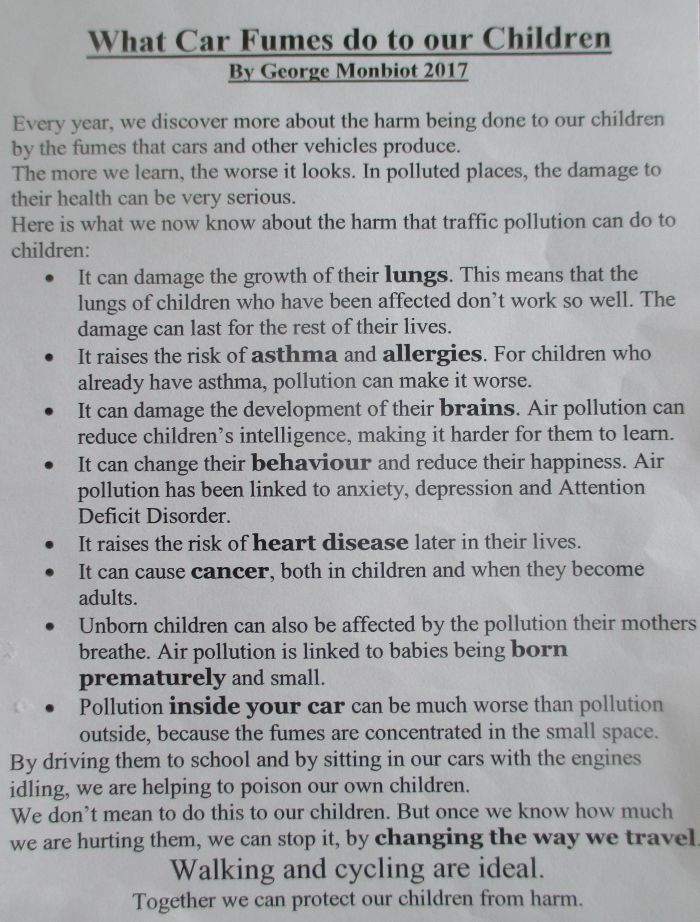
PLEASE READ CAREFULLY - from an article by George Monbiot "What car fumes do to
our children"
Key points for
revision of air pollution from particles and carbon monoxide, reduction by using
catalytic converters
Air pollution from soot, carbon
monoxide, and catalytic converters is a core GCSE/IGCSE chemistry topic
across all major UK boards.
Students must understand pollutant
sources, health/environmental impacts, and reduction strategies.
Summary Revision Notes: Air Pollution & Catalytic Converters
1.
Sources of Pollutants
- Soot (particulates): Produced during incomplete
combustion of hydrocarbons (e.g. diesel, petrol).
- Carbon monoxide (CO): A toxic, colourless,
odourless gas formed when carbon-containing fuels burn with
insufficient oxygen.
- Nitrogen oxides (NOx): Formed in car engines due to
high temperatures causing nitrogen and oxygen to react.
- Sulfur dioxide (SO2): From burning fossil fuels
containing sulfur impurities.
2.
Health & Environmental Effects
| Pollutant |
Health Impact |
Environmental Impact |
| Soot/Particulates |
Respiratory issues, lung damage |
Smog formation, global dimming |
| Carbon monoxide |
Prevents oxygen transport in blood |
Toxic to humans, no direct environmental effect |
| NOx
and SO2 |
Irritates lungs, asthma |
Acid rain, damage to buildings/plants |
3.
Catalytic Converters
- Found in car exhaust systems.
- Contain platinum, palladium, rhodium catalysts.
- Convert harmful gases into safer ones:
- Require high temperatures to function effectively.
Typical Exam Board Coverage
|
Key Focus Areas |
| Sources/effects of pollutants, catalytic converters, combustion
types |
| Combustion, pollutants, health/environmental effects, catalytic
converters |
| Complete/incomplete combustion, pollutant effects, reduction
strategies |
| Air pollution, combustion, catalytic converters, environmental
chemistry |
| Pollution from fuels, health impacts, reducing polluting emissions |
Student Exam Revision Tips & Misconceptions
Tips
- Link combustion type to pollutant: Complete = CO₂ +
H₂O; Incomplete = CO + soot.
- Use balanced equations for catalytic converter
reactions.
- Revise health versus environmental effects separately
for each pollutant.
- Practice past paper questions on combustion and
pollution.
Common Misconceptions
- “Carbon monoxide is the same as carbon dioxide”: CO is toxic;
CO2 is not directly harmful.
- “Catalytic converters remove all pollutants”: They reduce CO,
NOₓ, and hydrocarbons—not particulates or SO2.
- “Soot is a gas, its a solid particulate, not gaseous.
Other useful pages
Multiple Choice Quizzes and Worksheets
 KS4 Science GCSE/IGCSE m/c QUIZ on Oil Products (easier-foundation-level)
 KS4 Science GCSE/IGCSE m/c QUIZ on Oil Products (harder-higher-level)
 KS4 Science GCSE/IGCSE m/c QUIZ on other aspects of Organic Chemistry
and
 3 linked easy Oil Products gap-fill quiz worksheets
ALSO gap-fill ('word-fill') exercises
originally written for ...
... Ex AQA GCSE Science
Useful products from crude oil
AND
Oil, Hydrocarbons & Cracking
etc.
...
Ex
OCR 21st C GCSE Science
Worksheet gap-fill C1.1c Air pollutants
etc ...
... Edexcel GCSE Science
 Crude Oil and its Fractional distillation
etc ...
Crude Oil and its Fractional distillation
etc ...
... each set are interlinked, so
clicking on one of the above leads to a sequence of several quizzes
Website content © Dr
Phil Brown 2000+. All copyrights reserved on revision notes, images,
quizzes, worksheets etc. Copying of website material is NOT
permitted. Exam revision summaries & references to science course specifications
are unofficial. Doc Brown's GCSE revision notes on oil
products and organic chemistry for UK IGCSE and GCSE level and US grade 9 and grade 10
examinations
INDEX of GCSE level notes on Products from
oil and Organic
Chemistry
|
Explaining importance of air pollution from
incomplete combustion, carbon monoxide, particulates, soot
in GCSE level chemistry, What you need to know about air pollution from
incomplete combustion, carbon monoxide, particulates, soot for
GCSE level
chemistry,
Explaining use of air pollution from incomplete combustion, carbon
monoxide, particulates, soot knowledge in GCSE level chemistry, Examples of
air pollution from incomplete combustion, carbon monoxide, particulates,
soot
explained when studying GCSE level chemistry, What is the significance
of air pollution from incomplete combustion, carbon monoxide,
particulates, soot in GCSE level chemistry, describing
explaining theory of air pollution from incomplete combustion, carbon
monoxide, particulates, soot when studying GCSE level chemistry, exam revision
notes for air pollution from incomplete combustion, carbon monoxide,
particulates, soot, online help for understanding air pollution
from incomplete combustion, carbon monoxide, particulates, soot in GCSE
chemistry, what do I need to learn about air pollution from incomplete
combustion, carbon monoxide, particulates, soot? what do I need to know
about air pollution from incomplete combustion, carbon monoxide,
particulates, soot for GCSE chemistry exams, how to prepare for questions on
air pollution from incomplete combustion, carbon monoxide, particulates,
soot in GCSE
chemistry examination? air pollution from incomplete combustion, carbon
monoxide, particulates, soot for
syllabus-specifications
for students taking the IGCSE/GCSE level chemistry examinations, summary
revision notes key points on air pollution from incomplete combustion,
carbon monoxide, particulates, soot for students studying AQA
igcse/gcse chemistry notes on air pollution from incomplete combustion, carbon
monoxide, particulates, soot, Edexcel gcse
chemistry notes on air pollution from incomplete combustion, carbon
monoxide, particulates, soot, OCR 21st century GCSE
chemistry notes on air pollution from incomplete combustion, carbon
monoxide, particulates, soot, OCR gateway
GCSE chemistry notes on air pollution from incomplete combustion,
carbon monoxide, particulates, soot, WJEC gcse chemistry notes on
air pollution from incomplete combustion, carbon monoxide, particulates,
soot, CCEA
gcse chemistry notes on air pollution from incomplete combustion, carbon
monoxide, particulates, soot, CIE Cambridge igcse
chemistry, notes on
air pollution from incomplete combustion, carbon monoxide, particulates,
soot useful for US grade 9-10 chemistry student courses
Test your self on GCSE level organic chemistry
QUIZ on oil products & organic chemistry
(easier-foundation-level)
QUIZ on oil products
& organic chemistry (harder-higher-level)
|


 For searching