|
GCSE level organic chemistry exam
revision notes:
10. continued
10b. ESTERS –
structure, chemistry and uses and how
to make an ester (useful basic ester chemistry for A level students too)
Sub-index for this
page on esters (GCSE level
notes and questions)
(a)
What is an ester, how are they made?, a simple preparation
(b)
The detailed procedure for preparing and purifying an ester
(c)
The hydrolysis of esters (opposite of preparation
- esterification)
(d)
The uses of esters
(e)
Why does something dissolve in a solvent (like esters) or
not?
(f)
Other links with esters - (i) Triglycerides and (ii)
polyesters
(g) Key
revision points about esters like ethyl ethanoate
(h) Some
basic multiple choice questions based on esters (with answers & feedback)
For students of
School chemistry 14-16
GCSE level
chemistry
notes:
All my
GCSE level chemistry revision
notes
All my GCSE level oil and organic chemistry revision
notes
All my advanced A level organic chemistry notes
INDEX of Advanced A
Level revision notes on the
chemistry of CARBOXYLIC ACIDS and DERIVATIVES
email doc
brown - comments - query?
*
[privacy policy, cookies
and disclaimer]
See also
Carboxylic acids - structure, chemistry and
uses
 GCSE level m/c QUIZ on oil products & organic chemistry
(easier-foundation-level)
GCSE level m/c QUIZ on oil products & organic chemistry
(easier-foundation-level)
GCSE
level m/c QUIZ on oil products
& organic chemistry (harder-higher-level)
[Author
©
Dr Phil Brown PhD:
Doc Brown's chemistry exam revision notes on
oil products &
organic chemistry - esters,
suitable for students of UK GCSE Science level
AQA, Edexcel, OCR, WJEC and CCEA GCSE chemistry
courses, ~US grades 9-10 chemistry
[page updated RE-EDIT]
|
 10b
(a). ESTERS - formed from a carboxylic acid and an alcohol
in a process called esterification 10b
(a). ESTERS - formed from a carboxylic acid and an alcohol
in a process called esterification
-
What are
ESTERS?
How are they made?
- Esters are usually volatile colourless
liquids.
- Carboxylic acids are used to manufacture esters by reacting them with alcohols
- Carboxylic acids react with alcohols
to form
members of another homologous series called esters.
- Concentrated
sulphuric acid acts as a catalyst in this reaction.
- General word equation for esterification,
- (Esterification is sometimes
referred to as an example of a condensation reaction because water is
eliminated between the two reactant molecules):
- carboxylic acid + alcohol == acid catalyst ==> ester + water
- e.g.
- ethanoic acid + ethanol
 ethyl ethanoate + water
-
 +
+
 + H2O
+ H2O
- sometimes more simply written as
- CH3COOH + CH3CH2OH
CH3COOCH2CH3 + H2O
- The reaction is reversible and
the mixture reaches equilibrium, in fact about 2/3rds
of the carboxylic acid and alcohol have been converted to the ester.
- Without a strong acid catalyst
e.g. conc. sulfuric acid, the reaction is very slow and the mixture is
heated to further increase the rate of reaction (see details of the
method below).
- Structures of other esters
made from ethanoic acid:
-
 methyl ethanoate using
methanol, and ethanoic acid methyl ethanoate using
methanol, and ethanoic acid
-
 propyl
ethanoate from using propanol (propan-1-ol, n-propyl alcohol)
and ethanoic acid.
propyl
ethanoate from using propanol (propan-1-ol, n-propyl alcohol)
and ethanoic acid.
- Note the arrangement of the atoms at the
ester linkage, the functional group -COOC-.
- Naming
esters
- The first part of an ester's name is
derived from the alcohol e.g. methyl from methanol, ethyl from ethanol
and propyl from propanol etc.
- The second part of the name comes from the
carboxylic acid and ends in ...anoate e.g. methanoate from methanoic acid,
ethanoate from ethanoic acid and propanoate from propanoic acid etc.
-
A
very simple method of making an ester
- This is a nice class experiment
for GCSE/IGCSE or advanced level students.
- You can mix equal volumes of small
quantities of a carboxylic acid and an alcohol with an even smaller volume
of concentrated sulfuric acid.
- The mixture is gently warmed in beaker of warm
water for 5-10 minutes.
- The mixture is then poured into a beaker of
cold sodium hydrogencarbonate solution.
- The sodium hydrogencarbonate neutralises the acid
catalyst and any unreacted carboxylic acid.
- You should get some drops of ester left on
the surface which can be carefully smelled to appreciate the pleasant aroma of the
ester.
- You can do this is as a nice class
experiment with ethanoic acid and a variety of alcohols and noting what they
think the esters smells like (likely to be 'fruity') alongside appreciating
its molecular structure too!
Top of the page and indexes
OR do the wide ranging
practise exam question quiz on
GCSE level m/c QUIZ on oil products & organic chemistry
(easier-foundation-level)
GCSE
level m/c QUIZ on oil products
& organic chemistry (harder-higher-level)
OR
some
GCSE level practise questions just on esters
(b) The detailed procedure for preparing
an ester (esterification) and purifying it
- This is illustrated in the diagrams below and a detailed
description of the method for preparing ethyl ethanoate is described.
- Ethyl ethanoate and water are both
colourless, but to help in following the procedure via the diagrams, I've
coloured the ester
yellow and the reaction mixture and aqueous solutions a pale grey.
- This is a
detailed description that will do for Advanced A level chemistry
too!
-
 Stage 1 in making an ester
-
STAGE 1 Making the ester: In the
round-bottomed flask the alcohol (ethanol) is mixed with the carboxylic
acid (ethanoic acid) and a small amount of concentrated sulfuric acid
(catalyst) is added too. Anti-bumping granules are added to ensure a smooth
boiling action. The mixture is carefully heated to get the mixture
gently boiling and refluxing.
- Stage 1 is a technique called 'heating
under reflux', and ensures the reaction occurs the fastest at
highest possible reaction temperature, the boiling point of the mixture. However, to prevent vapour loss by boiling/evaporation, particularly of
the desired product - the ester, the vapourised
liquids are condensed back into the reaction flask recycling everything.
- The diagram shows a bunsen
burner being used to supply the heat ('my days'), these days its more
likely, and safer, to use an electrical heater that the round bottomed
flask fits in snugly.
-
 Stage 2 in making an ester
-
STAGE 2 Fractional distillation: The colourless ester liquid is
separated from the reaction mixture by fractional
distillation which is fully explained on the
Elements, Compounds, Mixtures
Notes.
- The example described is separating an ethanol/water mixture, but the same principal applies in separating the ester from
some of the
water, unreacted alcohol and acid and the sulphuric acid catalyst.
- Again
the mixture gently heated and boiled, but this time you want the vapour of
the lowest boiling component (ester) to separate out in the fractionating
column and pass through into the condenser.
- This happens when the
temperature at the top of the column reaches the boiling point of the ester.
The ester and small quantities of carboxylic acid, sulfuric acid and alcohol
can be collected from the condenser in a suitable glass vessel.
- Preferably a
quick-fit apparatus that connects to the condenser, BUT it must not be a
completely sealed system otherwise pressure would build up, hence the vent
to the sink. You should realise at this point in the preparation that the
ester (ethyl ethanoate) is very impure.
-
 Stage 3 in making an ester
-
STAGE 3 Removing acidic impurities: The rest of the procedure is
all about purifying the initial ester distillate from the fractional
distillation. The condensate (liquid distillate) from the fractional
distillation apparatus is transferred to a separating funnel (tap
funnel). Sodium carbonate solution is added to neutralise any acids and the
stopper replaced.
- The separating funnel is shaken to ensure complete removal
of the acid, but carbon dioxide is formed, so every so often you invert the
funnel, open the tap and allow the gas to escape. When there doesn't seem to
be any more effervescence or gas pressure, the mixture is allowed to settle.
- When the two layers have fully separated, the stopper is removed, and the
lower aqueous layer is careful run off, don't lose any of the ester in the
process! When doing the run-off the stopper must be removed.
- The acidic
impurities and any salts formed have now been removed in the aqueous sodium
carbonate solution, therefore there should be no carboxylic acid or sulfuric
acid catalyst left in the ester layer.
-
 Stage 4 in making an ester
-
STAGE 4 Removing the impurities: However, despite removing
some impurities there will still be some traces of the alcohol left in the
ester layer. Concentrated calcium chloride solution is added to the still
impure ester in the separating funnel and the mixture shaken again.
- The
aqueous calcium chloride will remove any remaining unreacted alcohol
(ethanol). Again, the lower aqueous layer is tapped off to leave only the
ester layer which will still contain some water.
-
 Stage 5 in making an ester
-
STAGE 5 Drying the product: By now the only impurity left is
water. So, to dry the ester, it is run off (tapped off) from the separating
funnel into a small conical flask and some granules of anhydrous calcium
chloride added.
- The conical flask is stoppered and the mixture shaken, and
the calcium chloride absorbs any remaining moisture in the ester. The pure
ester can than be filtered off.
- You can make butyl ethanoate and other
esters by
the same reaction and procedure.
- ethanoic acid + butan–1–ol ===> butyl ethanoate + water
- CH3COOH +
CH3CH2CH2CH2OH
===> CH3COOCH2CH2CH2CH3
+ H2O
- At GCSE level butan-1-ol might be
just written as 'butanol'.
-
The yield of ester
- Its an equilibrium, and
starting with the pure acid plus pure alcohol, you heat the mixture in
and you get about 2/3rds
conversion* to the ester, and the preparation reaction is
catalysed by a
few drops of concentrated sulphuric acid.
- *
This means a theoretical maximum reaction
yield of about ~67%. - in reality, a lot less due to losses in the various
steps.
- For more on % yields and 'atom
economy' see
Calculations section 14.
Top of the page and indexes
OR do the wide ranging
practise exam question quiz on
GCSE level m/c QUIZ on oil products & organic chemistry
(easier-foundation-level)
GCSE
level m/c QUIZ on oil products
& organic chemistry (harder-higher-level)
OR
some
GCSE level practise questions just on esters
(c)
HYDROLYSIS of esters - the opposite of preparing them by esterification
Top of the page and indexes
OR do the quiz
GCSE level m/c QUIZ on oil products & organic chemistry
(easier-foundation-level)
GCSE
level m/c QUIZ on oil products
& organic chemistry (harder-higher-level)
(d) The USES
of ESTERS
-
Esters occur widely in
nature e.g. fruit odours
-
Esters are usually sweet/pleasant smelling liquids and widely used as fragrances
(components in perfumes) and
food flavourings.
- Perfumes can natural, obtained from plant
sources, or artificial, since esters are readily synthesised in the
laboratory.
- Natural
substances are used in many cosmetics but many mixtures contain
synthetic organic compounds.
- Many esters have pleasant sweet or fruity
smells and the colourless liquids are quite volatile, that's why fruits have
strong pleasing odours or aromas.
- The pleasure of most flavours and fragrances
from fruits is due to esters, the vapours from esters definitely entice the
receptors in your nose to feel good!
-
How and why do we smell perfumes? (or any other substance)
- Anything that we smell must have come from
substances evaporating, no matter how little of it evaporates, the nose is
quite sensitive to low concentrations of many chemicals in air.
- Therefore, in order to smell a substance,
that substance must be to some extent be a volatile material.
- If a substance isn't volatile, you are
highly unlikely to smell it i.e. detect it with your nose.
- The most volatile materials are those that
most easily evaporate e.g. like petrol, how easily a liquid evaporates is
referred to as its volatility.
- The intermolecular forces between molecules
are relatively weak in liquids that are volatile, so the particles don't
need to much kinetic energy to escape from the surface of your skin.
- Because of random collisions, the particles in a liquid have a variety
of speeds and kinetic energies.
- Evaporation occurs all the time from
volatile liquids, but it is the higher kinetic energy particles that can
overcome the attractive forces between the molecules in the bulk of the
liquid and escape from the surface into the surrounding air.
- It is these higher kinetic energy escaped molecules that diffuse through
the air to reach the receptor cells in the nostril to trigger the sense of
smell.
- That is why perfume molecules must be quite volatile to work, but they
must be not too volatile or their effect won't last very long.
- On heating particles gain kinetic energy
and move faster and are more are able to overcome the intermolecular forces
between the molecules, therefore theoretically, perfumes should smell
stronger in a warmer room.
- Because they are volatile and pleasing to
the nostril, it makes esters ideal
for cosmetic perfumes and cosmetic fragrances in general, but esters are
also used in air fresheners e.g. flowery smells like jasmine.
- Because fruit sources are limited, many
esters are now synthesised in large quantities so the flavourings and
derived taste and aromas in fruit drinks, sweets and cakes etc. may be from
manufactured esters simulating strawberry, pineapple, pear, apple, grape,
orange, banana when used as food and drink additives etc.
- Esters are used in pharmaceutical and
household products e.g. ointments, washing–up liquids to give the
medications or cleaning products a pleasant odour.
Examples of plant ester sources:
- Lavender oil essence is distilled
from the lavender plant
Examples of flavouring esters:
- Pear drop sweet
essence is an ester (once called amyl acetate)
Factors affecting perfume
design e.g. using esters:
- Designing a perfume – several issues
to address by way of design factors.
- You can't just use any ester, no matter
how beautiful it smells.
- The chemicals in cosmetic perfumes must
have a particular set of properties including ...
- the chemical components (they)
must evaporate easily, otherwise the molecules will never
reach your nose, but different evaporation rates are needed by
different components to give a prolonged effect,
- they must not react with water
in your sweat forming compounds that might not smell nice, like
carboxylic acids, which could be irritating to the skin too,
- at the same time, they must
not
be soluble in water or they would be easily washed away,
- they must be non-toxic and
not be absorbed by the skin to cause irritation or poisoning, but
you do want them to be absorbed by the skin, BUT harmlessly,
- they must not irritate the skin,
since you are applying the perfume to you skin of the neck or wrists
as well as part of your clothing.
- The perfume needs to be a mixture of
compounds to give a prolonged perfumery effect.
- The perfumer chemist has to design the
mixture to give a particular fragrance which includes ...
- the top note – the first fragrant
molecule to be released,
- and the low note, the last molecule to be
vapourised.
Cosmetic companies are always
developing
new products to comply with our aesthetic desires!
- BUT, every new product must be thoroughly
tested before it is ready for the consumer.
- Unfortunately, this sometimes involves using
animals e.g. to monitor their skin response to the new cosmetic formulation.
- Opinions can be strongly divided and
divisive as to the merit and ethics (morality) of using animal testing for
new cosmetic formulations (and of course using animals to test new medicines
from the pharmaceutical industry).
- One view is that animal testing is worth it
to avoid possible adverse effects on consumers, so any discomfort or worse,
suffered by the animals to prevent us suffering in the same way, a sort of
'health and safety' issue argument.
- The opposing view argues that it is entirely
wrong to use animals in tests. 'Animal rights' people argue its unfair to
use defenceless animals who cannot speak for themselves AND the results of
animal tests are not necessarily conclusive and so unnecessary animal
suffering.
- So, because of concerns about animal welfare
in conducting tests of cosmetics on animals, the European Union (EU) has
banned almost all of these animal test procedures.
Esters are used as solvents
- e.g. nail
varnish remover (the solvent propanone/acetone is also used), but also in paints, glues and ink formulations as a medium
compatible with the other ingredients.
- Some larger ester molecules are used in
plastic formulations as plasticisers which are added to make the
polymer more flexible.
- They aren't totally free of health issues
but esters have replaced more harmful aromatic hydrocarbon solvents like
benzene (a carcinogen – a cancer promoting chemical) and methylbenzene (old
name toluene, also carcinogenic) in paint and varnishing products.
- BUT take care ...
- (i) although imparting a pleasant odour,
ester fumes can irritate mucous membranes in the nose and mouth,
- (ii) because they are volatile and
combustible, the fumes are highly flammable and easily ignited by a
naked flame. The vapour is heavier than air and will not disperse quickly,
- (iii) some people may be allergic to ester
fumes, or indeed their use as food additives.
Top of the page and indexes
OR do the wide ranging
practise exam question quiz on
GCSE level m/c QUIZ on oil products & organic chemistry
(easier-foundation-level)
GCSE
level m/c QUIZ on oil products
& organic chemistry (harder-higher-level)
OR
some
GCSE level practise questions just on esters
(e) Why does a substance dissolve in one
liquid solvent but not another?
-
Esters
are useful solvents, so why does something dissolve or not dissolve in a
solvent?
- There are three particle interactions going
on if you mix one substance with another e.g. a liquid solvent that
may or may not dissolve a solid.
- The three possible attractions are (i)
solid ... solid, (ii)
solid ... liquid and (iii) liquid ...
liquid.
- The relative strength of these attractive
intermolecular forces decides whether e.g. a solid will dissolve in a
particular solvent.
- For example, nail varnish will not dissolve
in water, but will dissolve in organic solvents like an ester, alcohol or
acetone.
- Nail varnish is insoluble in water
because the intermolecular forces between the nail varnish molecules
themselves, and between the water molecules themselves are much stronger
than the attraction between water and the nail varnish molecules, so the
nail varnish cannot possibly dissolve in water. Forces (i) and (iii)
override force (ii)
- However, nail varnish will dissolve in
organic solvents like butyl ethanoate or ethyl ethanoate (esters, old
names butyl acetate and ethyl acetate), ethanol ('alcohol')
and propanone (old name acetone) solvents. Here the organic solvent
intermolecular attraction to the nail varnish molecules can override the
nail varnish ... nail varnish and the solvent ... solvent intermolecular
forces and the nail varnish will dissolve. In this case attractive force
(ii) overrides both attractive forces (i) and (iii).
- Since different solvents are different
molecular affinities for different substances, the solubility of a solute in
a solvent can vary quite considerably from one solvent to another.
- The question of which solvent you choose
to use to dissolve a substance depends on two main factors ..
- (a) How soluble is the substance in
the solvent?
- (b) How safe is to use the solvent?
e.g. in terms of inhaling vapour or spillage on the skin (gloves!), is it
harmful?, irritating?, even toxic?, and is it highly flammable, so more
dangerous to use.
- Chlorinated organic solvents e.g.
trichloromethane ('chloroform') tend to be harmful, alcohols and esters are
safer but are more flammable.
-
This section
is repeated in alcohols
Top of the page and indexes
OR do the wide ranging
practise exam question quiz on
GCSE level m/c QUIZ on oil products & organic chemistry
(easier-foundation-level)
GCSE
level m/c QUIZ on oil products
& organic chemistry (harder-higher-level)
OR
some
GCSE level practise questions just on esters
(f) Other links
with esters - triglycerides and polyesters
(i)
Other natural esters - triglycerides
- Esters from the 'triol' alcohol
glycerol
 , which has three C-O-H alcohol groups (hydroxyl groups), is the alcohol plants and animals use
to make oils and fats - which are esters we use in food and soaps.
, which has three C-O-H alcohol groups (hydroxyl groups), is the alcohol plants and animals use
to make oils and fats - which are esters we use in food and soaps.
- Animals and
plants combine glycerol and long chain fatty acids to make triglyceride
esters - mainly fats in animals and mainly unsaturated vegetable oils in plants.
- For more details on fatty acids, oil and fat
esters see
Oils, fats,
margarine and soaps
(ii) Polyesters

- Polymers - polyesters like Terylene (diagram
above)
- The diagram above shows part of structure of
Terylene, a very useful polymer used for making plastic objects and also
manufactured as fibres for use in fabrics for the clothing industry.
- You don't have to know any detailed
molecular structure at GCSE/IGCSE level, but I have highlighted the -COOC-
ester linkage, which is the same functional group structure as in the
'little' esters described on the page above.
- The most common use of polyester today is
called PET (for short!) and is used to make the plastic bottles for storing
liquids in like soft drinks, PET is very useful because it is transparent,
shatterproof and cheap!
- Fine polyester fibres can be made into a
variety of articles of clothing which are lighter and cheaper than
traditional materials like wool.
- Plastic bottles made from polyester can
recycled and turned into fibres again and reused in clothing.
- For more see section
11.
 Condensation polymers including
Terylene Condensation polymers including
Terylene
Top of the page and indexes
OR do the wide ranging
practise exam question quiz on
GCSE level m/c QUIZ on oil products & organic chemistry
(easier-foundation-level)
GCSE
level m/c QUIZ on oil products
& organic chemistry (harder-higher-level)
OR
some
GCSE level practise questions just on esters
(g) Revision Notes - key points: Esters (e.g. Ethyl Ethanoate)
General
Properties
- Functional group:
–COO– (ester linkage).
- General formula:
R–COO–R′ (where R and R′ are alkyl groups).
- Naming:
First part from alcohol (ethyl from ethanol), second part from
acid (ethanoate from ethanoic acid).
e.g.
Ethyl Ethanoate
- Structure:
CH3COOCH2CH3
- Preparation:
- Ethanoic acid + ethanol →
ethyl ethanoate + water.
- Requires concentrated H2SO4
catalyst (acid catalyst).
- Reaction type:
Esterification (condensation reaction).
Properties
- Pleasant, fruity smell.
- Volatile, low boiling point
compared to acids/alcohols.
- Insoluble in water (small
esters slightly soluble).
Uses
- Solvents:
Nail polish remover, paints, inks.
- Food flavourings:
Fruity esters used in sweets, drinks.
- Perfumes:
Pleasant odours.
- Plasticisers:
Modify polymers.
Key
Revision Points about esters
- Esters are formed from
carboxylic acids + alcohols.
- Naming rule: Alcohol part
first, acid part second.
- Ethyl ethanoate is the classic
example.
- Catalyst: concentrated
H(_2)SO(_4).
- Esters often have
fruity smells → exam favourite.
- Uses: solvents, perfumes,
flavourings, plasticisers.
Student
Tips and Misconceptions
- Misconception:
Esters are acids.
Correction: They are neutral compounds, not acidic.
- Misconception:
Naming order is acid first.
Correction: Alcohol first, acid second (ethyl ethanoate).
- Tip:
Always mention catalyst in esterification.
- Tip:
Don’t confuse esterification with neutralisation.
- Tip:
Fruity smell = ester clue in exam questions.
(h) Some basic exam revision multiple questions
based on esters
Each question has A–D
options, the correct answer, and
distractor analysis.
Jot down your responses and check your answers
If you think there
is an error on this page email me asap
Q1.
Which functional group do esters contain?
- –OH
- –COOH
- –COO–
- –CHO
Q2.
Ethyl ethanoate is formed from:
- Ethanol + ethanoic acid
- Ethanol + hydrochloric acid
- Ethane + ethanoic acid
- Ethanol + sodium hydroxide
Q3.
Catalyst used in esterification:
- NaOH
- HCl
- Concentrated H2SO4
- MgO
Q4.
General formula of esters:
(R represents the 'rest' of the organic molecule)
- R–OH
- R–COOH
- R–COO–R′
- R–CHO
Q5.
Ethyl ethanoate has a smell described as:
- Rotten eggs
- Fruity
- Vinegar
- Ammonia
Q6.
Naming parts rule for esters:
- Acid first, alcohol second
- Alcohol first, acid second
- Random order
- Alphabetical order
Q7.
Reaction type forming esters:
- Neutralisation
- Condensation
- Oxidation
- Reduction
Q8.
Which of these is an ester?
- CH3OH
- CH3COOH
- CH3COOC2H5
- CH3CHO
Q9.
Esters are commonly used as:
- Fertilisers
-
Fuels
- Bleaches
-
Perfumes
Q10.
Which statement is true about esters?
- They are strong acids
- They are neutral compounds
- They are strong bases
- They are salts
Q11.
Which ester is formed from methanol + ethanoic acid?
- Ethyl ethanoate
- Methyl ethanoate
- Methanoic acid
- Ethanol
Q12.
Esters are formed in presence of:
- Alkali catalyst
- Acid catalyst
- Enzyme catalyst
- No catalyst
Q13.
Which property makes esters useful in perfumes?
- High boiling point
- Fruity smell
- Strong acidity
- Reactivity with metals
Q14.
Ethyl ethanoate is used as:
- Fertiliser
-
Bleach
- Fuel
-
Solvent
Q15.
Which reaction produces water as a by-product?
- Esterification
- Neutralisation
- Combustion
- Displacement
Q16.
Which acid forms ethyl ethanoate?
- Methanoic acid
- Ethanoic acid
- Propanoic acid
- Hydrochloric acid
Q17.
Which alcohol forms methyl propanoate?
-
Butanol
- Ethanol
- Propanol
-
Methanol
Q18.
Esters are described as:
- Ionic compounds
- Covalent compounds
- Metallic compounds
- Salts
Q19.
Which statement is false about esters?
- They have fruity smells
- They are formed from acids +
alcohols
- They fizz when added to sodium
carbonate solution
- They are usually colourless
liquids.
Q20 To which homologous series do molecules A to D belong?
A
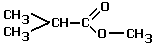
B

C

D

Jot down your responses and check your answers
If you think there
is an error on this page email me asap
|
Top of the page and indexes
OR do the wide ranging
practise exam question quiz on
GCSE level m/c QUIZ on oil products & organic chemistry
(easier-foundation-level)
GCSE
level m/c QUIZ on oil products
& organic chemistry (harder-higher-level)
OR
some
GCSE level practise questions just on esters
|
|
INDEX of Advanced A
Level revision notes on the
chemistry of CARBOXYLIC ACIDS and DERIVATIVES
Multiple Choice Quizzes and Worksheets
 KS4 Science GCSE/IGCSE m/c QUIZ on Oil Products
(easier–foundation–level)
KS4 Science GCSE/IGCSE m/c QUIZ on Oil Products
(easier–foundation–level)
 KS4 Science GCSE/IGCSE m/c QUIZ on Oil Products
(harder–higher–level)
KS4 Science GCSE/IGCSE m/c QUIZ on Oil Products
(harder–higher–level)
 KS4 Science GCSE/IGCSE m/c QUIZ on other aspects of Organic Chemistry
and
 3 linked easy Oil Products gap–fill quiz worksheets
ALSO gap–fill ('word–fill') exercises
originally written for ...
... AQA GCSE Science
Useful products from
crude oil AND
Oil, Hydrocarbons
& Cracking
etc.
... OCR 21st C GCSE Science
Worksheet gap–fill C1.1c Air
pollutants etc ...
... Edexcel GCSE Science
 Crude Oil and its Fractional distillation
etc ... Crude Oil and its Fractional distillation
etc ...
... each set are interlinked,
so clicking on one of the above leads to a sequence of several quizzes
|
14-16 gcse organic chemistry Urban Outfitters,
American Outfitters, Target, Lulus, Hollister, Victoria's Secret, Adidas,
Forever 21, Nike sports products, 14-16
gcse organic chemistry
keywords and phrases:
revision study notes for 14-16 school chemistry AQA Edexcel OCR IGCSE/GCSE
9-1 chemistry science topics modules for studying how to make
esters preparation method described synthesis of ethyl ethanoate procedure
to purify ester reflux esterification method uses of esters in perfumes
chemistry gcse revision notes igcse revising KS4 science, Explaining importance of
esters
in GCSE level chemistry, What you need to know about esters for
GCSE level
chemistry,
Explaining use of esters knowledge in GCSE level chemistry, Examples of
esters
explained when studying GCSE level chemistry, What is the significance
of esters in GCSE level chemistry, describing
explaining theory of esters when studying GCSE level chemistry, exam revision
notes for esters, online help for understanding esters in GCSE
chemistry, what do I need to learn about esters? what do I need to know
about esters for GCSE chemistry exams, how to prepare for questions on
esters in GCSE
chemistry examination? esters for
syllabus-specifications
for students taking the IGCSE/GCSE level chemistry examinations, summary
revision notes key points on esters for students studying AQA
igcse/gcse chemistry notes on esters, Edexcel gcse
chemistry notes on esters, OCR 21st century GCSE
chemistry notes on esters, OCR gateway
GCSE chemistry notes on esters, WJEC gcse chemistry notes on esters, CCEA
gcse chemistry notes on esters, CIE Cambridge igcse
chemistry, notes on
esters useful for US grade 9-10 chemistry student courses
INDEX of Advanced A
Level revision notes on the
chemistry of CARBOXYLIC ACIDS and DERIVATIVES
|
ANSWERS
to the multiple choice questions
If you think there
is an error on this page email me asap
Q1.
Which functional group do esters contain?
- –OH
- –COOH
- –COO–
- –CHO
Answer:
C. –COO–
- A: Alcohol group.
- B: Carboxylic acid group.
- D: Aldehyde group.
Exam tip: Spot ester linkage –COO–.
Q2.
Ethyl ethanoate is formed from:
- Ethanol + ethanoic acid
- Ethanol + hydrochloric acid
- Ethane + ethanoic acid
- Ethanol + sodium hydroxide
Answer:
A. Ethanol + ethanoic acid
- B: Wrong acid.
- C: Ethane is not reactive.
- D: Neutralisation, not
esterification.
Tip: Alcohol + carboxylic acid → ester.
Q3.
The catalyst used in esterification:
- NaOH
- HCl
- Concentrated H2SO4
- MgO
Answer:
C. Concentrated
H2SO4
- A/B/D: Wrong catalysts.
Tip: Always state acid catalyst.
Q4.
General formula of esters:
(R & R' represents the 'rest' of the organic molecule)
- R–OH
- R–COOH
- R–COO–R′
- R–CHO
Answer:
C. R–COO–R′
- A/B/D: Wrong functional
groups.
Tip: Learn ester general formula.
Q5.
Ethyl ethanoate has a smell described as:
- Rotten eggs
- Fruity
- Vinegar
- Ammonia
Answer:
B. Fruity
- A/C/D: Wrong smells.
Tip: Fruity smell = ester clue.
Q6.
Naming parts rule for esters:
- Acid first, alcohol second
- Alcohol first, acid second
- Random order
- Alphabetical order
Answer:
B. Alcohol first, acid second
- A: Common misconception.
- C/D: Wrong.
Tip: Ethanol → ethyl, ethanoic acid →
ethanoate.
Q7.
Reaction type forming esters:
- Neutralisation
- Condensation
- Oxidation
- Reduction
Answer:
B. Condensation
- A: Wrong, no neutralisation.
- C/D: Wrong processes.
Tip: Water is eliminated → condensation,
the more specific name is esterification.
Q8.
Which of these is an ester?
- CH3OH
- CH3COOH
- CH3COOC2H5
- CH3CHO
Answer:
C.
CH3COOC2H5
- A: Alcohol.
- B: Acid.
- D: Aldehyde.
Tip: Look for –COO–.
Q9.
Esters are commonly used as:
- Fertilisers
-
Fuels
- Bleaches
-
Perfumes
Answer:
D. Perfumes
- A/B/C: Wrong uses.
Tip: Pleasant smell → perfumes.
Q10.
Which statement is true about esters?
- They are strong acids
- They are neutral compounds
- They are strong bases
- They are salts
Answer:
B. They are neutral compounds
- A/C/D: Misconceptions. Esters
are covalent molecules and do contain ions like in salts.
Tip: Esters ≠ acids/bases.
Q11.
Which ester is formed from methanol + ethanoic acid?
- Ethyl ethanoate
- Methyl ethanoate
- Methanoic acid
- Ethanol
Answer:
B. Methyl ethanoate
- A: Wrong alcohol (ethanol
gives ethyl ester).
- C/D: Wrong products.
Tip: Alcohol name first.
Q12.
Esters are formed in presence of:
- Alkali catalyst
- Acid catalyst
- Enzyme catalyst
- No catalyst
Answer:
B. Acid catalyst
- A/C/D: Wrong.
Tip: Concentrated H2SO4
Q13.
Which property makes esters useful in perfumes?
- High boiling point
- Fruity smell
- Strong acidity
- Reactivity with metals
Answer:
B. Fruity smell
- A/C/D: Wrong.
Tip: Pleasant odour is key, and also volatile.
Q14.
Ethyl ethanoate is used as:
- Fertiliser
-
Bleach
- Fuel
-
Solvent
Answer:
D. Solvent
- A/B/C: Wrong uses.
Tip: e.g. Solvent in nail polish remover.
Q15.
Which reaction produces water as a by-product?
- Esterification
- Neutralisation
- Combustion
- Displacement
Answer:
A. Esterification
- B/C/D: Wrong contexts.
Tip: Condensation → water formed.
- carboxylic acid +
alcohol ===> ester + water
Q16.
Which acid forms ethyl ethanoate?
- Methanoic acid
- Ethanoic acid
- Propanoic acid
- Hydrochloric acid
Answer:
B. Ethanoic acid
- A/C/D: Wrong acids.
Tip: Ethanoic acid → ethanoate.
Q17.
Which alcohol forms methyl propanoate?
-
Butanol
- Ethanol
- Propanol
-
Methanol
Answer:
D. Methanol
- A/B/C: Wrong alcohols.
Tip: Methanol → methyl.
Q18.
Esters are described as:
- Ionic compounds
- Covalent compounds
- Metallic compounds
- Salts
Answer:
B. Covalent compounds
- A/C/D: Wrong bonding.
Tip: Organic molecules = covalent.
Q19.
Which statement is false about esters?
- They have fruity smells
- They are formed from acids +
alcohols
- They fizz when added to sodium
carbonate solution
- They are usually colourless
liquids.
Answer: C not acidic so will not react with carbonates
A, B and D are typical properties
of esters which do not have an acidic group like -COOH in carboxylic
acids.
Q20 To which homologous series do molecules A to D belong?
A
A
ester
(-COOC-- linkage)
B
B
alcohol (-OH, no
C=O)
C
C
carboxylic acid
(-COOH group)
D
D alkene (>C=C< group)
Jot down your responses and check your answers
If you think there
is an error on this page email me asap
INDEX of GCSE level notes on Products from
oil and Organic
Chemistry
Test your self on GCSE level organic chemistry
Top of the page and indexes
OR do the wide
ranging practise exam question quiz on
GCSE level m/c QUIZ on oil products & organic chemistry
(easier-foundation-level)
GCSE
level m/c QUIZ on oil products
& organic chemistry (harder-higher-level)
OR
some GCSE level practise questions just on esters
|
|
 For searching