|
GCSE level biology notes on
Evolution - adaptations:
Part 2.
Structural adaptations of animals
[Author
©
Dr WP Brown PhD:
Doc Brown's biology exam revision notes suitable for students of UK
IGCSE & GCSE level biology courses & ~ US grades 9-10 biology, updated
Feb 2nd 2026 *]
[Key
points and learning objectives for this page, after the main body of
notes]
Sub-index for evolution - adaptations biology notes
[email doc b]
*
[privacy-policies-disclaimer] *
]SEARCH doc b's
science website]
2.
Animals
- Structural
physical
adaptations described and explained
This applies to features of organism's
body structure, anatomical adaptations e.g. colour, shape, nature of outer
body layers etc.
Arctic animals like the arctic fox and
polar bears have white fur for camouflage against the background of snow and
offer some 'avoidance protection' against predators, but also allows the fox to sneak up
on prey!
One of my 'favourite' set of
adaptive traits is shown by the snowshoe hare!
This animal is well adapted for their
life in the cold northern regions of the Earth. This hare has large,
furry feet that act as snowshoes for travelling on top of the snow
(wonderful !!!). Their fur is thick to protect them from freezing
temperatures - traps insulating warm air. They are brown in the summer,
blending in with the tundra, but the snowshoe hare also turns white in
winter so that they are almost invisible in a snowy background and helps
them hide from predators. These physical adaptations make it possible to
survive in their harsh, northern climate.
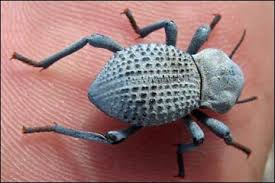 Another
favourite adaptation of mine is the ironclad beetle and its physical
adaptations. Another
favourite adaptation of mine is the ironclad beetle and its physical
adaptations.
The ironclad beetle is an insect that
has lost the ability to escape by flying but evolved an extraordinary
tough body armour. It can survive being stamped on and even withstand
the pressure of a car tyre. It lives under the bark of trees or rocks.
To survive being pecked to death by hungry birds, the ironclad beetle,
having lost the ability to fly away from danger, has evolved
crush-resistant forewings (known as elytra) - these have a series of
interlocked jigsaw-shaped joints within the exoskeleton.
Material scientists are interested in
the potential of this type of structure as a way of joining together
different materials, such as plastics and metal. Scientists have
designed and made a series of joints from metal and composites based on
those seen in the beetle to enhance the strength and toughness of the
materials. So, it isn't just new medicines we can get from natural
world, new structural designs too!
Some insects and other animals
have very bright 'warning' colours to look 'fearful' to potential predators
e.g. wasps.
Insects like bees and wasps have
stings as
a means of defence against predators, more of a functional adaptation of a
gland.
Thermal insulation:
A good example of physical adaptations. Animals living in cold climates like
polar bears have thick layers of fur to trap a good insulating layer of warm
air next to the skin - air is a poor conductor of heat, essential in very
cold environments.
As well as a thick hairy coat the fur is 'greased'
from glands in the skin and this greasy fur lets water run off easily so
there is less water to evaporate giving a cooling effect.
It is the same for
seabirds and penguins who must keep their wing feathers oily - often seen
pruning their feathers.
Note on bear and fur adaptations -
camouflage as well as
insulation:
Polar bears have white fur
to
blend in with ice and snow enhancing their camouflage and ability to
hunt prey in arctic conditions - a brown bear would rather
conspicuous!
The fur colour of brown bears
helps them blend in with their forest environment - a white bear
would rather conspicuous!
Many desert animals have sand coloured
fur to give good camouflage protection from predators or to act as predators
themselves!
Animals in very cold aquatic climates, like
whales (mammals), seals and penguins in polar oceans, have a
thick layer of
blubber (fat) and a low surface area to volume ratio (from nearly the most
compact shape) to help reduce heat loss through the skin.
The blubber acts
as an insulator to retain body heat - applies to the
bodies of seals, penguins and polar bears.
The greater the surface area the
greater the rate of heat transfer.
The most compact shape to give the
lowest surface area/volume ratio is a
sphere, but that's
no good for swimming efficiently through oceans, so a rounded
streamlined whale (mammal) shape
is a good compromise!
The polar bear is large but reasonably compact
bearing it mind it needs arms and legs to walk, swim and hunt!
Compared to similar animals in warm
climates, some animals in cold climates have smaller ears to minimise
surface area contact with cold air - so minimising heat loss.
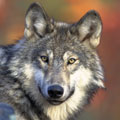 Arctic foxes and arctic wolves
and their
physical adaptations Arctic foxes and arctic wolves
and their
physical adaptations
The thick dense fur of these
animals also traps air proving a 'layer' of good thermal insulation
because are is a poor conductor of thermal energy (heat energy)
The arctic fox has a white coat
in the winter but this turns brown along the back with light grey
around the abdomen in summer. This ensures the fox is camouflage
throughout the seasons and better able to sneak up on its prey!
The arctic fox can shiver
to increase metabolic rate providing more heat energy and can live
conditions, the shivering kicks in at very low temperatures well below
the freezing point of water. The arctic fox also has a short muzzle, short legs and
short thick ears to minimise the surface area of heat energy loss.
Through evolution, arctic
wolves have several adaptations to help them survive in their harsh,
very cold environment of the arctic regions.
For the arctic wolf
(compared to the larger grey wolf), these adaptation include a thick,
insulating fur coat of trapped air (poor heat energy conductor), small
ears and a short muzzle to minimize surface area exposed to cold air,
hence reduction in heat energy loss by conduction and radiation.
Arctic wolves also have
padded paws for grip on snow and ice and an extra layer of fat that
functions as insulation and food storage (for when food is scarce) for
the long very cold winters of the arctic regions.
The
prehistoric woolly mammoth
The fur of the woolly
mammoth traps air to provide thermal insulation, essential for periods
of an extreme cold environment like in the ice ages.
Mammoths also had a 4inch
(~10 cm) layer of fat under the skin as extra thermal insulation.
Never-the-less, for several reasons, including being hunted by humans,
they still became extinct, but not that long ago!
Mammoths lived until
around 4000oC, but prior to this, as their numbers declined,
one reason may have been due to inbreeding which reduced the quality of
the gene pool proving disadvantages to survival. For many animal
species, mating between closely related individuals can lead to reduced
genetic diversity and increased risk of inheriting harmful recessive
genetic traits. These are likely to cause health problems and reduce
fitness for the species to survive and breed.
More examples of physical adaptations
The blubber in whales and seals is also a
great store of energy for the whale and other species like seals, it
also provide good insulation to minimise thermal energy loss.
Animals that live in very hot climates eg
desert camels, only have a thin layer of fat and a large surface area to
volume ratio to lose excess body heat efficiently.
Animals in hot dry climates have the
minimum of fat and body hair to prevent overheating.
Most a camel's fat
(energy store) is in the hump which means the rest of the body doesn't need
a layer of insulating fat that would reduce heat loss through the skin.
A
camel's fur layer is also thinner so too much heat is not retained.
Animals like camels do no sweat to
minimise water and need the minimum of water to drink to help cope with
the scarcity of water in desert regions.
Warm blood flows in the arteries to heat up the feet and cold blood returns
to the heart in the veins.
The feet are still relatively cold but it stops
cold blood from cooling down the body.
Many animals in
hot environments, by
being small, have a large surface area to volume ratio which helps them keep
cool by losing more heat through the skin.
Also, large thin ears with a
large surface area and lots of blood vessels have the same effect increase
heat loss by conduction and convection.
Hedgehogs have needle like spikes/spines
over the upper side of their body and can curl up to give all round
protection - predators from biting and trying to eat them!
Some insects display prominent
warning
colours to deter predators.
The work of Wallace (with Darwin, joint
founder of
evolution theory)
showed that many
species of butterflies had a (i) peculiar odour and
taste or (ii) warning colours - all adaptations to deter
potential predators from eating them - these beneficial
characteristics had come about by natural selection - the
fittest traits to help the species survive -
beneficial characteristic passed on in the alleles of their
offspring.
Mimicry, looking like something
they are not, is used by both plants and animals to help them survive e.g.
The hoverfly has warning colours like
a wasp - so is observed-perceived to be potentially harmful.
Some butterfly markings mimic another
unpleasant tasting species, but orchid plants are tops at mimicry!
A group of orchids with very apt
names such as fly orchid, bee orchid, and spider orchid actually mimic
the insects themselves to attract them. These orchid flower species look
and act as a dummy female of the insect species. The resemblance is so
good that males visit the flower in an attempt to copulate with the
dummy female! In trying to copulate, the visiting male insect acquires
the pollen sacs of the orchid and so transfers them to other orchid
flowers - nice one!
Large heavy animals like polar bears have
large flattish feet to spread their weight more evenly and reducing their
sinking into snow and falling through ice.
A physics note in biology!: pressure = force (weight) / surface area, increase area, pressure
reduced
Seals, penguins and many fish have
streamlined bodies adapted for swimming.
The streamlining reduces water
resistance, friction, (just like an aircraft's shape reduces air resistance)
and enables the creature to escape from predators OR catch some prey!
Giraffes have long tall necks to eat
leaves that other animals can't reach and can forage at a 'higher level'
of the plant.
Hedgehogs can curl up into a ball and protect themselves
with the sharp strong spikes protruding from the skin, unfortunately,
being very slow moving, this adaptation does not protect them from becoming
roadkill..
A bit of surface area/volume maths
... to
illustrate this adaptation I'm starting with cubes of various sizes (6 faces/sides):
(Ex. 1) A 1 cm cube has a volume
of 1 cm3 (1 x 1 x 1), a surface are of 6 x 1 x 1 = 6 cm2
So the surface area / volume
ratio = 6 / 1 = 6 cm-1
(6 : 1
(Ex. 2) A 2 cm cube has a volume
of 8 cm3 (2 x 2 x 2), a surface are of 6 x 2 x 2 =
24 cm2
So the surface area / volume
ratio = 24 / 8 = 3 cm-1
(3 : 1 ratio)
(Ex. 3) A 3 cm cube has a volume
of 27 cm3 (3 x 3 x 3), a surface are of 6 x 3 x 3 =
54 cm2
So the surface area / volume
ratio = 54 / 27 = 2 cm-1
(2 : 1 ratio)
I've worked out the surface area
: volume ratio for other shapes.
(Ex. 4) Take a 1 cm x 2 cm x 4 cm
rectangular block.
The volume = 1 x 2 x 4 =
8
cm3 (this volume matches Ex. 2 above)
The surface area = 28 cm2
(from 2 + 2 + 4 + 4 + 8 + 8)
Surface area / volume = 28 /
8 = 3.5 cm-1
(3.5 : 1, note this is higher than Ex. 2)
(Ex. 5) Take a 1 cm x 3 cm x 9 cm
rectangular block.
The volume = 1 x 3 x 9 = 27 cm3 (this volume matches Ex. 3 above)
The surface area = 78 cm2
(from 3 + 3 + 9 + 9 + 27 + 27)
Surface area / volume = 78 /
8 = 2.9
cm-1 (2.9 : 1, note this is much higher
than Ex. 3)
It turns out the cube or a sphere
have the smallest surface area : volume ratio.
In fact, for a given volume,
the
sphere has the smallest surface area : volume ratio.
(Ex. 6) In this example I'm
matching the volume of 8 cm3 for Ex. 2 and Ex. 4)
Take a sphere of radius 1.24 cm (I worked backwards using the formula below to get
this!)
Volume of sphere = 4/3 x π x
r3 = (4 x 3.142 x 1.243) / 3 = 7.99 cm3
Surface area of sphere = 4 x
π x r2 = 4 x 3.142 x 1.242 =
19.325 cm2
Surface area / volume ratio =
19.325 / 7.99 = 2.4
cm-1 (2 s.f., ratio
2.4 : 1)
This value is lower than the
cube (3.0) and rectangular volume (3.5) computed for the same
volume.
Note that the smaller the sphere,
the greater the surface area : volume ratio
For a given radius: surface
area / volume = 4 x π x r2 / 4/3 x π x r3
= 3 / r
So, the smaller the radius r,
the greater the surface area : volume ratio is.
You can see clearly that the smaller
(thinner etc.) of the animal the greater the surface to volume ratio and
the greater the rate of heat loss.
So, you can clearly see the advantage
of a compact shape minimising the surface area for larger animals i.e.
to minimise heat loss in large animals like polar bears, but the fat
layer and fur help too!
You might have noticed that many
animals try to adopt a spherical shape, though often a rugby ball shape.
e.g. warm bloodied mammals like
rabbits, hedgehogs or mice.
Note that cats/kittens and
dogs/puppies instinctively curl up into the minimum volume before
going to sleep - this minimises surface area : volume ratio and so
minimises heat loss.
You completely reverse the argument
when dealing with the transport of substances in multi-cellular
organisms, when you want the most efficient transfer system possible for
one or more functions of the organisms.
This is best achieved with a
high surface area to volume ratio.
A good example is the fine and
numerous villi in the intestine where their large surface
area is very efficient for absorbing nutrients from absorbed food.
The villi can be envisaged
as tall thin rectangular blocks in shape.
See also
Diffusion, osmosis and active transport
and
Examples of exchange surfaces
Key points -
Summary of
ideas
Based on
the syllabus-specifications for students taking the AQA, Edexcel and OCR
GCSE level biology examinations (~US grades 9-10).
Evolutionary Structural Adaptations of Animals
Animals have evolved structural adaptations to help them survive, find food,
defend themselves, and reproduce successfully.
1.
Adaptations for Movement and Locomotion
-
Streamlined Body Shapes – Reduce resistance in water or
air (e.g., fish have torpedo-shaped bodies, birds have aerodynamic wings).
-
Specialized Limbs – Webbed feet for swimming (ducks),
long limbs for running (cheetahs), and opposable thumbs for grasping
(primates).
-
Strong Muscles and Tendons – Help animals move
efficiently, such as kangaroos with powerful hind legs for jumping.
2.
Adaptations for Predation and Feeding
-
Sharp Teeth and Claws – Carnivores have large canines
for tearing meat (e.g., foxes) and claws for gripping prey (e.g., owls).
-
Beak Shapes – Birds have beaks adapted for different
diets (e.g., finches with strong beaks for seeds, hummingbirds with long
beaks for nectar).
-
Venom and Poison – Some animals use toxins to
immobilize prey or deter predators (e.g., adders inject venom).
3.
Adaptations for Defence
-
Camouflage – Helps animals blend into their environment
(e.g., stick insects, Arctic foxes turn white in winter).
-
Mimicry – Some animals resemble more dangerous
organisms to avoid predators (e.g., hoverflies mimic wasps).
-
Protective Coverings – Thick fur, scales, or shells
provide physical protection (e.g., hedgehogs have spines, turtles have hard
shells).
4.
Adaptations for Temperature Regulation
-
Thick Fur and Fat Layers – Insulation helps animals
survive in cold conditions (e.g., seals have blubber, polar bears have dense
fur).
-
Large Ears for Heat Dissipation – In hot climates,
animals like elephants use large ears to release heat.
-
Sweating and Panting – Mechanisms to cool the body
(e.g., dogs pant, humans sweat).
5.
Adaptations for Reproduction
-
Bright Colors and Displays – Some animals attract mates
with vivid colors and elaborate dances (e.g., peacocks).
-
Parental Care – Some species invest significant time in
raising offspring (e.g., birds feed chicks).
-
Egg-Laying vs. Live Birth – Some animals lay eggs for
external development (e.g., birds, reptiles), while mammals give birth to
live young for better survival chances.
These adaptations are the
result of natural selection over generations, ensuring that species are suited
to their environments.
Selected examples of more detailed notes on specific
individuals or groups of particular animal or plant species adaptations
(in alphabetical order)
arctic fox
* camel
*
fishes-general *
hydrothermal vent organisms *
lemurs
*
meerkats *
mole *
owls-general *
penguins *
polar
bear *
wasps *
whales
Learning objectives for this page on the
evolutionary structural adaptations of animals
Be able to describe
examples of structural adaptations that have arisen fro animal
evolution.
Be able to explain why a
particular physical adaptation gives the animal an evolutionary survival
advantage.
Understand the significance of
surface to volume ratio in terms of efficient heat loss from a relatively
large surface area or efficient heat retention by insulation.
Be able to describe how heat
(thermal) energy is minimised by animals living in cold conditions.
Understand that trapped air in
thick dense fur or a thick layer of fat can both act as a good thermal insulator (poor conductor of
heat energy).
Understand how physical shape
and/or colour mimicking other animals can aid the survival of a species.
Be able to explain how shape
gives an evolutionary advantage e.g. broad feet, large ears or streamlined
body.
Know that some species or
animals like foxes, wolves and hares can change their fur colour through
the seasons to help them either hide from being hunted or be more
disguised from prey they are hunting e.g. white in arctic winter or
brown in the summer.
WHAT NEXT?
TOP OF PAGE
Sub-index for evolution - adaptations biology notes
INDEX of all my BIOLOGY NOTES
HOME PAGE of Doc Brown's Science
website Links to all indexes
UK KS3 Science Quizzes for
KS3 science students aged ~11-14, ~US grades 6, 7 and 8
Biology * Chemistry
* Physics UK
GCSE level students aged ~14-16, ~US grades 9-10
Advanced Level Chemistry
for pre-university age ~16-18 ~US grades 11-12, K12 AP Honors
Find your GCSE/IGCSE
science course for more help links to all science revision notes
email doc
brown - comments - query?
Explaining the importance of
structural adaptations of animals
in GCSE level biology, What you need to know about structural
adaptations of animals for
GCSE level
biology,
Explaining the use of structural adaptations of animals knowledge in GCSE level biology, Examples of
structural adaptations of animals explained
when studying GCSE level biology, What is
the significance of structural adaptations of animals in GCSE level biology,
describing and
explaining the theory of structural adaptations of animals when studying GCSE level biology, revision
notes for structural adaptations of animals in exams, online help for
understanding structural adaptations of animals, exam revision notes for
structural adaptations of animals, what do I need to learn about
structural adaptations of animals? revision summary for structural
adaptations of animals, learning notes for structural adaptations of
animals, help to pass the structural adaptations of animals topic in an exam
question, how to prepare for questions on structural adaptations of
animals in a GCSE biology examination?
Based on the syllabus-specifications
for students taking the IGCSE/GCSE level biology examinations summary
revision notes and key points on structural adaptations of animals for students taking the AQA
igcse/gcse biology notes on structural adaptations of animals, Edexcel gcse
biology notes on structural adaptations of animals, OCR 21st century GCSE
biology notes on structural adaptations of animals, OCR gateway
GCSE biology notes on structural adaptations of animals, WJEC gcse biology notes on
structural adaptations of animals, CCEA
gcse biology notes on structural adaptations of animals for students taking CIE Cambridge igcse
biology, or any other GCSE or IGCSE level biology exams notes on
structural adaptations of animals, useful for US grade 9-10 biology courses
SITEMAP Website content © Dr
Phil Brown 2000+. All copyrights reserved on biology revision notes, images,
quizzes, worksheets etc. Copying of website material is NOT
permitted. Exam revision summaries and references to science course specifications
are unofficial.
|
