|
* York Area Index * 32a. Ripon Cathedral, the Town streets and buildings and a River Walk Ripon Cathedral is dedicated to St Wilfrid who was educated at Lindisfarne and travelled to Rome in AD 652 and on his return in AD 655 he became Abbot of a Benedictine monastery here. A new church was built and the crypt you see today is the oldest surviving Saxon crypt in England. Bede (672-735) the monk historian of Jarrow describes how a little 'mission station' or monastery was built in the heathen village of Rhypum about 655 and how St Wilfrid, its 2nd abbot, enlarged it and built a great church and become a distinguished bishop and statesman in the Kingdom of Northumbria.
This was destroyed by the Danes in the 9th century
(except for the famous crypt).
Email:
chem55555@hotmail.com
[Author
and photographer
*
The south-west tower of Ripon Cathedral. After the Norman Conquest in 1066 Ripon Minster became a collegiate church. This church lasted until the Reformation and in 1547 the College of canons was dissolved. In 1604 King James 1st re-established the canonical Chapter at Ripon and in 1836 the Collegiate Church of Ripon became the Cathedral Church of the new Diocese of Ripon.
On the right, the northwest tower of Ripon Cathedral.
An angled view of all three towers of Ripon Cathedral
The impressive west front of Ripon Cathedral with its twin towers. This Early English architecture was commissioned by Walter de Grey, Archbishop of York from 1216-1255.
In the late afternoon winter sunlight splendid view of the magnificent west front of Ripon Cathedral
Details of the facade of the west end of Ripon Cathedral.
The great Decorated style east window was built around 1300 - though much restored in Victorian times (1854?).
A view of Ripon Cathedral from southeast.
Another view of Ripon Cathedral from the south-east.
2nd view from the south-east, south transept, tower and south aisle of the chancel.
The Romanesque style south door in the south transept of Ripon Cathedral.
View of south side of Ripon Cathedral, the buttresses of the south aisle between the west tower and the south transept.
View from the south-west, south aisle of nave, tower and south transept of Ripon Cathedral.
View across the nave from the south aisle to the north aisle of the nave. Note at the end of the nave the earlier 'Romanesque' rounded arch and the later pointed arch across the crossing above the organ.
Views looking east down the nave towards the crossing. The nave of Ripon Cathedral dates from the early 16th century and built in Perpendicular style.
View from the north aisle (began in 1515) across the nave to the south aisle (began in 1502) and in the far left the magnificent asymmetric chancel arch (columns of different height on either side of the arch supports, and beyond the organ, screen and choir entrance.
View due east down the nave of Ripon Cathedral.
Left: A fine bronze sculpture of 'Mother and Child' in Ripon Cathedral. Right: An interesting 'different' stone sculpture of an interpretation of the Cross, Madonna and child in Ripon Cathedral.
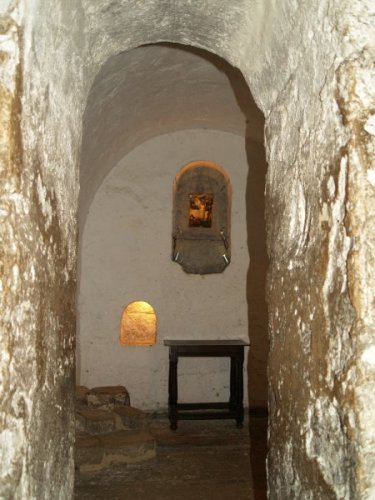
The crypt below the nave of Ripon Cathedral is the surviving remnant of St Wilfrid's Church dating from AD 672.
The steps down to the entrance to the crypt.
Another fine bronze sculpture of 'Mother and Child' in Ripon Cathedral.
Looking west down the nave to the fine west windows and their stained glass panels. These two rows of Gothic lancet windows date from around 1220. The splendid Perpendicular nave was rebuilt at the start of the 16th century by the addition of side aisles and wide clerestory windows (top left and right of above picture) added to the 12th century nave.
Looking west down the south aisle of the nave with its fine rib vaulting.
Some of the fine 'mixed' architecture in the nave.
The architecture of the crossing viewed from the south transept - the nave to the left and the north transept to the right. A structural collapse in 1450 led to a massive rebuilding programme which included most of the nave, but was incomplete by the time of the Reformation which greatly affected Ripon in 1539. This has resulted in a combination of earlier rounded Romanesque arches and rebuilt pointed arches with fine columns supporting them. The north transept is a good example of Norman Transitional style.
The crossing. The central tower was reconstructed by building two pointed arches and three massive pillars in the Perpendicular style. The south side of the choir and the east side of the south transept were rebuilt.
A 3rd fine bronze sculpture of 'Mary and Christ' in Ripon Cathedral
The Lady Chapel has become the Cathedral Library of Ripon Cathedral houses the 'Treasury' including the Saxon brooch known as the 'Ripon Jewel'. It was built over the Chapter House in the late 14th century.
The larger 'heraldic' stained glass window in the library
Details of the heraldic stained glass in the library of Ripon Cathedral.
Two fine medieval? stained glass panels in the library of Ripon Cathedral.
Stained glass panels donated by Bill Emmers in loving memory of his wife Jean Emmers in Ripon Cathedral
Recumbent effigy of a knight in Ripon Cathedral.
The Art Nouveau pulpit in bronze on marble columns dating from 1910 or 1913?
Art Nouveau pulpit with the choir screen in the distance.
The figures depict four Saxon saints and their crests are replicated on the kneelers.
The arcade columns and stained glass windows of the south aisle of the nave of Ripon Cathedral.
Details of some of the stained glass windows in the south aisle of Ripon Cathedral.
A few fragments of surviving medieval glass at the west end of the south aisle of Ripon Cathedral.
Medieval? or later? stained glass in the north aisle of Ripon Cathedral.
Medieval? or later? stained glass in the north aisle of Ripon Cathedral.
Medieval? or later? stained glass in the north aisle of Ripon Cathedral.
Victorian and more modern stained glass window panels in the north transept. The north transept remains as Archbishop Roger (Archbishop of York from 1154-1181) built it in the later 12th century. The left heraldic panels were put up in 1840 by Lord Grantly of Markenfield to commemorate his long ancestry stretching back to John of Gaunt and Edward III.
Stained glass window at the western end of the north aisle of the nave of Ripon Cathedral.
The medieval screen below the organ, that separates the nave-crossing from the choir-chancel of Ripon Cathedral. The brightly painted figures date from 1946 and depict important people in the history of Ripon Cathedral including Archbishop Thurstan (founder of Fountains Abbey), King Athelstan (who created the 'Liberty of Ripon' AD 926) and Archbishop Longley (the first Bishop of Ripon in 1836).
The medieval screen, organ and the entrance to the choir and chancel of Ripon Cathedral.
The chancel, Victorian restored (1854?) Great East Window of ~1300, executed in grand Gothic style, and before it the high altar and screen. The screen above the high altar is by Ninian Comper.
Details of the high altar and Reredos of Ripon Cathedral, whose figures are depictions of the key contemporaries of St Wilfrid and is also a War Memorial to Riponians killed in the First World War.
Details of the great east window of Ripon Cathedral (Victorian 1854), a true homage to the great architecture of the medieval Gothic stone masons and builders.
The choir stalls and organ. These are some of the most famous and finest choir stalls in England and there are fourteen stalls on either side and eight returned against the Screen and topped by intricately carved canopies (see below). They were carved by Ripon craftsmen between 1489 and 1494 under the leadership of William Bromflet, later known as William Carver who became Wakeman i.e. Mayor of Ripon in 1511. In 1660 the then spire of the central tower collapsed, fell through the roof and wrecked many of the canopies, which were replaced in the 19th century with copies of William Bromflet's work However, the seats or Misericords are outstanding surviving examples of medieval craftsmanship - many are illustrated at the end of the page - fantastic carvings.
Details of the late 15th century choir stalls in Ripon Cathedral.
The fine intricate carving of the oak choir stalls which were completed in 1494 by Ripon woodcarvers.
A whole selection of the late 15th century misericords - the carvings on the back of the choir stall seats.
32b. The Town Centre of Ripon - streets and buildings
Kirkgate Street leading up to Minster Road by which you approach the west front of Ripon Cathedral from the town centre.
The 'Old Courthouse' by Ripon Cathedral, built ~1830 on the site of the Palace of the Bishops of York, and now the 'Courthouse Museum', 'Workhouse Museum' and 'Prison and Police Museum' of Ripon.
Market Square, Ripon, the tall obelisk was erected in 1781 to commemorate the sixty years membership of Parliament for Ripon of William Aislabie of Studley Royal.
The Town Hall, Ripon, housed the public assembly and reading rooms and was designed by James Wyatt in 1798. The Corporation of Ripon met here in the 19th century and in 1897 the Marquess of Ripon gave it to the City as the Town Hall. Information courtesy of the Ripon Civic Society plaque on Ripon Town Hall.
A fine 16th century timber-framed building in one corner of Ripon's Market Square, known as the Wakeman's House. It houses the very nice and atmospheric Wakeman's House Cafe. The history of the Wakeman's House is described below.
A side-view of the timber-framed Wakeman's House in Ripon
Left: The Royal Oak pub in Market Square Ripon. Right: The old Temperance Hall of 1859 on Kirkgate across from Duck Hill, Ripon, now converted into the Duck Hill Shopping Quarter.
The Unicorn Hotel and the Skipton Building Society on the corner of Market Place East and Kirkgate, Ripon.
Left: The grade II listed building of Saint Agnes Lodge House in St Agnesgate, Ripon, originally dating from ~1630-1660 ; Right: Almshouses? in Ripon
St Agnes Lodge, Ripon
A brief history of The Old Hall, Ripon
An old medieval church in Ripon, south of Ripon Cathedral, the former chapel of St Anne's Hospital, now a quiet garden 'retreat'.
The Thorpe Prebend House in Ripon (Thorpe Prebends House), restored in 1609 and once hosted King James 1st in 1617
32c. The Ripon River Walk - River Skell and River Ure After starting out from Sainsbury's Cafe! we did a T shaped, but 'circular' walk from the town centre, by first heading south from the Cathedral to Bondgate Green bridge.
You cross the B6265 Bondgate Green bridge and head east along the south bank of the River Skell
There are some great 'across the river' views of Ripon Cathedral.
Further on along Fishergreen you reach the ford and footbridge at Fishergreen
You then pass under the old railway bridge which now carries the A61 trunk road.
Then you come to the confluence of the River Skell and River Ure,
You then turn south on the west bank of the River Ure.
When you come to the B6265 road bridge on Boroughbridge Road, you cross over and head north on the east bank of River Use
Looking north and south from the B6265 Boroughbridge Road bridge.
You just head north on the east bank of the River Ure passing some stone steps that were used for tank training in the 2nd World War.
Back to the confluence of the rivers Skell and Ure.
You then head northwest, passing under the A61 road bridge ...
... and then a little further on turn left over the North Road bridge over the River Ure.
Looking northwest and southeast from the North road bridge over the River Ure.
Some interesting houses near the west bank of the River Ure as you re-enter Ripon.
You pass under the A61 bridge again and just keep on heading south on the west bank of the River Ure.
Very pleasant walking by the River Ure.
After the confluence of the Rivers Ure and Skell you head west on the north bank of the River Skell ...
... and you get some nice views of Ripon Cathedral across the fields.
Trees!
Back to the stepping stones and the A61 road bridge.
Re-entering Ripon ...
... and the glorious west front of Ripon Cathedral with all its carved pointed arches and decorated doorways and finally ended up in Booths Cafe! A two rivers and two cafes walk! A history of Ripon Cathedral Absolutely — Ripon Cathedral is one of
the most rewarding churches in northern England to study, because it
combines Anglo‑Saxon origins, Norman grandeur,
Gothic rebuilding, Victorian restoration,
and a remarkable programme of 21st‑century contemporary art. 1. Origins: St Wilfrid’s Anglo‑Saxon Minster (c. 672)Ripon Cathedral stands on the site of a 7th‑century monastery founded by St Wilfrid, one of the most influential churchmen of early medieval England. ⭐ The Crypt (c. 672) — the oldest built structure in any English cathedral
The early minster
2. The Norman Cathedral (1080s–12th century)After the Norman Conquest, the minster was rebuilt on a grand scale. Key Norman features
Ripon became a cathedral briefly in the 12th century, then reverted to a collegiate church until the Reformation. 3. Gothic Rebuilding (13th–16th centuries)Ripon’s most beautiful architectural elements date from this period. ⭐ Early English Choir (c. 1220–1280)
⭐ Decorated Style Transepts (c. 1300–1350)
⭐ Perpendicular Nave & West Front (c. 1500–1522)
The west front is often compared to Beverley Minster and York Minster’s Perpendicular work. 4. Reformation, Civil War, and Restoration (16th–17th centuries)
5. Victorian Restoration (19th century)Ripon was elevated to cathedral status again in 1836, becoming the seat of the new Diocese of Ripon. Major Victorian works
Victorian Ripon is a harmonious blend of medieval and Gothic Revival. 6. Artistic Treasures of Ripon Cathedral⭐ The Misericords (c. 1489–1494)Ripon has one of the most important sets of medieval misericords in England. Themes include:
One misericord depicting a rabbit attacking a hunter is thought to have inspired Lewis Carroll’s Alice in Wonderland (Carroll lived in nearby Croft). St Wilfrid’s CryptAs noted above, the crypt is a masterpiece of early medieval architecture. Stained GlassRipon’s glass spans many centuries: Medieval fragments
Victorian windows
Modern stained glass
The Organ
7. Contemporary Art in Ripon CathedralRipon has embraced contemporary art more than many English cathedrals. ⭐ The Wilfrid Screen (2012)
⭐ The “Threads Through Creation” and “Threads Through Revelation” exhibitions
⭐ The “Gaia” installation (Luke Jerram)
⭐ Seasonal and temporary exhibitionsRipon regularly hosts:
This makes it one of the most artistically active cathedrals in the north. 8. The Cathedral TodayRipon Cathedral remains:
It is known for:
9. Summary: Why Ripon Cathedral MattersRipon Cathedral is unique because it combines:
It is a cathedral where 1,350 years of English Christianity coexist in a single, coherent architectural whole. A history of Ripon Here is a full, structured,
deeply detailed social and industrial history of Ripon, from
its earliest origins to the present day — with only a brief
mention of the cathedral, as you requested. 1. Origins: Ripon Before the Cathedral (Pre‑7th Century)Long before St Wilfrid founded his minster, the Ripon area was already a place of settlement and exchange. Prehistoric and Roman Context
Anglo‑Saxon SettlementBy the 600s, Ripon was a
Northumbrian estate centre, with royal patronage and
agricultural wealth.
2. The Wilfridian Minster and the Birth of a Town (7th–11th Centuries)St Wilfrid’s foundation (c. 672) transformed Ripon from a rural estate into a religious and economic hub. Social and Economic Effects
Royal and Ecclesiastical Patronage
This early autonomy shaped Ripon’s civic identity for centuries. 3. Medieval Ripon: A Market and Craft Town (12th–15th Centuries)⭐ A. Markets, Fairs, and TradeRipon developed into a classic medieval market town, with:
Key trades included:
The town’s prosperity was tied to the Ure valley’s sheep farming and its position on routes between York, Richmond, and the Dales. ⭐ B. Guilds and Civic IdentityRipon had active craft guilds, regulating:
The town’s civic pride is reflected in:
These customs are among the oldest continuous civic traditions in England. 4. Early Modern Ripon (16th–18th Centuries): Reformation to Georgian Prosperity⭐ A. Reformation and Social Change
⭐ B. 17th‑Century Turbulence
⭐ C. Georgian RiponBy the 18th century, Ripon was:
New buildings included:
The town became a stopping point on routes to the Dales and the Lake District. 🧵 5. Industrial Ripon (19th Century): A Small but Diverse Industrial TownRipon never industrialised on the scale of Leeds or Bradford, but it developed a distinctive mix of small‑scale industries. ⭐ A. Textile Mills
⭐ B. Tanning and LeatherworkingOne of Ripon’s most important historic industries:
Ripon’s leather goods were exported across Britain. ⭐ C. Horn and Bone WorkingRipon became famous for:
This industry linked symbolically to the town’s hornblower tradition. ⭐ D. Agricultural EngineeringSmall foundries and workshops produced:
⭐ E. RailwaysRipon gained a railway station in
1848, connecting it to Harrogate and Northallerton. 6. 20th Century: Decline, Adaptation, and New Identities⭐ A. Industrial DeclineBy the mid‑20th century:
Ripon avoided heavy industry, so it avoided heavy pollution — but also missed out on large‑scale industrial employment. ⭐ B. Military InfluenceNearby RAF Dishforth, RAF Linton‑on‑Ouse, and Catterick Garrison shaped the local economy through:
⭐ C. Tourism and HeritageFrom the 1970s onward, Ripon reinvented itself as:
The cathedral, museums, and Georgian streetscape became major draws. 7. Ripon in the 21st Century: A Small City with a Strong Identity⭐ A. EconomyModern Ripon’s economy is based on:
⭐ B. Social CharacterRipon today is:
It retains a strong sense of civic identity through:
⭐ C. Urban DevelopmentRecent decades have seen:
⭐ D. Cultural LifeRipon hosts:
It remains one of England’s smallest and most characterful cities. 8. Summary: The Social and Industrial Story of RiponRipon’s identity has been shaped by:
It is a city where deep history and small‑town industry have combined to create a distinctive, resilient community. docspics images photos of the City of York, England © Phil Brown Tourist information on Ripon Cathedral, Things to do near Ripon Cathedral, What to see in Ripon Cathedral, Walks near Ripon Cathedral, Holidays near Ripon Cathedral, Top tourist attractions of Ripon Cathedral, luxury hotels near Ripon Cathedral, self-catering holiday cottages near Ripon Cathedral, B&B in Ripon Cathedral, friendly pubs near Ripon Cathedral, cafes in Ripon Cathedral, eating out in fine restaurants in Ripon Cathedral, weekend breaks near Ripon Cathedral, wining & dining weekends near Ripon Cathedral, touring coach tours including Ripon Cathedral, pretty villages near Ripon Cathedral, historic towns near Ripon Cathedral, visiting museums near Ripon Cathedral, local art galleries near Ripon Cathedral, guided walks from Ripon Cathedral, history of Ripon Cathedral, architecture of Ripon Cathedral docspics images photos of Ripon © Phil Brown Tourist information on Ripon, top tourist attractions in Ripon Things to do in Ripon, What to see in Ripon, Walks in Ripon, weekend breaks in Ripon family holidays in Ripon, Top tourist attractions in Ripon, luxury hotels in Ripon, self-catering holiday cottages in Ripon, B&B in Ripon, friendly pubs in Ripon, cafes in Ripon, eating out in fine restaurants in Ripon, bargain holiday breaks in Ripon, wining & dining weekends in Ripon, touring coach tours including Ripon, pretty villages in Ripon, historic towns in Ripon, visiting museums in Ripon, local art galleries in Ripon, guided walks in Ripon, history of Ripon, architecture of Ripon trains to Ripon buses to Ripon coach tours to Ripon historic houses in Ripon historic churches in Ripon historic buildings tourist attractions in Ripon tourist information for things to do and see in Ripon property for sale in Ripon good places to eat in Ripon |




 The stepping stones


 Enter place, village, feature, church, museum, historic building, street, anything of historic
interest!
Enter place, village, feature, church, museum, historic building, street, anything of historic
interest!