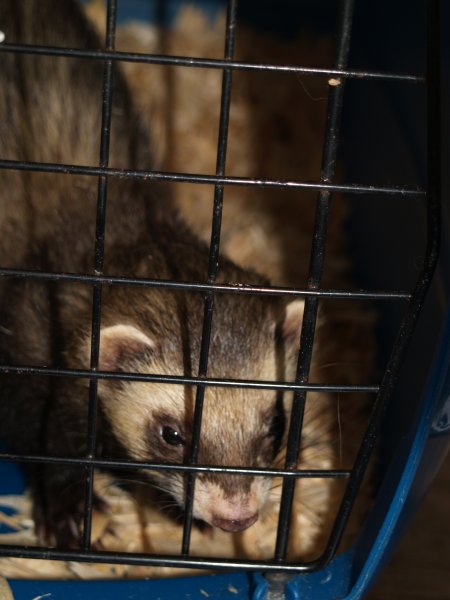
Enter
anything of interest
Enter
anything of interest
|
*
 *
*
Ferret
From Wikipedia, the free encyclopedia
This article is about the mammal.
Ferret
Ferret 2008.png
Conservation status
Domesticated
Scientific classification e
Kingdom: Animalia
Phylum: Chordata
Class: Mammalia
Order: Carnivora
Family: Mustelidae
Genus: Mustela
Species: M. putorius
Subspecies: M. p. furo
Trinomial name
Mustela putorius furo
Linnaeus, 1758
Synonyms
Mustela furo Linnaeus, 1758
The ferret (Mustela putorius furo) is the domesticated form of the European
polecat, a mammal belonging to the same genus as the weasel, Mustela of the
family Mustelidae. ferret 1 ferret They typically have brown, black, white, or
mixed fur. They have an average length of 51 cm (20 in) including a 13 cm (5.1
in) tail, weigh about 1.5–4 pounds (0.7–2 kg), and have a natural lifespan of 7
to 10 years. ferret 2 ferret Ferrets are sexually dimorphic predators with males
being substantially larger than females.
Several other Mustelids also have the word ferret in their common names,
including an endangered species, the black-footed ferret.
The history of the ferret's domestication is uncertain, like that of most other
domestic animals, but it is likely that ferrets have been domesticated for at
least 2,500 years. They are still used for hunting rabbits in some parts of the
world, but increasingly they are kept only as pets.
Being so closely related to polecats, ferrets easily hybridize with them, and
this has occasionally resulted in feral colonies of polecat-ferret hybrids that
have caused damage to native fauna, especially in New Zealand. ferret 3 ferret
As a result, some parts of the world have imposed restrictions on the keeping of
ferrets.
Contents
1 Etymology
2 Biology
2.1 Characteristics
2.2 Behavior
2.3 Diet
2.4 Dentition
2.5 Health
3 History of domestication
3.1 Ferreting
4 As pets
4.1 Regulation
5 Other uses
6 Terminology and coloring
6.1 Waardenburg-like coloring
7 Import restrictions
8 See also
9 Notes
10 References
11 External links
Etymology
The name "ferret" is derived from the Latin furittus, meaning "little thief", a
likely reference to the common ferret penchant for secreting away small items.
ferret 4 ferret The Greek word ictis occurs in a play written by Aristophanes,
The Acharnians, in 425 BC. Whether this was a reference to ferrets, polecats, or
the similar Egyptian mongoose is uncertain. ferret 5 ferret
Biology
Characteristics
Ferret profile
Ferrets have a typical Mustelid body-shape, being long and slender. Their
average length is about 50 cm including a 13-cm tail. Their pelage has various
colorations including brown, black, white or mixed. They weigh between 0.7 kg
and 2.0 kg and are sexually dimorphic as the males are substantially larger than
females. The average gestation period is 42 days and females may have two or
three litters each year. The litter size is usually between three and seven kits
which are weaned after three to six weeks and become independent at three
months. They become sexually mature at approximately six months and the average
life span is seven to 10 years. ferret 6 ferret ferret 7 ferret
Behavior
Ferrets spend 14–18 hours a day asleep and are most active around the hours of
dawn and dusk, meaning they are crepuscular. ferret 8 ferret Unlike their
polecat ancestors, which are solitary animals, most ferrets will live happily in
social groups. A group of ferrets is commonly referred to as a "business".
ferret 9 ferret They are territorial, like to burrow, and prefer to sleep in an
enclosed area. ferret 10 ferret
Like many other mustelids, ferrets have scent glands near their anus, the
secretions from which are used in scent marking. Ferrets can recognize
individuals from these anal gland secretions, as well as the sex of unfamiliar
individuals. ferret 11 ferret Ferrets may also use urine marking for sex and
individual recognition. ferret 12 ferret
As with skunks, ferrets can release their anal gland secretions when startled or
scared, but the smell is much less potent and dissipates rapidly. Most pet
ferrets in the US are sold de-scented (anal glands removed). ferret 13 ferret In
many other parts of the world, including the UK and other European countries,
de-scenting is considered an unnecessary mutilation.
If excited, they may perform a behavior called the "weasel war dance",
characterized by frenzied sideways hops, leaps and bumping into nearby objects.
Despite its common name, it is not aggressive but is a joyful invitation to
play. It is often accompanied by a unique soft clucking noise, commonly referred
to as "dooking". ferret 14 ferret When scared, ferrets will hiss; when upset,
they squeak softly. ferret 15 ferret
Diet
Ferrets are obligate carnivores. ferret 16 ferret The natural diet of their wild
ancestors consisted of whole small prey, including meat, organs, bones, skin,
feathers, and fur. ferret 17 ferret Ferrets have short digestive systems and
quick metabolism, so they need to eat frequently. Prepared dry foods consisting
almost entirely of meat (including high-grade cat food, although specialized
ferret food is increasingly available and preferable) ferret 18 ferret provide
the most nutritional value and are the most convenient, ferret 19 ferret though
some ferret owners feed pre-killed or live prey (such as mice and rabbits) to
their ferrets to more closely mimic their natural diet. ferret 20 ferret ferret
21 ferret Ferret digestive tracts lack a cecum and the animal is largely unable
to digest plant matter. ferret 22 ferret Before much was known about ferret
physiology, many breeders and pet stores recommended food like fruit in the
ferret diet, but it is now known that such foods are inappropriate, and may in
fact have negative ramifications on ferret health. Ferrets imprint on their food
at around six months old. This can make introducing new foods to an older ferret
a challenge, and even simply changing brands of kibble may meet with resistance
from a ferret that has never eaten the food as a kit. It is therefore advisable
to expose young ferrets to as many different types and flavors of appropriate
food as possible. ferret 23 ferret
Dentition
Ferret dentition
Ferrets have four types of teeth (the number includes maxillary (upper) and
mandibular (lower) teeth) with a dental formula of 3/3 1/1 4/4 1/2:
Twelve small teeth (only a couple of millimeters) located between the canines in
the front of the mouth. These are known as the incisors and are used for
grooming.
Four canines used for killing prey.
Twelve premolar teeth that the ferret uses to chew food—located at the sides of
the mouth, directly behind the canines. The ferret uses these teeth to cut
through flesh, using them in a scissors action to cut the meat into digestible
chunks.
Six molars (two on top and four on the bottom) at the far back of the mouth are
used to crush food.
Health
Main article: Ferret health
Male ferret
Ferrets are known to suffer from several distinct health problems. Among the
most common are cancers affecting the adrenal glands, pancreas, and lymphatic
system. Viral diseases include canine distemper and influenza. Health problems
can occur in unspayed females when not being used for breeding. ferret 24 ferret
Certain health problems have also been linked to ferrets being neutered before
reaching sexual maturity. ferret citation needed ferret Certain colors of ferret
may also carry a genetic defect known as Waardenburg syndrome. Similar to
domestic cats, ferrets can also suffer from hairballs and dental problems.
History of domestication
Women hunting rabbits with a ferret in the Queen Mary Psalter
In common with most domestic animals, the original reason for ferrets being
domesticated by human beings is uncertain, but it may have involved hunting.
According to phylogenetic studies, the ferret was domesticated from the European
polecat (Mustela putorius), and likely descends from a North African lineage of
the species. ferret 25 ferret Analysis of mitochondrial DNA suggests that
ferrets were domesticated around 2,500 years ago. It has been claimed that the
ancient Egyptians were the first to domesticate ferrets, but as no mummified
remains of a ferret have yet been found, nor any hieroglyph of a ferret, and no
polecat now occurs wild in the area, that idea seems unlikely. ferret 26 ferret
Ferrets were probably used by the Romans for hunting. ferret 27 ferret ferret 28
ferret
Colonies of feral ferrets have established themselves in areas where there is no
competition from similarly sized predators, such as in the Shetland Islands and
in remote regions in New Zealand. Where ferrets coexist with polecats,
hybridization is common. It has been claimed that New Zealand has the world's
largest feral population of ferret-polecat hybrids. ferret 29 ferret In 1877,
farmers in New Zealand demanded that ferrets be introduced into the country to
control the rabbit population, which was also introduced by humans. Five ferrets
were imported in 1879, and in 1882–1883, 32 shipments of ferrets were made from
London, totaling 1,217 animals. Only 678 landed, and 198 were sent from
Melbourne, Australia. On the voyage, the ferrets were mated with the European
polecat, creating a number of hybrids that were capable of surviving in the
wild. In 1884 and 1886, close to 4,000 ferrets and ferret hybrids, 3,099 weasels
and 137 stoats were turned loose. ferret 30 ferret Concern was raised that these
animals would eventually prey on indigenous wildlife once rabbit populations
dropped, and this is exactly what happened to New Zealand's bird species which
previously had had no mammalian predators.
Ferreting
Main article: Rabbiting
Muzzled ferret flushing a rat, as illustrated in Harding's Ferret Facts and
Fancies (1915)
For millennia, the main use of ferrets was for hunting, or ferreting. With their
long, lean build, and inquisitive nature, ferrets are very well equipped for
getting down holes and chasing rodents, rabbits and moles out of their burrows.
Caesar Augustus sent ferrets or mongooses (named viverrae by Plinius) to the
Balearic Islands to control the rabbit plagues in 6 BC. ferret 31 ferret ferret
32 ferret In England, in 1390, a law was enacted restricting the use of ferrets
for hunting to the relatively wealthy:
it is ordained that no manner of layman which hath not lands to the value of
forty shillings a year shall from henceforth keep any greyhound or other dog to
hunt, nor shall he use ferrets, nets, heys, harepipes nor cords, nor other
engines for to take or destroy deer, hares, nor conies, nor other gentlemen's
game, under pain of twelve months' imprisonment. ferret 33 ferret
Ferrets were first introduced into the New World in the 17th century, and were
used extensively from 1860 until the start of World War II to protect grain
stores in the American West from rodents. They are still used for hunting in
some countries, including the United Kingdom, where rabbits are considered a
plague species by farmers. ferret 34 ferret The practice is illegal in several
countries where it is feared that ferrets could unbalance the ecology. In 2009
in Finland, where ferreting was previously unknown, the city of Helsinki began
to use ferrets to restrict the city's rabbit population to a manageable level.
Ferreting was chosen because in populated areas it is considered to be safer and
less ecologically damaging than shooting the rabbits.
As pets
A ferret in a war dance jump.
In the United States, ferrets were relatively rare pets until the 1980s. A
government study by the California State Bird and Mammal Conservation Program
estimated that by 1996 about 800,000 domestic ferrets were being kept as pets in
the United States. ferret 35 ferret
Like many household pets, ferrets require a cage. For ferrets, a wire cage at
least 18 inches long and deep and 30 inches wide or longer is needed. Ferrets
cannot be housed in environments such as an aquarium because of the poor
ventilation. ferret 36 ferret It is preferable that the cage have more than one
level but this is not crucial. Usually two to three different shelves are used.
Regulation
Australia: It is illegal to keep ferrets as pets in Queensland or the Northern
Territory; in the Australian Capital Territory a licence is required.
Brazil: They are allowed only if they are given a microchip identification tag
and sterilized.
New Zealand: It has been illegal to sell, distribute or breed ferrets in New
Zealand since 2002 unless certain conditions are met. ferret 37 ferret
United States: Ferrets were once banned in many US states, but most of these
laws were rescinded in the 1980s and 1990s as they became popular pets.
Ferrets are still illegal in California under Fish and Game Code Section 2118;
ferret 38 ferret and the California Code of Regulations, ferret 39 ferret
although it is not illegal for veterinarians in the state to treat ferrets kept
as pets.
Additionally, "Ferrets are strictly prohibited as pets under Hawaii law because
they are potential carriers of the rabies virus"; ferret 40 ferret the territory
of Puerto Rico has a similar law. ferret 41 ferret
Ferrets are restricted by individual cities, such as Washington, D.C., and New
York City, ferret 41 ferret which renewed its ban in 2015. ferret 42 ferret
ferret 43 ferret They are also prohibited on many military bases. ferret 41
ferret A permit to own a ferret is needed in other areas, including Rhode
Island. ferret 44 ferret Illinois and Georgia do not require a permit to merely
possess a ferret, but a permit is required to breed ferrets. ferret 45 ferret
ferret 46 ferret It was once illegal to own ferrets in Dallas, Texas, ferret 47
ferret but the current Dallas City Code for Animals includes regulations for the
vaccination of ferrets. ferret 48 ferret Pet ferrets are legal in Wisconsin,
however legality varies by municipality. The city of Oshkosh, for example,
classifies ferrets as a wild animal and subsequently prohibits them from being
kept within the city limits. Also, an import permit from the state department of
agriculture is required to bring one into the state. ferret 49 ferret Under
common law, ferrets are deemed "wild animals" subject to strict liability for
injuries they cause, but in several states statutory law has overruled the
common law, deeming ferrets "domestic". ferret 50 ferret
Japan: In Hokkaido prefecture, ferrets must be registered with the local
government. ferret 51 ferret In other prefectures, no restrictions apply.
Other uses
Ferrets are an important experimental animal model for human influenza, ferret
52 ferret ferret 53 ferret and have been used to study the 2009 H1N1 (swine flu)
virus. ferret 54 ferret Smith, Andrews, Laidlaw (1933) inoculated ferrets
intra-nasally with human naso-pharyngeal washes, which produced a form of
influenza that spread to other cage mates. The human influenza virus (Influenza
type A) was transmitted from an infected ferret to a junior investigator, from
whom it was subsequently re-isolated.
Ferrets have been used in many broad areas of research, such as the study of
pathogenesis and treatment in a variety of human disease, these including
studies into cardiovascular disease, nutrition, respiratory diseases such as
SARS and human influenza, airway physiology, ferret 55 ferret cystic fibrosis
and gastrointestinal disease.
Because they share many anatomical and physiological features with humans,
ferrets are extensively used as experimental subjects in biomedical research, in
fields such as virology, reproductive physiology, anatomy, endocrinology, and
neuroscience. ferret 56 ferret
In the UK, ferret racing is often a feature of rural fairs or festivals, with
people placing small bets on ferrets that run set routes through pipes and wire
mesh. Although financial bets are placed, the event is primarily for
entertainment purposes as opposed to 'serious' betting sports such as horse or
greyhound racing. ferret 57 ferret ferret 58 ferret
Terminology and coloring
Typical ferret coloration, known as a sable or polecat-colored ferret
Male ferrets are called hobs; female ferrets are jills. A spayed female is a
sprite, a neutered male is a gib, and a vasectomised male is known as a hoblet.
Ferrets under one year old are known as kits. A group of ferrets is known as a
"business", ferret 59 ferret or historically as a "busyness". Other purported
collective nouns, including "besyness", "fesynes", "fesnyng", and "feamyng",
appear in some dictionaries, but are almost certainly ghost words. ferret 60
ferret
Most ferrets are either albinos, with white fur and pink eyes, or display the
typical dark masked sable coloration of their wild polecat ancestors. In recent
years fancy breeders have produced a wide variety of colors and patterns. Color
refers to the color of the ferret's guard hairs, undercoat, eyes, and nose;
pattern refers to the concentration and distribution of color on the body, mask,
and nose, as well as white markings on the head or feet when present. Some
national organizations, such as the American Ferret Association, have attempted
to classify these variations in their showing standards. ferret 61 ferret
There are four basic colors. The sable (including chocolate and dark brown),
albino, dark eyed white (DEW), and the silver. All the other colors of a ferret
are variations on one of these four categories.
Waardenburg-like coloring
White or albino ferret
Ferrets with a white stripe on their face or a fully white head, primarily
blazes, badgers, and pandas, almost certainly carry a congenital defect which
shares some similarities to Waardenburg syndrome. This causes, among other
things, a cranial deformation in the womb which broadens the skull, white face
markings, and also partial or total deafness. It is estimated as many as 75
percent of ferrets with these Waardenburg-like colorings are deaf.
White ferrets were favored in the Middle Ages for the ease in seeing them in
thick undergrowth. Leonardo da Vinci's painting Lady with an Ermine is likely
mislabelled; the animal is probably a ferret, not a stoat, (for which "ermine"
is an alternative name for the animal in its white winter coat). Similarly, the
ermine portrait of Queen Elizabeth the First shows her with her pet ferret,
which has been decorated with painted-on heraldic ermine spots.
"The Ferreter's Tapestry" is a 15th-century tapestry from Burgundy, France, now
part of the Burrell Collection housed in the Glasgow Museum and Art Galleries.
It shows a group of peasants hunting rabbits with nets and white ferrets. This
image was reproduced in Renaissance Dress in Italy 1400–1500, by Jacqueline
Herald, Bell & Hyman. ferret a ferret
Gaston Phoebus' Book of the Hunt was written in approximately 1389 to explain
how to hunt different kinds of animals, including how to use ferrets to hunt
rabbits. Illustrations show how multicolored ferrets that were fitted with
muzzles were used to chase rabbits out of their warrens and into waiting nets.
Import restrictions
Australia – Ferrets cannot be imported into Australia. A report drafted in
August 2000 seems to be the only effort made to date to change the situation.
ferret 62 ferret
Canada – Ferrets brought from anywhere except the US require a Permit to Import
from the Canadian Food Inspection Agency Animal Health Office. Ferrets from the
US require only a vaccination certificate signed by a veterinarian. Ferrets
under three months old are not subject to any import restrictions. ferret 63
ferret
European Union – As of July 2004, dogs, cats, and ferrets can travel freely
within the European Union under the pet passport scheme. To cross a border
within the EU, ferrets require at minimum an EU PETS passport and an
identification microchip (though some countries will accept a tattoo instead).
Vaccinations are required; most countries require a rabies vaccine, and some
require a distemper vaccine and treatment for ticks and fleas 24 to 48 hours
before entry. Ferrets occasionally need to be quarantined before entering the
country. PETS travel information is available from any EU veterinarian or on
government websites.
United Kingdom – The UK accepts ferrets under the EU's PETS travel scheme.
Ferrets must be microchipped, vaccinated against rabies, and documented. They
must be treated for ticks and tapeworms 24 to 48 hours before entry. They must
also arrive via an authorized route. Ferrets arriving from outside the EU may be
subject to a six-month quarantine. ferret 64 ferret
For Doc Brown's
latest updates of pictures or science see https://twitter.com/docbrownchem
Doc Brown's
Science Website - GCSE Biology, GCSE & A Level Chemistry and GCSE Physics
TOP OF PAGE