Shire horse
From Wikipedia, the free encyclopedia
Jump to navigationJump to search
This article is about the breed of horse. For the British band, see Shirehorses.
Shire
A tall black horse with four white legs, standing in harness, with shafts of a
cart visible
Conservation status At risk (RBST, 2016)
Country of origin United Kingdom
Traits
Weight
850-1100 kg shire horse 1 shire horse
Height
Stallions 17.0 hands (68 inches, 173 cm), mares 16.0 hands (64 inches, 163 cm),
geldings 16.2 hands (66 inches, 168 cm) shire horse 1 shire horse
Distinguishing features
large size
draught conformation
feathered legs
Breed standards
Shire Horse Society
American Shire Horse Association
Equus ferus caballus
The Shire is a British breed of draught horse. It is usually black, bay, or
grey. It is a tall breed, and Shires have at various times held world records
both for the largest horse and for the tallest horse. The Shire has a great
capacity for weight-pulling, and has been popular throughout its history for
pulling brewer's drays delivering ale to customers. The horses may also be used
for forestry, for riding and for commercial promotion.
In 1878, the British organisation now known as the Shire Horse Society was
created, with the American Shire Horse Association beginning in 1885. The breed
was exported from Britain to the United States in large numbers during the late
19th and early 20th centuries, but popularity fell as mechanisation increased,
reaching a low point in the 1950s and 1960s. Popularity began to increase again
in the 1970s and after. However, population numbers are still considered to be
at critical levels by both the UK-based Rare Breeds Survival Trust and the
US-based American Livestock Breeds Conservancy.
Contents
1 Characteristics
2 Breed history
3 Uses
4 References
5 External links
Characteristics
Shire stallions may be black, bay or grey. They may not be roan or have large
amounts of white markings. Mares and geldings may be black, bay, grey or roan.
In the UK stallions may not be chestnut, shire horse 1 shire horse but the
colour is allowed by the US association. shire horse 2 shire horse The Shire
Horse Society of the UK specifies that stallions must stand at least 17 hands
(68 inches, 173 cm) high when mature, and they average around 17.2 hands (70
inches, 178 cm). Geldings are required to be at least 16.2 hands (66 inches, 168
cm) high and mares at least 16 hands (64 inches, 163 cm). Their average weight
ranges from 850 to 1,100 kg (1,870 to 2,430 lb) for geldings and stallions, with
no set standard for mares. shire horse 1 shire horse The head of a Shire is long
and lean, with large eyes, set on a neck that is slightly arched and long in
proportion to the body. The shoulder is deep and wide, the chest wide, the back
muscular and short and the hindquarters long and wide. Not too much feathering
is to occur on the legs, and the hair is fine, straight, and silky. shire horse
1 shire horse Smaller Shires, under 17 hands (68 inches, 173 cm), are generally
preferred for working horses, while taller horses, especially those over 18.2
hands (74 inches, 188 cm), are used for show and promotional purposes. The breed
is known for its easy-going temperament. shire horse 3 shire horse Shires have
been identified to be at risk for chronic progressive lymphedema, a chronic
progressive disease that includes symptoms of progressive swelling,
hyperkeratosis, and fibrosis of distal limbs. The disease is similar to chronic
lymphedema in humans. shire horse 4 shire horse
The Shire has an enormous capacity for pulling weight. In 1924, at a British
exhibition, a pair of horses was estimated to have pulled a starting load equal
to 45 tons, although an exact number could not be determined as their pull
exceeded the maximum reading on the dynamometer. Working in slippery footing,
the same pair of horses pulled 16.5 tons at a later exhibition. shire horse 5
shire horse
The largest horse in recorded history was probably a Shire named Mammoth (also
known as Sampson), born in 1848. He stood 21.2 1⁄4 hands (86.25 inches, 219 cm)
high, and his peak weight was estimated at 1,524 kilograms (3,360 lb). shire
horse 6 shire horse At over 19 hands (76 inches, 193 cm), a Shire gelding named
Goliath was the Guinness Book of World Records record holder for the world's
tallest horse until his death July 3, 2014 on the Priefert Ranch in Mt.
Pleasant, Texas. shire horse 7 shire horse
Breed history
two bay (reddish-brown) horses wearing red caps over their ears, hitched to a
plow and pulling it across dried grassy turf with a man walking behind the plow
A pair of Shire horses ploughing
Though oxen were used for most farm work into the 18th century, horses 'fit for
the dray, the plough, or the chariot' were on sale at Smithfield Market in
London as early as 1145. shire horse 8 shire horse
The English Great Horse was valued during the reign of Henry VIII, when
stallions measuring less than 'fifteen handfuls' could not be kept, but the
increasing role of gunpowder brought an end to the use of heavy horses in
battle. Oliver Cromwell's cavalry favoured lighter, faster mounts and the big
horses began to be used for draught work instead. shire horse 8 shire horse
During the 16th century, Dutch engineers brought Friesian horses with them when
they came to England to drain the fens, and these horses probably had a
significant influence on what became the Shire breed. shire horse 9 shire horse
From this mediaeval horse came an animal called the Old English Black Horse in
the 17th century. The Black Horse was improved by the followers of Robert
Bakewell, of Dishley Grange in Leicestershire, shire horse 8 shire horse
resulting in a horse sometimes known as the "Bakewell Black". shire horse 10
shire horse Bakewell imported six Dutch or Flanders mares, notable since
breeders tended to concentrate on improving the male line. Two different types
of black horses developed: the Fen or Lincolnshire type and the Leicester or
Midlands type. shire horse 8 shire horse The Fen type tended to be larger, with
more bone and extra hair, while the Midlands type tended to have more endurance
while being of a finer appearance. shire horse 11 shire horse The term "Shire
horse" was first used in the mid-17th century, and incomplete records begin to
appear near the end of the 18th century. The "Packington Blind Horse", from
Leicestershire, is one of the best-known horses of the era, with direct
descendants being recorded from 1770 to 1832. shire horse 3 shire horse This
horse is usually recognised as the foundation stallion for the Shire breed, and
he stood at stud from 1755 to 1770. shire horse 5 shire horse During the 19th
century, Shires were used extensively as cart horses to move goods from the
docks through the cities and countryside. The rough roads created a need for
large horses with extensive musculature. shire horse 9 shire horse
A grey horse with fully white hair coat, harnessed to a log, pulling it through
a green forest
A grey Shire employed in forestry
In 1878, the English Cart Horse Society was formed, and in 1884 changed its name
to the Shire Horse Society. The Society published a stud book, with the first
edition in 1878 containing 2,381 stallions and records dating back to 1770.
Between 1901 and 1914, 5,000 Shires were registered each year with the society.
shire horse 3 shire horse shire horse 5 shire horse The first Shires were
imported to the United States in 1853, with large numbers of horses being
imported in the 1880s. The American Shire Horse Association was established in
1885 to register and promote the breed. shire horse 12 shire horse The Shire
soon became popular in the United States, and almost 4,000 Shires were imported
between 1900 and 1918. Approximately 6,700 Shires were registered with the US
association between 1909 and 1911. Around the time of the Second World War,
increasing mechanisation and strict regulations on the purchase of livestock
feed reduced the need for and ability to keep draught horses. Thousands of
Shires were slaughtered and several large breeding studs closed. The breed fell
to its lowest point in the 1950s and 1960s, and in 1955 fewer than 100 horses
were shown at the annual British Spring Show. shire horse 3 shire horse shire
horse 12 shire horse
In the 1970s, the breed began to be revived through increased public interest.
Breed societies have been established in the United States, Canada, the
Netherlands, France, and Germany, and in 1996 the first World Shire Horse
Congress was held in Peterborough. The first use within the breed of artificial
insemination through frozen semen was with several Australian mares in 1997.
Between the 1920s and 1930s and today, the Shire has changed in conformation.
The Clydesdale was used for cross-breeding in the 1950s and 1960s, which changed
the conformation of the Shire and most notably changed the feathering on the
lower legs from a mass of coarse hair into the silky feathering associated with
modern Shires. shire horse 3 shire horse At the peak of their population, Shires
numbered over a million. In the 1950s and 1960s, this number declined to a few
thousand. shire horse 13 shire horse In the United States, the Shire population
dropped significantly in the early part of the 20th century, and continued to
decline in the 1940s and 1950s. Between 1950 and 1959, only 25 horses were
registered in the United States. However, numbers began to increase, and 121
horses were registered in the US by 1985. shire horse 12 shire horse
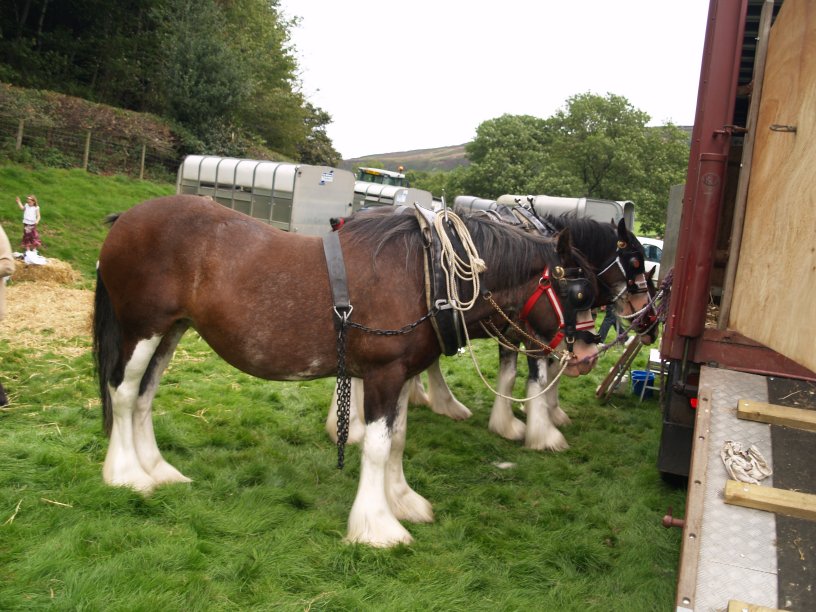
A reddish-brown horse with black mane and tail and all four legs having white
markings from the feet to well above the knees is standing, tied, next to a bag
of hay
A bay-coloured Shire, showing Clydesdale influence in colour and markings
The National Shire Horse Spring Show is still held annually and is the largest
Shire show in Great Britain. shire horse 14 shire horse Currently, the American
Livestock Breeds Conservancy considers the population of the Shire to be at
"critical" levels, shire horse 15 shire horse meaning that the estimated global
population of the breed is less than 2,000 and fewer than 200 registrations are
made annually in the US. shire horse 16 shire horse The UK Rare Breeds Survival
Trust considers the breed to be "at risk", meaning that population numbers are
estimated to be under 1,500. shire horse 17 shire horse The Equus Survival Trust
considers the breed to be "vulnerable", meaning that between 500 and 1500 active
adult breeding mares are in existence today. shire horse 18 shire horse
Uses
The Shire horse was originally the staple breed used to draw carts to deliver
ale from the brewery to the public houses. A few breweries still maintain this
tradition in the UK. These include the Wadworth Brewery in Devizes, Wiltshire,
shire horse 19 shire horse the Hook Norton Brewery, shire horse 20 shire horse
the Samuel Smith Brewery in Tadcaster, shire horse 21 shire horse shire horse 22
shire horse and Thwaites Brewery, which made Shire-drawn deliveries from the
early 1800s to the 1920s, then resumed service in 1960, with deliveries
continuing to be horse-drawn to the present day. shire horse 23 shire horse
Several breweries have recently withdrawn their Shire horse teams, including the
Tetley brewery in Leeds. shire horse 24 shire horse
Today, the breed is also used for forestry work and leisure riding. shire horse
3 shire horse
For Doc Brown's
latest updates of pictures or science see https://twitter.com/docbrownchem
Doc Brown's
Science Website - GCSE Biology, GCSE & A Level Chemistry and GCSE Physics
TOP OF PAGE


 Enter
anything of interest
Enter
anything of interest *
*