|
Doc Brown's
Advanced Chemistry: Part 14.7
Examples of structural isomers of molecular formula
C6H6
[Author
©
Dr
Phil Brown PhD: Doc
Brown's advanced level organic chemistry exam revision notes suitable
for students of UK advanced level chemistry courses, IB advanced
chemistry & US K12 grades 11-12 and AP honors chemistry courses: Molecular
spectroscopy and analysing the isomers of C6H6
[page updated Feb
26th 2026 *]
Index of sets of isomers for a given
molecular formula
email doc
brown - comments - query?
*
[privacy policy, cookies
and disclaimer]
Associated organic chemistry page links
This is a big chemistry website, please allow time
to explore it
Introduction to
selected examples of the constitutional-structural isomers of molecular formula
C6H6
(Mr = 78)

Introduction to the isomers of C6H6
Percent composition of
C6H 6 based on atomic masses C= 12.01 H =
1.01 and Mr(C6H6) = 78.12
Element composition (to two dp): carbon =
92.24%
hydrogen = 7.76%
Empirical formula =
CH and molecular formula
= C6H6
Structural
isomerism includes carbon chain variation (usually need
a minimum of 4 C atoms), change in position of a substituent
or functional group and functional group isomerism where the
atoms have a different configuration, usually with
significant differences in chemical and physical properties.
All three types apply to the isomers of C6H6
Stereoisomerism is where molconstitutionalecules have the same basic
constitutional structural formula, but isomers differ in the
2D/3D arrangement of the atoms.
E/Z
stereoisomerism was called 'geometrical isomerism' e.g. cis
and trans isomers of alkenes or disubstituted cyclic alkanes
where there are 3D spatial variations that are not mirror
images and not super imposable.
This applies to some of the
isomers of C6H6 I've selected to describe.
R/S
stereoisomerism was called 'optical isomerism', the pairs of
isomers are called enantiomers which are 3D non-superimposable
mirror image forms of the molecule. The molecule must have a chiral centre
(a stereocentre), that is an asymmetric carbon atom with four
different atoms/groups attached to it.
This does not apply to
the isomers of C6H6 I've selected to describe.
NOTE
Some of these isomers are highly reactive
and very unstable and some may not exist at all (except
theoretically). often due to highly strained bonds from
strained bond angles.
https://www.ias.ac.in/article/fulltext/reso/006/05/0074-0078
is quite interesting to view!
Details of
selected examples of constitutional isomers of
C6H6
and any associated stereoisomers
They are all functional group isomers as well as chain and
positional isomers.
Apart from benzene, pre-university students are
unlikely to come across the other isomers of
C6H6, but, you never know!
However, you should be able to recognise the functional
groups present i.e. benzene ring ( ), alkenes
(C=C) and alkynes
(C≡C)
even if the compounds are only theoretical or exist, but very unstable. ), alkenes
(C=C) and alkynes
(C≡C)
even if the compounds are only theoretical or exist, but very unstable.
Aromatic compound
(1) benzene,
skeletal formula
 ,
structural formula ,
structural formula

Note:
'Dewer benzene'
 (commonly used Kekule style structure) and
 are not strictly speaking correct, because benzene is NOT a triene, i.e. it
is NOT cyclohexa-1,3,5-triene (1,3,5-cyclohexatriene).
are not strictly speaking correct, because benzene is NOT a triene, i.e. it
is NOT cyclohexa-1,3,5-triene (1,3,5-cyclohexatriene).
See also spectra that can distinguish one C6H6 isomer
from another
The infrared spectrum of benzene
The mass spectrum of benzene
The H-1 NMR spectrum of benzene
The C-13 NMR spectrum of benzene
Cyclotrienes (that do exist, but all very unstable)
(2) cyclohexa-1,2,3-triene or 1,2,3-cyclohexatriene,
 ,
skeletal formula ,
skeletal formula
(3) cyclohexa-1,2,4-triene or 1,2,4-cyclohexatriene,
 ,
skeletal formula ,
skeletal formula
(4) 3-methylcyclopenta-1,2,4-triene or 3-methyl-1,2,4-cyclopentatriene,

(5) 4-methylcyclopenta-1,2,4-triene or 4-methyl-1,2,4-cyclopentatriene,

(6) 4-methylenecyclopenta-1,2-diene or 4-methylene-1,2-cyclopentadiene,

and lots of other cyclo-compounds, saturated, unsaturated,
bicyclo and tricyclo etc. but these are more for university students!
Alkynes (di-ynes), open chain aliphatic compounds
with C≡C
triple bonds
(7) hexa-1,3-diyne
or
1,3-hexadiyne,
H-C≡C-C≡C-CH2-CH3,

(7) to (10) are linear alkynes
(8)
hexa-1,4-diyne
or 1,4-hexadiyne, H-C≡C-CH2-C≡C-CH3,

(9) hexa-1,5-diyne or 1,5-hexadiyne,
H-C≡C-CH2-CH2-C≡C-H,
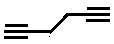
(10) hexa-2,4-diyne or 2,4-hexadiyne,
H3C-C≡C-C≡C-CH3,
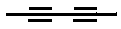
A completely linear molecule.
(11) 3-methylpenta-1,4-diyne or 3-methyl-1,5-pentadiyne,
H-C≡C-CH(CH3)-C≡C-H,

A branched alkyne.
These are all well characterised on the internet.
Combined alkene and
alkyne molecules (ene-yne)
Open chain aliphatic compounds
with C=C and C≡C
double and triple bonds
(12) hexa-1,2-diene-5-yne
or 1,2-hexadiene-5-yne,
H2C=C=CH-CH2-C≡CH,
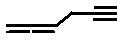
(13) hexa-1,3-diene-5-yne
or
1,3-hexadiene-5-yne,
H2C=CH-CH=CH-C≡CH
 skeletal formulae of the E/Z geometrical isomers
Also
spelt as:
hexa-1,3-dien-5-yne, 1,3-hexadien-5-yne
(3E)-hexa-1,3-diene-5-yne
and
(3Z)-hexa-1,3-diene-5-yne
(3E)-hexa-1,3-dien-5-yne
and (3Z)-hexa-1,3-dien-5-yne
CIP assignment priority rule for
E/Z isomers:
6C >
1H
(14) hexa-1,5-diene-3-yne
or
1,5-hexadiene-3-yne,
H2C=CH-C≡C-CH=CH2,
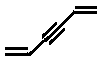
also spelt as:
hexa-1,5-dien-3-yne, 1,5-hexadien-3-yne
Alkenes
(tetra-enes),
open chain aliphatic compounds with multiple C=C double bonds
(15) hexa-1,2,4,5-tetraene
or
1,2,4,5-hexatetraene,
H2C=C=CH-CH=C=CH2,
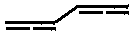
This is well characterised on the internet.

3 other named structures mentioned in the extra
notes.
Dewar benzene (triene), prismane and benzvalene.
Gopalpur Nagendrappa of Bangalore University, India has come up
with 217 theoretical isomers of C6H6 at
https://www.ias.ac.in/article/fulltext/reso/006/05/0074-0078 wow !!!!
My favourite is the saturated 'tent' molecule of 6 CH units
joined together and no C=C or C≡C
bonds!
EXTRA NOTES -
little of this is of use to pre-university students
Exploring benzene's isomers
We have benzene
itself, along with its constitutional isomers, like fulvene, Dewar
benzene, prismane, and benzvalene. I recall five main ones: benzene,
fulvene, Dewar benzene, prismane, and benzvalene. It seems there are
theoretical 12, but common ones are five.
These isomers differ in their
stability and reactivity.
For example, benzene is stable and undergoes
electrophilic substitution, while others like fulvene are more reactive.
Benzene is widely used as feedstock, while the others are mostly
interesting for research or special applications.
Representative constitutional isomers
of C6H6
- Benzene (aromatic, planar hexagon with
delocalised π system)
- Fulvene (cross‑conjugated pentadienylidene
structure: a five‑membered ring with an exocyclic =CH2 group in its
parent form)
- Dewar benzene (bicyclic bridged structure; a
valence isomer of benzene)
- Prismane (polycyclic cage isomer; highly
strained)
- Benzvalene (tricyclic, highly strained valence
isomer)
These five are the principal, widely referenced constitutional
(valence) isomers of formula C6H6 used in teaching and literature; many
others can be drawn theoretically, but the five above are the standard
examples contrasted with aromatic benzene.
Types of isomerism exhibited and
explanation
- Constitutional (structural) isomerism:
different connectivities of the six carbons and six hydrogens
produce distinct molecules (benzene versus fulvene versus Dewar benzene
etc.).
- Valence isomerism: special case of
constitutional isomerism where isomers interconvert by
reorganisation of π bonds and σ framework (e.g., benzene ↔ Dewar
benzene ↔ benzvalene interconversions under photochemical or thermal
conditions).
- Resonance/aromaticity (conceptual isomerism):
benzene is stabilised by delocalised π electrons (aromatic) whereas
the other isomers are non‑aromatic or antiaromatic in local
fragments; this is not a separate constitutional class but a key
electronic distinction that explains reactivity and properties.
- (Limited) stereoisomerism: most C6H6
constitutional isomers lack stereogenic centres; however, some
constrained valence isomers can display stereochemical relationships
in derivatives or intermediates (not a major feature for the parent
C6H6 set).
- Tautomers/rapid interconversion: certain
substituted analogues show tautomeric behaviour; for the parent
hydrocarbons interconversion is usually valence rearrangement rather
than prototropic tautomerism.
Why these isomers differ fundamentally
(structure → electronic effect)
- Delocalisation versus localisation of π electrons:
benzene’s fully delocalised 6π system gives a large aromatic
stabilization energy; valence isomers localise π bonds and introduce
ring strain or angle strain.
- Ring strain and angle distortion: prismane and
benzvalene contain severe bond‑angle and steric strain, raising
internal energy and making them reactive and often unstable.
- Conjugation patterns: fulvene is
cross‑conjugated and has very different HOMO/LUMO characteristics
compared with benzene, altering reactivity
(nucleophilicity/electrophilicity at specific carbons).
Differences in physical properties
- Stability and enthalpy: benzene is the
lowest‑enthalpy, most thermodynamically stable isomer because of
aromaticity; valence isomers (Dewar, prismane, benzvalene) are
higher in energy and often exist only at low temperature or as
transient species.
- Boiling/melting points: benzene is a stable
liquid at room temperature with well‑defined melting/boiling points;
the unstable valence isomers are typically solids or isolable only
under special conditions and show widely different melting points
due to shape and packing.
- Spectroscopy signatures: benzene shows
characteristic aromatic IR/C‑H stretches and a distinct 1H NMR
pattern (singlet for equivalent aromatic protons under idealised
symmetry). Other isomers give very different IR and NMR spectra
(non‑aromatic chemical shifts, multiple non‑equivalent protons,
large upfield/downfield shifts for exocyclic protons).
- Colour and photophysical properties: many
non‑aromatic isomers are more coloured or photoreactive because of
different π‑conjugation and allowed transitions.
Differences in chemical reactions and
relative reactivity
- Benzene (aromatic)
- Reactivity: reluctant to undergo addition across the ring;
favours electrophilic aromatic substitution (nitration,
sulfonation, halogenation with catalyst), radical substitution
(requires harsh conditions) and metal‑mediated substitutions.
- Reasons: aromatic stabilization energy disfavours loss of
aromaticity; reactions proceed by conserving aromaticity
(substitution) or by high‑energy conditions for addition.
- Uses: key petrochemical feedstock; precursor to phenyl
derivatives, polymers, dyes, and pharmaceuticals (industrially
important despite toxicity concerns).
- Fulvene (cross‑conjugated)
- Reactivity: much more reactive than benzene toward addition
and nucleophilic or electrophilic attack at defined positions;
can act as a ligand in organometallic chemistry and as a
diene/dienophile in pericyclic reactions.
- Reasons: loss of aromatic stabilization and
cross‑conjugation produce high HOMO/LUMO reactivity.
- Dewar benzene
- Reactivity: can rearrange thermally or photochemically to
benzene; undergoes addition reactions more readily than benzene;
often used conceptually in reaction mechanisms as a high‑energy
intermediate.
- Reasons: strained two‑bridge structure with localized bonds
that are susceptible to opening.
- Prismane and benzvalene
- Reactivity: highly strained; prone to ring opening,
polymerisation or rearrangement to benzene under appropriate
conditions; prismane derivatives can be energetic and reactive
in radical processes.
- Reasons: angle strain and destabilised σ/π frameworks make
C–C bonds easier to break or reorganise.
Relative reactivity ranking (general): prismane ≈ benzvalene >
fulvene > Dewar benzene > benzene (benzene least reactive toward
addition; non‑aromatic isomers far more reactive).
Uses and applications of the isomers
- Benzene: large‑scale industrial use as
feedstock for phenol, aniline, styrene, cyclohexane; solvent and
starting material for many syntheses (use limited by toxicity and
regulation).
- Fulvene: mostly a research reagent and useful
synthon in organic synthesis and organometallic ligand design; used
to illustrate cross‑conjugation reactivity in advanced courses.
- Dewar benzene, prismane, benzvalene: largely
academic/experimental interest; used as case studies of valence
isomerism, strain, and photochemistry; some derivatives explored for
energetic materials or exotic ligand scaffolds but commercial
applications are limited because of instability.
- Practical teaching point: except for benzene,
most C6H6 constitutional isomers are not bulk industrial chemicals;
their chief value is mechanistic, theoretical and synthetic
methodology examples.
Student misconceptions to correct
- “All C6H6 structures are equivalent to benzene” — wrong: many
constitutional isomers exist and differ dramatically in stability
and reactivity.
- “If two structures have same formula they must behave the same
chemically” — false; connectivity (aromaticity, conjugation, strain)
dominates behaviour.
- “Aromatic compounds always undergo addition reactions” — false;
aromatic systems favour substitution to preserve delocalisation.
- “Valence isomers are simply resonance forms” — false; resonance
structures are not isolable; valence isomers are true, separate
molecules with different bonding and energy.
- “High reactivity always means useful industrial reagent” —
false; extreme reactivity/instability often makes isolation or safe
industrial use impractical.
Exam revision tips (A level, IB, AP
level, pre‑university advanced courses)
- Learn and be able to draw the common C6H6 isomers (benzene,
fulvene, Dewar benzene, prismane, benzvalene) and explain why
benzene is uniquely stable (Hückel’s rule, 6π electrons, planarity,
equal bond lengths).
- Always link observations to fundamental principles: aromatic
stabilization, conjugation, ring strain, and HOMO/LUMO
considerations.
- For reactivity questions state whether a reaction conserves or
destroys aromaticity; explain mechanism choice (electrophilic
aromatic substitution versus addition) in one clear sentence.
- Use spectral clues: aromatic 1H NMR chemical shift ~7–8 ppm
(often a singlet for benzene); non‑aromatic isomers give diverse
shifts—mention this when asked to predict or interpret spectra.
- In comparison answers use a short table: property → observation
→ structural reason. Keep each line tightly reasoned.
- Expect tasks asking to predict stability, give likely products
after photochemical rearrangement, or sketch mechanistic routes for
valence isomer interconversion—practice concise mechanism sketches
and energy‑profile descriptions.
- Practice describing why certain isomers are isolable and others
are transient: state energy and kinetic versus thermodynamic control
succinctly.
Learning objectives - questions to be answered?
How do you work out the structure
of the isomers of molecular formula C6H6?
How do you draw the structural
formula and skeletal formula of the isomers of molecular formula
C6H6?
How do you name the isomers of molecular formula
C6H6?
How many aliphatic structural
isomers are there of molecular formula C6H6?
How many aliphatic carbon chain
isomers are there of molecular formula C6H6?
How many positional isomers are
there of molecular formula C6H6?
Are there any aliphatic open chain
alkene isomers of molecular formula C6H6?
Are there any alkene isomers of molecular formula
C6H6?
Are there any functional group
isomers with a molecular formula C6H6?
Does C6H6 have any stereoisomers?
Are there any E/Z (geometrical)
isomers with a molecular formula C6H6?
Are there any R/S (optical) isomers
(enantiomers) with a molecular formula C6H6?
How many E/Z (geometrical) isomers
are there of molecular formula C6H6?
How many R/S (optical) isomers
(enantiomers) of molecular formula C6H6?
This page will answer these questions
for molecular formula C6H6
Associated organic chemistry links
Index of sets of isomers for a given
molecular formula
All my advanced Level pre-university
organic chemistry notes
IR, mass and H-1 and C-13 NMR
spectra of organic compounds
The molecular structure and
naming of ALKANES (how
to name and draw alkane structures)
The molecular structure and naming
of ALKENES
(how to name and draw alkene structures)
Index of revision notes
on the chemistry of ALKANES and the petrochemical
industry
INDEX of
ALL revision notes on the chemistry ALKENES
including reactions and polymers
Isomerism: introduction, structural isomerism - chain,
positional, functional group, tautomerism
Stereoisomerism:
introduction, definition,
priority rules, E/Z isomerism (cis/trans isomerism)
Stereoisomerism - R/S isomerism (optical
isomerism) -
definition - examples explained
This is a big chemistry website, please allow time
to explore it

|
Website content © Dr
Phil Brown 2000+. All copyrights reserved on revision notes, images,
quizzes, worksheets etc. Copying of Doc Brown's pre-university
advanced level chemistry website material is NOT
permitted. Exam revision summaries & references to science course specifications
are unofficial. These organic chemistry revision notes on
isomerism are
suitable for use of pre-university students studying AQA advanced level
chemistry constitutional isomers of C6H6, Edexcel advanced level
chemistry constitutional isomers of C6H6, OCR advanced level
chemistry constitutional isomers of C6H6, IB advanced level chemistry
constitutional isomers of C6H6, WJEC (Eduqas) advanced level
chemistry constitutional isomers of C6H6, CIE Cambridge advanced level chemistry
constitutional isomers of C6H6, US grade 11-12 AP honors
chemistry courses constitutional isomers of C6H6 and they will also prove useful to
1st year undergraduate students of chemistry including
constitutional isomers of C6H6. |
Keywords or phrases: how many isomers are
there of molecular formula C6H6? how do you name the isomers of
molecular formula C6H6? what is the molecular structure of the
isomers of C6H6, what type of isomerism is exhibited by molecules
of formula C6H6, how do you work out the isomers of cycloalkenes
and alkynes of molecular
formula C6H6, what are the structural isomers of C6H6, the carbon chain
isomers of C6H6 in the homologous series of alkanes, comparing
the spectra of isomers of molecular formula C6H6 how many structural isomers of
C6H6 can you draw? how many structural isomers does C6H6 have?
what are the possible isomers of C6H6? revision notes on
isomerism of C6H6 molecules, isomerism in
alkane, alkene and alkyne
isomers of C6H6, alkyne isomers of C6H6, the molecular structure of
the isomers of C6H6 how to draw the
structural formula of isomers of C6H6, how to draw the displayed
formula of isomers of C6H6, how to draw the skeletal formula of
isomers of C6H6 cycloalkenes and alkynes, how to name the isomers of molecular formula
C6H6,
isomers of C6H6 of molecular mass ? R/S optical isomers
enantiomers of C6H6 cycloalkenes and alkynes E/Z isomers cis
trans stereoisomers of C6H6
E/Z isomers of molecular formula C6H6 (geometric cis/trans
isomers) alkene molecules isomeric of molecular formula C6H6,
molecules isomeric with molecular formula C6H6, structural isomers of molecular
formula C6H6, optical isomers R/S enantiomers isomeric with molecular
formula C6H6, positional isomers isomeric with cycloalkenes and
alkynes of molecular formula C6H6,
which types of isomerism are exhibited by molecules isomeric with
molecular formula C6H6 alkyl positional isomers of C6H6 branched
carbon chain alkene isomers of C6H6 cycloalkanes of molecular formula
C6H6 which are isomeric with alkenes of molecular formula C6H6
stereoisomers of molecular formula C6H6
cycloalkene molecules isomeric of molecular formula C6H6,
cycloalkenes and alkynes molecules isomeric with molecular formula
C6H6, structural isomers of molecular
formula C6H6, optical isomers R/S enantiomers isomeric with molecular
formula C6H6, positional isomers isomeric with molecular formula
C6H6,
which types of isomerism are exhibited by molecules isomeric with
molecular formula C6H6 alkyl positional isomers of C6H6 cycloalkenes
and alkynes branched carbon chain cycloalkene isomers of
molecular formula C6H6
cyclic alkanes of formula
C6H6 E/Z isomers of molecular formula C6H6 (geometric cis/trans
isomers) alkene molecules isomeric of molecular formula C6H6,
molecules isomeric with molecular formula C6H6, structural isomers of molecular
formula C6H6, optical isomers R/S enantiomers isomeric with molecular
formula C6H6, positional isomers isomeric with molecular formula
C6H6,
alicyclic alkanes of formula C6H6 which types of isomerism are exhibited by molecules isomeric with
molecular formula C6H6 alkyl positional isomers of C6H6 branched
carbon chain alkene isomers of C6H6 cycloalkanes of molecular formula
C6H6 which are isomeric with alkenes of molecular formula C6H6
stereoisomers of molecular formula C6H6 cycloalkane functional group
isomers of C6H6 are there alkyne isomers of C6H6? are there
cycloalkanes of formula C6H6? are there cycloalkenes of formula
C6H6 chain isomers of C6H6 functional group isomers of C6H6
substituent and functional group positional isomers of C6H6
|
