|
Part 7.12
The chemistry of
AROMATIC COMPOUNDS - structure,
properties and uses of aromatic polyesters and polyamides
[Author
© Dr
Phil Brown PhD: Doc
Brown's exam revision notes suitable
for A level chemistry students of advanced pre-university/college advanced level organic chemistry courses:
aromatic
chemistry revision notes on polyesters and polyamides
[aromatic page updated Mar 7th 2026 *]
email doc
brown - comments - query?
*
[privacy, cookies and disclaimer]
All my advanced level
aromatic chemistry notes
All my advanced A level organic
chemistry notes
Part 7.12 The
structure, properties and uses of
polyesters and polyamides involving aromatic monomers - including
high performance polymers
Sub-index for this page
7.12.1
PET and Terylene
7.12.2
The high performance
polymer Kevlar
7.12.3
The high performance
polymer Nomex
|
All My synthetic
polymer-plastics revision notes pages
Introduction to addition polymers: poly(ethene), poly(propene), polystyrene, PVC,
PTFE - structure, uses
More on the
uses of plastics, issues with using plastics, solutions and recycling
methods
Introducing condensation polymers: Nylon, Terylene/PET,
comparing thermoplastics, fibres, thermosets
Extra
notes for more advanced level organic chemistry students
Polymerisation of alkenes to addition polymers - structure, properties, uses of
poly(alkene) polymers
The manufacture, molecular structure, properties and uses of
polyesters
Amides
chemistry - a mention of
polyamides
The structure, properties and uses of
polyesters and polyamides involving aromatic monomers
The
chemistry of amides including Nylon formation, structure, properties and uses
Stereoregular polymers -
isotactic/atactic/syndiotactic poly(propene) - use of Ziegler-Natta
catalysts
and note that
polypeptides are also polyamides
|
7.12.1
The
formation, molecular structure and uses of the polyester PET/Terylene
PET is the acronym for
Poly Ethylene Terephthalate, and it has the same molecular structure
as Terylene!
Terylene (a polyester)
is
good for making 'artificial' or 'man-made' fibres
used in the clothing
industry.
 benzene-1,4-dicarboxylic acid,
(terephthalic acid) a carboxylic acid functional group at each end of
the molecule
benzene-1,4-dicarboxylic acid,
(terephthalic acid) a carboxylic acid functional group at each end of
the molecule
Ethane-1,2-diol
(ethylene glycol),
 two primary
alcohol groups, one at each end of the molecule; two primary
alcohol groups, one at each end of the molecule;
benzene-1,4-dicarboxylic acid forms a
condensation polymer with ethane-1,2-diol, the polyester Terylene and
the eliminated molecule is water
H2O, 1st diagram below, and the 4th diagram shows
several of the linked ester units.
You can carry out the reaction with a different
aromatic acid derivative to make PET/Terylene e.g. using ...
the diacid chloride of benzene-1,4-dicarboxylic
acid and the eliminated molecule is hydrogen chloride (HCl).
the dimethyl ester of benzene-1,4-dicarboxylic
acid and the eliminated molecule is methanol (CH3OH)l.
(see the two middle diagrams below)


More advanced displayed formula
representations of Terylene/PET and its formation
 The plastic PET is the same as
Terylene! The plastic PET is the same as
Terylene!
The acronym
PET stands for
Polyethylene
terephthalate.
When used in clothing
fibres, it is called Terylene, but when used in bottles, it is called
PET !!
PET is a clear, strong and
lightweight plastic belonging to the polyester family.
It is typically called "polyester"
e.g. the brand Terylene when used for fibres or fabrics, and "PET" or
"PET Resin" when used for bottles, jars, containers and packaging
applications - but they have the same molecular structure - its just how
its processed into a particular product.
PET
is a thermoplastic, softens on heating, that can be extruded into different shapes,
particularly for water and fizzy drinks. The bottle keeps the dissolved carbon
dioxide from escaping and it is shatterproof if dropped on the floor - so its
quite a tough plastic.
PET is the world's packaging
choice for many foods and beverages because it is hygienic, strong,
lightweight, shatterproof, and retains freshness.
PET is most commonly used to
package carbonated soft drinks and water.
The most common use of polyester today
is called PET (for short!) and is used to make the plastic
bottles for storing liquids in like soft drinks. PET is very useful
because it is transparent, shatterproof and cheap!
Terylene
polyester is a typical synthetic fibres which have, in many cases,
replaced cotton, silk and wool fabrics in the clothing industry.
Fine polyester fibres can be
made into a variety of articles of clothing which are lighter and
cheaper than traditional materials like wool.
Shirts, sheets, socks and trousers are manufactured
from a mix of a polyester and a natural fibre such as cotton and wool.
The polyester gives fabric strength and creases
resistance and the natural fibre gives the material a softer more natural
feel and also allows the material to absorb some perspiration from the
wearer - remember plastic materials are usually hydrophobic - water
repellent.

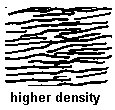
The manufacturing process of
drawing out fibres makes them stronger
In the manufacturing process the polymer chains are made to
line up by drawing out the polymer into a fine fibre.
Increasing the polymer chain alignment greatly increases the intermolecular forces between the
'aligned' polymer molecules and strong fibre strands of the
plastic can be made - the process increases the surface - surface
contact, so increasing the instantaneous dipole - induced dipole forces
and the permanent dipole - permanent dipole forces.
Terylene fibres are cheap to make on an industrial
scale compared to cotton from fields, silk from silkworms and wool from
sheep.
As well as being cheaper, the physical
properties of synthetic fibres have several advantages compared to their
natural predecessors like cotton, silk and wool.
Compared to natural fibres, synthetic
fibres tend to be ....
lighter - outdoor or indoor clothing,
more durable - harder tougher wearing
fibres,
water-resistant - better water-proofed
fabrics,
Polyester fibres are good thermal insulators - trap air
e.g. the stuffing in duvets.
However, there are some disadvantages
e.g.
they are not very breathable and sweat
builds up making you feel uncomfortable.
The use of 'breathable' fabrics like
GORE-TEX are described and discussed on the
smart materials page 6. Gore-Tex and
thinsulate etc.
Stability to hydrolysis
Since the monomer linkage is an
ester, its not unreasonable to consider the possibility that
PET/Terylene might degrade in the environment by hydrolysis.
Fortunately, the ester linkage in
polyesters is quite stable and no such degradation takes place with
water and very slowly in contact with acids.
(i)
However, if you reflux fragmented bits of PET/Terylene (to increase the
surface area) for long enough in aqueous sodium hydroxide solution, they will
eventually dissolve to form a solution of ethane-1,2-diol (one of the
monomers) and the disodium salt of benzene-1,4-dicarboxylic acid,
disodium benzene-1,4-dicarboxylate (the salt of the other monomer material).
(ii) If you add excess dilute
hydrochloric acid to the mixture, a white precipitate of
benzene-1,4-dicarboxylic acid forms.
C6H4
represents the benzene ring structure in these simple structural
formula equations.
State symbols are omitted for
simplification: PET and the acid (s) and everything else is (aq).
(i)
-(-CH2-CH2-OOC-C6H4-COO-)n-
+ 2n NaOH ===> n HO-CH2-CH2-OH + n Na+-OOCC4H4COO-Na+
-(-CH2-CH2-OOC-C6H4-COO-)n-
+ 2n OH- ===> n HO-CH2-CH2-OH + n
-OOCC4H4COO-
(ii)
Na+-OOCC4H4COO-Na+
+ 2HCl ===>
HOOCC4H4COOH
+ 2NaCl
-OOCC4H4COO-
+ 2H+ ===>
HOOCC4H4COOH
Therefore it is unwise to store
acidic, and especially alkaline, chemicals in PET containers and
Terylene clothing should not come into contact with acids or alkalis.
TOP OF PAGE and
sub-index
7.12.2
High performance polymers - KEVLAR
Kevlar is an aramid, a polyamide in which the amide
links (HN-CO-) are directly attached to benzene rings.
These are polymer materials that
are extremely strong, chemically very inert and thermally very stable at higher temperatures where
other polymers might melt or degrade-decompose.
Both Kevlar and Nomex are stable to hydrolysis and unlike
Nylons, they are not attacked by aqueous acids or alkalis.

KEVLAR is the trade name for an aramid (aromatic
amide) polymer fibre.
These aramid polymeric
molecules contain the -NH-CO- linkage between benzene rings.

The diagram above shows the condensation polymerisation
equation for the manufacture of KEVLAR.
Both monomer molecules have their substituent groups in
the 1,4 orientation.
Its actually the same secondary
amide linkage you get in protein (peptide linkage) and nylon molecules!
The polymer molecule chain in Kevlar is a little more
'linear' than Nomex (7.12.3)
which means the molecules can pack more closely together increasing the
intermolecular force between them.

The equations for the formation of Kevlar are repeated in
structural formula style and with the repeating unit shown.
You need to be able to work out the structural formula
of the original monomers i.e. the original aromatic dicarboxylic acid or
its dichloride and the aromatic diamine.
You also need to be able to point out the link formed on
condensation i.e. the HN-CO- linkage.
The properties and uses of Kevlar fibres
Kevlar fibres are made by
spinning liquid crystal aramid oligomers (oligomers are molecules consisting
of a few monomers linked together - but much shorter than a polymer!).
Kevlar is a very strong artificial fibre
that can be
woven into materials that are very light and strong.
It is used to make flexible body armour, i.e. it is a
polymer designed for 'heavy duty' use including bulletproof vests!
Kevlar is used to make aircraft parts (low density -
light and strong), reinforce tyres.
It is used in the manufacture of brake linings and
cables.
It
is strong and tough because its molecules are held together in sheets by
strong chemical bonds and strong intermolecular forces - see diagrams below.
A
more detailed look at the polymer structure of Kevlar and why it is so
strong
The longer polymer chains are held together by strong
C-C and C-N covalent bonds, but there are no cross-linking covalent
bonds.
However, the intermolecular forces
between the long Kevlar molecules within each sheet include hydrogen bonds, formed
by the strong directional interaction of the two permanently polar bonds
δ-N-Hδ+
and δ+C=Oδ-,
i.e.
δ-N-Hδ+llllδ-O=Cδ+
(see diagram further down).
The highly polar bonds, and hence
the hydrogen bonding, is due to the significant difference in
electronegativity between nitrogen and hydrogen, AND, carbon and oxygen.
The hydrogen bonding supplements the instantaneous
dipole - induced dipole intermolecular attractive forces, so the
long polyamide molecules are strongly held together within each
sheet (several diagrams below show this).
The sheets of molecules are
themselves held together by strong intermolecular forces (instantaneous
dipole - induced dipole attractive forces) and the 'molecular
sheets' can be aligned to maximise theses forces and the combined strength
of many such sheets gives Kevlar fibres their great strength.

Along the polymer 'backbone' is
a chain of strong of -N-C-C-C-C-N- bonds continuously repeated for hundreds
or thousands of units which produces a strong rigid linear molecule.
Between adjacent aramid
molecules there are regular points where an intermolecular hydrogen bonding force can operate.
This extra bonding force
holds the aramid molecules together in strong 'molecular' sheets.

The sheets are held together in
Kevlar fibres by the 'random' but 'continuous' intermolecular forces between
adjacent layers of molecules, that is the instantaneous dipole - induced dipole
Van der Waals attractive forces, but with the added effects of permanent
dipole - permanent dipole hydrogen bonds.

7.12.3 The high performance
polymer Nomex
Nomex is an aramid, a polyamide in which the amide
links (HN-CO-) are directly attached to benzene rings.
Nomex is another polymer material that
is extremely strong, chemically very inert and thermally very stable at higher temperatures where
other polymers might melt or degrade-decompose.
Both Kevlar and Nomex are stable to hydrolysis and unlike
Nylons, they are not attacked by aqueous acids or alkalis.
Nomex has very good flame resistant properties.
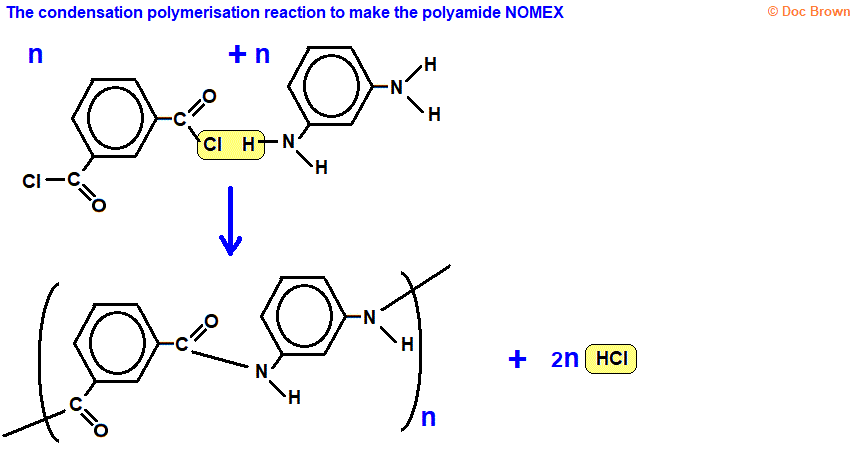
The diagram above shows the condensation polymerisation
equation for the manufacture of NOMEX.
Both monomer molecules have their substituent groups in
the 1,3 orientation.
The polymer molecule chain in Nomex is less 'linear'
than Kevlar (7.12.3)
which means the molecules can't pack as closely together decreasing the
intermolecular force between them compared to Kevlar.
Website content © Dr
Phil Brown 2000+. All copyrights reserved on Doc Brown's Chemistry revision notes, images,
quizzes, worksheets etc. Copying of website material is NOT
permitted. Doc Brown's chemistry of aromatic compounds exam revision notes,
Website content © Dr Phil Brown 2000+. All
copyrights reserved on revision notes, images, quizzes, worksheets etc. Copying
of website material is NOT permitted. Exam revision summaries & references to
science course specifications are unofficial.
Website content © Dr Phil Brown 2000+. All
copyrights reserved on these organic chemistry exam revision
notes on structure, manufacture, properties & uses of PET & Terylene polymers, these A level chemistry revision notes are suitable for use of pre-university students studying AQA advanced level
organic chemistry revision notes on structure, manufacture,
properties & uses of PET & Terylene polymers, Edexcel advanced level
organic chemistry revision notes on structure, manufacture,
properties & uses of PET & Terylene polymers, OCR advanced level
organic chemistry revision notes on structure, manufacture,
properties & uses of PET & Terylene polymers, IB advanced level
organic chemistry revision notes on structure, manufacture,
properties & uses of PET & Terylene polymers, WJEC (Eduqas) advanced level
organic chemistry revision notes on structure, manufacture,
properties & uses of PET & Terylene polymers, CIE Cambridge advanced level
organic chemistry revision notes on structure, manufacture,
properties & uses of PET & Terylene polymers, CCEA advanced level
organic chemistry revision notes on structure, manufacture,
properties & uses of PET & Terylene polymers, and useful for
US grade 11 grade 12 AP honors organic chemistry courses
involving structure, manufacture, properties & uses of PET &
Terylene polymers,
Explaining the importance of
structure, manufacture, properties & uses of Kevlar polymer
in organic chemistry, What you need to know about structure,
manufacture, properties & uses of Kevlar polymer for organic
chemistry,
Explaining the use of structure, manufacture, properties & uses of
Kevlar polymer knowledge in organic chemistry, Examples of
structure, manufacture, properties & uses of Kevlar polymer explained
when studying organic chemistry, What is
the significance of structure, manufacture, properties & uses of Kevlar
polymer in organic chemistry, What is the use of structure,
manufacture, properties & uses of Kevlar polymer
in organic chemistry Describing and
explaining the theory of structure, manufacture, properties & uses of
Kevlar polymer when studying organic chemistry, exam revision
notes for structure, manufacture, properties & uses of Kevlar polymer in exams, online help for
structure, manufacture, properties & uses of Kevlar polymer, revision notes for
structure, manufacture, properties & uses of Kevlar polymer,
what do I need to learn for structure, manufacture, properties & uses of
Kevlar polymer in exams? revision summary for structure,
manufacture, properties & uses of Kevlar polymer, help in
teaching structure, manufacture, properties & uses of Kevlar polymer, learning notes for
structure, manufacture, properties & uses of Kevlar polymer, help to pass the
structure, manufacture, properties & uses of Kevlar polymer exam, how to
prepare for examination questions on structure, manufacture, properties
& uses of Kevlar polymer? Explaining the importance of
structure, manufacture, properties & uses of Nomex polymer
in organic chemistry, What you need to know about structure,
manufacture, properties & uses of Nomex polymer for organic
chemistry,
Explaining the use of structure, manufacture, properties & uses of Nomex
polymer knowledge in organic chemistry, Examples of
structure, manufacture, properties & uses of Nomex polymer explained
when studying organic chemistry, What is
the significance of structure, manufacture, properties & uses of Nomex
polymer in organic chemistry, What is the use of structure,
manufacture, properties & uses of Nomex polymer
in organic chemistry Describing and
explaining the theory of structure, manufacture, properties & uses of
Nomex polymer when studying organic chemistry, exam revision
notes for structure, manufacture, properties & uses of Nomex polymer in exams, online help for
structure, manufacture, properties & uses of Nomex polymer, revision notes for
structure, manufacture, properties & uses of Nomex polymer,
what do I need to learn for structure, manufacture, properties & uses of
Nomex polymer in exams? revision summary for structure,
manufacture, properties & uses of Nomex polymer, help in
teaching structure, manufacture, properties & uses of Nomex polymer, learning notes for
structure, manufacture, properties & uses of Nomex polymer, help to pass the
structure, manufacture, properties & uses of Nomex polymer exam, how to
prepare for examination questions on structure, manufacture, properties
& uses of Nomex polymer?
[SEARCH
BOX]
All my advanced level
aromatic chemistry revision notes
All my advanced A level organic
chemistry notes |
|
