SEARCH website * HOME PAGE * UK KS3 Science Quizzes (for students aged ~11-14)

For UK GCSE level (age ~14-16) BiologyChemistryPhysics * Advanced Chemistry (~16-19)

8. Hydrochloric acid titration determination of the concentration of calcium hydroxide in limewater or a magnesium hydroxide solution (both are slightly soluble alkali powders)

[Author © Dr Phil Brown GRIC, PhD: Doc Brown's chemistry exam revision notes on titrating magnesium/calcium hydroxide solutions  suitable for students of UK GCSE level and Advanced A-level chemistry courses, ~US grades 9-12 chemistry notes  [page updated RE-EDIT]

email doc brown: query? comment?  *  [privacy policy, cookies & disclaimer]

Titration index  *  Full chemistry calculations index

Quiz 12 The basics of acid-alkali titration calculations Good exam practice questions for GCSE level

8. Titration determination of the concentration of calcium hydroxide in limewater

A practical exercise for Advanced A level students

Calcium hydroxide is slightly soluble in water and the resulting solution is commonly known as 'limewater.

With this hydrochloric acid titration technique you can determine the maximum solubility of calcium hydroxide in water - a saturated solution called 'limewater'.

It is a relatively strong alkali and readily titrated with standardised hydrochloric acid using phenolphthalein indicator.

You can use the same procedure to determine the maximum solubility of magnesium hydroxide in water.

titrating magnesium hydroxide/calcium hydroxide limewater solution with standardised hydrochloric acid using phenolphthalein indicatorRequirements

  • how to use a calibrated pipette

  • A bottle of water shaken well for quite a few minutes with excess solid calcium hydroxide and left to stand so that the excess solid settles out.

    • It should be left to stand for too long, otherwise the solution absorbs the acidic gas carbon dioxide.

  • 50 cm3 burette (with 0.1 cm3 graduations on the scale)

  • 25.0 cm3 pipette (you can use a 10 cm3 pipette, but smaller and less accurate titration)

  • 250 cm3 conical flask and white tile

  • Squeezy wash bottle of deionised/distilled water.

  • Standardised 0.1 or 0.05 mol dm-3 (M for short) hydrochloric acid.

  • Phenolphthalein acid-base indicator solution (pink >pH 9, colourless <pH 9

Method-Procedure

  • Wear safety glasses, initially work below eye level and use a funnel to fill the burette.

  • Fill the burette with the standard acid solution of known concentration and level off so that the bottom of the meniscus rests on the 0.00 calibration mark.

  • Using a safe suction bulb, suck the calcium hydroxide solution until its a few cm above the calibration mark, then run it down until the meniscus rests on the calibration mark (diagram on right).

  • Pipette 25.0 cm3 of the clear liquid above the excess solid in the bottle of limewater into the conical flask.

  • Add a few drops of phenolphthalein indicator solution (it should turn pink - alkaline)

  • Place the conical flask on the white tile under the burette tip.

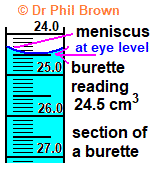
  • how to use a burette how to read the scale on a burette line under meniscusCarefully titrate the limewater until ONE drop of the hydrochloric acid removes the last of the pink colour (the end-point is pink to colourless).

  • Take the reading of the burette scale - the line on which the meniscus rests (right diagram).

  • Repeat the procedure at least twice to obtain good concordance of titration results.

  • Your results should be over a maximum of 0.2 cm3 and +/- 0.1 cm3 range would be very good.

  • In doing subsequent titrations you do not have to keep on

Typical Results and Calculations

('borrowed' Q19 from one of my volumetric titration calculation pages)

The solubility of calcium hydroxide in water can be measured reasonably accurately to 3sf by titrating the saturated solution with standard hydrochloric acid.

In the calculation below assume the molarity of the standardised hydrochloric acid is 0.1005 mol dm-3.

At 25oC, a few grams of solid calcium hydroxide was shaken with about 400 cm3 of deionised water, and then filtered.

  1st 2nd 3rd 4th 5th -
2nd burette reading/cm3           average
1st burette reading/cm3           titration
titration value/cm3            
titration value used in average           -

50.0 cm3 samples of the 'limewater' gave an average titration of 15.22 cm3 of 0.1005 mol dm-3 hydrochloric acid using phenolphthalein indicator.

(a) The equation for calcium hydroxide reacting with hydrochloric acid.

Ca(OH)2(aq) + 2HCl(aq) ==> CaCl2(aq) + 2H2O(l)

(b) The reacting mole ratio of Ca(OH)2 : HCl and hence calculate the moles of them involved in the titration.

from equation, mole ratio Ca(OH)2 : HCl is 1:2

and since moles solute = molarity x volume in dm3   (dm3 = cm3/1000)

mol HCl used in titration = 0.1005 x 15.22/1000 = 0.001530 mol HCl

therefore mol Ca(OH)2 = 0.001558/2 = 0.000765 mol Ca(OH)2

(c) Calculate the molarity of the solution in terms of mol Ca(OH)2 dm-3.

Scaling up from mol Ca(OH)2 in 50 cm3 to 1 dm3 (1000 cm3)

molarity Ca(OH)2 = 0.00765 x 1000/50 = 0.1558 = 0.153 mol dm-3 (to 3sf)

(d) What is the approximate solubility of calcium hydroxide in g Ca(OH)2 per 100g water?

Mr[Ca(OH)2] =74, mass = moles x formula mass

so solubility in g dm-3 = 0.153 x 74 = 1.13 g dm-3 (3 sf)

(If needed in another question, this is equal to 1.13/1000 = 1.13 x 10⁻³ g/cm3 water)

Since density of water is ~1.0 g cm-3, so the solubility per 100g is 1/10th of the solubility per dm3,

solubility of Ca(OH)2 is about 0.113 g/100 g H2O

There is also a section on errors and reasons for repeating a titration several times.


10. Quiz Chemical, calculations QUIZ 12 on the basics of acid-alkali titrations Good practice questions for GCSE level students

  • Titration Calculation Example 12.7
    • A titration to determine the solubility of calcium hydroxide in water.
    • Approximately 250 cm3 of water was shaken with solid calcium hydroxide (slaked lime) until no more appeared to dissolve and the solution filtered to remove any excess undissolved solid.
    • You now have a saturated solution known as limewater.
    • 25.00 cm3 of the filtered calcium hydroxide solution (limewater) was pipetted into a conical flask and titrated with standard hydrochloric solution (0.100 mol/dm3) using phenolphthalein indicator until the pink colour just disappeared (the end-point). The experiment was repeated several times giving an average HCl titration of 10.0 cm3.
    • Calculate the concentration of the calcium hydroxide in mol/dm3 and g/dm3.
    • The equation for the titration is: Ca(OH)2 + 2HCl ==> CaCl2 + 2H2O
      • This is read as 1 mol  +  2 mol  reactants  ===> 1 mol  +  2 mol  products
    • moles = molarity x volume (dm3)
    • mol HCl in titration = 0.10 x 10.0/1000 = 0.0010
    • Therefore from the equation: mol Ca(OH)2 = mol HCl/2 = 0.0005
    • Molarity of Ca(OH)2 = moles/volume = 0.0005 / (25.00/1000) = 0.0005 / 0.025 = 0.02 mol/dm3
    • concentration g/dm3 = molarity x formula mass
    • Atomic masses: Ca = 40, O = 16, H = 1, Mr[CaOH)2] = 74
    • Concentration of Ca(OH)2 = 0.02 x 74 = 1.48 g/dm3

Practise exam questions on acid-alkali titrations for Advanced A-level chemistry students

(From my original A-level acid-alkali titration questions SET 1 and SET 2)

After each question there is a link to the fully worked out answers.


Q4 100 cm3 of a dilute magnesium hydroxide solution required 4.5 cm3 of sulphuric acid (of concentration 0.100 mol dm-3) for complete neutralisation. [atomic masses: Mg = 24.3, O = 16, H = 1)

Magnesium hydroxide is only slightly soluble in water, hence the large volume to titrate.

(a) give the equation for the neutralisation reaction.

(b) calculate the moles of sulphuric acid neutralised.

(c) calculate the moles of magnesium hydroxide neutralised.

(d) calculate the concentration of the magnesium hydroxide in mol dm-3 (molarity).

(e) calculate the concentration of the magnesium hydroxide in g cm-3.

ANSWERS to Q4 SET 1. questions


Q21 Analysis of limewater.  25.0 cm3 aliquots of a calcium hydroxide solution were titrated with 0.100 mol dm-3 (0.100M) hydrochloric acid using phenolphthalein indicator. On average it took 10.50 cm3 of the acid to neutralise the limewater.

Calculate ...

(a) the molarity of the calcium hydroxide solution

(b) the concentration of calcium hydroxide in (i) g dm-3 and (ii) g/100 cm3

ANSWERS to Q21 SET 2. volumetric questions (non-redox)


Titration index  *  Full chemistry calculations index

Quiz 12 The basics of acid-alkali titration calculations Good exam practice questions for GCSE level


GCSE chemistry A-level chemistry revision notes on titrating magnesium/calcium hydroxide solutions KS4 GCSE Science revision notes on titrating magnesium/calcium hydroxide solutions GCSE chemistry guide notes on titrating magnesium/calcium hydroxide solutions for schools colleges academies science course tutors images pictures diagrams for titrating magnesium/calcium hydroxide solutions science chemistry revision notes on titrating magnesium/calcium hydroxide solutions for revising chemistry module topics notes to help on understanding of titrating magnesium/calcium hydroxide solutions, USA US grade 8 grade 9 grade10 AQA chemistry science GCSE notes on titrating magnesium/calcium hydroxide solutions Edexcel chemistry science notes on titrating magnesium/calcium hydroxide solutions for OCR 21st century chemistry science notes on titrating magnesium/calcium hydroxide solutions OCR GCSE Gateway science chemistry notes on titrating magnesium/calcium hydroxide solutions WJEC Eduqas gcse science chemistry notes on titrating magnesium/calcium hydroxide solutions CCEA/CEA gcse chemistry notes A-level chemistry notes for titrating magnesium/calcium hydroxide solutions A-level chemistry revision notes on titrating magnesium/calcium hydroxide solutions A-level chemistry notes should prove useful for the new AQA GCSE chemistry, Edexcel chemistry & OCR chemistry GCSE 9–1 science courses gcse chemistry revision free detailed notes on titrating magnesium/calcium hydroxide solutions to help revise A-level chemistry A-level chemistry revision notes on titrating magnesium/calcium hydroxide solutions A-level chemistry revision free detailed notes on titrating magnesium/calcium hydroxide solutions to help revise gcse chemistry free online website to help revise titrating magnesium/calcium hydroxide solutions for gcse chemistry  free online website to help revise titrating magnesium/calcium hydroxide solutions for A-level chemistry free online website to help revise A-level titrating magnesium/calcium hydroxide solutions chemistry how to succeed in questions on titrating magnesium/calcium hydroxide solutions for gcse chemistry how to succeed at A-level chemistry how to succeed at A-level chemistry a good website for free questions on titrating magnesium/calcium hydroxide solutions to help to pass gcse chemistry questions on titrating magnesium/calcium hydroxide solutions a good website for free help to pass A-level chemistry with revision notes on titrating magnesium/calcium hydroxide solutions a good website for free help to pass A-level chemistry GCSE 9-1 chemistry courses

TOP OF PAGE