|

Introduction
There are many
brands of antacid indigestion medications on the market and
through the following experimental investigation you can
check out their value for money. There are various ways you
can approach the investigation e.g. you can compare tablet
with tablet in terms of the recommended dose as to which
neutralises the most acid. You can compare the cost of each
tablet with the amount of acid it neutralises.
Experimentally, the investigation involves
titrating an indigestion tablet (weighed) with standardised hydrochloric acid
(in the burette, to represent stomach acid) using methyl orange indicator
to observe when the tablet has been completely neutralised,
that point is known as the end-point of the titration.
The apparatus, chemicals and indicator colours are
illustrated in the diagram on the left and the
procedure described in five stages below.
Preparing the sample and titration
procedure
 Initially the burette
is clamped carefully in a vertical position and filled with
standard
hydrochloric acid of known concentration. A burette is a
long glass tube (open at the top), and accurately calibrated
for volume in cm3 an 1/10th
cm3 intervals, with a tap and tip at the lower
end. Initially the burette
is clamped carefully in a vertical position and filled with
standard
hydrochloric acid of known concentration. A burette is a
long glass tube (open at the top), and accurately calibrated
for volume in cm3 an 1/10th
cm3 intervals, with a tap and tip at the lower
end.
For safety reasons wear
safety
glasses, initially work below eye level, using a funnel, the acid is carefully added from the stock bottle down
in to the burette, avoid spillage, until the level is above
the 0.00 cm3 scale mark.
This burette filling is done below
eye level in case of spillage down into
your eyes - goggles/safety glasses, which you should be wearing, do not protect from liquid falling onto
your forehead!
The acid is run through to
expel any air bubbles in the tip or tap until the reading
below the meniscus is 0.00 cm3 (the reading
on the above diagram is 7.00 cm3, which could represent
a small titration value).
All burette readings should be
made at eye level and taking the value exactly below the
meniscus on the burette scale.
The burette is usually
calibrated to a maximum 50.00 cm3 (only 10.00 cm3
in diagram - I couldn't fit rest of scale on!). Now we are
ready to take the antacid indigestion tablet!
 The
weighed tablet is crushed up and dissolved in e.g. 25 cm3
or 50 cm3 of pure water (for other tablets keep
to the same volume of water as part of the fair test). The
weighed tablet is crushed up and dissolved in e.g. 25 cm3
or 50 cm3 of pure water (for other tablets keep
to the same volume of water as part of the fair test).
Add a few drops of methyl orange
indicator to the tablet solution and it should turn yellow
for an alkali. Carefully place the conical flask under the
tip of the burette so drops don't go astray!
 The
titration: You carefully add small portions of the
hydrochloric acid, swirling after each addition and checking the colour
of the indicator (although not shown in the diagram, its good to
stand the flask on white tile to see the colour changes
better). The
titration: You carefully add small portions of the
hydrochloric acid, swirling after each addition and checking the colour
of the indicator (although not shown in the diagram, its good to
stand the flask on white tile to see the colour changes
better).
At the start of the
titration the methyl orange indicator is yellow.
As you add the acid you
get 'splurges' of reddish-orange colour until the mixture is
swirled in the conical flask and the yellow is temporarily
restored.
The swirling of the flask
contents is important, it ensures all the added hydrochloric
acid reacts with the antacid indigestion tablet solution
i.e. everything gets well mixed up and reacted.
 Try
to add drop wise (to avoid overshooting) when you seem to be near the
orange colour
at the end-point as the yellow indicator colour begins
to fade. Try
to add drop wise (to avoid overshooting) when you seem to be near the
orange colour
at the end-point as the yellow indicator colour begins
to fade.
The indicator colour at the end-point is orange
and indicates all the dissolved tablet has been neutralised.
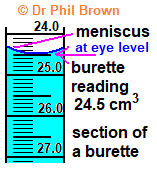 At the end-point you take the titration reading by
carefully reading the burette scale under the meniscus
(think of the underside of the meniscus as sitting on your
reading - see diagram on the right illustrating a reading of
24.5 cm3). At the end-point you take the titration reading by
carefully reading the burette scale under the meniscus
(think of the underside of the meniscus as sitting on your
reading - see diagram on the right illustrating a reading of
24.5 cm3).
To get the titration value you subtract the1st
reading from the 2nd.
The first reading might be zero (0.00
cm3) BUT you can do subsequent titrations without
refilling the burette every time, again you just subtract
the 1st reading from the 2nd.
You continue to use the
burette like this until in needs refilling for further
titrations.
 If
you 'overshoot' the titration with excess acid, the
methyl orange indicator turns red and the result is invalid. If
you 'overshoot' the titration with excess acid, the
methyl orange indicator turns red and the result is invalid.
 The
first titration you do is likely to be the most inaccurate
until you 'get your eye in'. This is called the rough
titration and you can do the next titration quite
rapidly until near the end-point and then proceed slowly and
accurately to the end-point itself. The
first titration you do is likely to be the most inaccurate
until you 'get your eye in'. This is called the rough
titration and you can do the next titration quite
rapidly until near the end-point and then proceed slowly and
accurately to the end-point itself.
The
titration should be repeated several times with the same
brand of and the
average (mean) titration value calculated to use in any
subsequent calculations.
This makes the experimental results
more valid and reliable, as will any subsequent calculations
and conclusions based on the data recorded.
The procedure
should then be repeated with different brands of antacid
indigestion tablets and the results compared.
You should
keep to the same volumes of water and the same concentration
of hydrochloric acid throughout the whole class/individual
investigation.
Using a whole class you could amass quite a
bit of data by dividing the work up amongst the pupils.
Data and analysis of
the results
There are various ways in which
you can interpret the results, so here are a few ideas.
(a) Initially you can compare
the volume of acid needed to neutralise an individual
tablet, which is simply X cm3 of HCl
neutralised per tablet. This gives a straightforward
comparison, the bigger the titration the more stomach acid
would be neutralised.
(b) If you have weighed the
tablet, which I recommend you do, you can compare the
effectiveness of the antacid tablets in terms of acid per
mass of tablet i.e. X cm3 of HCl neutralised
per gram tablet (cm3/g). So this measure the
effectiveness of the tablet based on mass ('weight').
(c) If you know the cost of the
packet of indigestion tablets, you can work out the cost of
an individual tablet.
Then you can calculate the 'cost
effectiveness' of the medication by dividing the titration
value by the cost per tablet e.g. X cm3 of HCl
neutralised per cost of tablet (cm3/p)
- Summary of procedure to compare the effectiveness of ant-acid indigestion
tablets
- These tablets are designed to neutralise excess acid in the
stomach.
- A known and equal mass of each
brand of indigestion tablet is crushed and mixed with some water
e.g. 20 cm3 (fair test points).
- Make sure the mixture is gently
swirled to completely dissolve the crushed tablet powder.
- The burette is filled with a
standard solution of hydrochloric acid and zeroed to the top
calibration mark of 0.00 cm3.
- Universal indicator is added to
the flask and the indigestion powder should turn it blue -
alkaline.
- The acid is carefully and slowly
added until the indicator turns green - neutral at the end-point
of the titration.
- You then read the volume of acid
required to neutralise the ant-acid powder.
- The bigger the volume of acid
required for neutralisation, the more effective the indigestion
powder per mass of powder.
- Repeat the procedure with
another brand of indigestion powder using the same standard acid
solution (fair test).
Practise exam
questions on acid-alkali titrations for Advanced A-level
chemistry students
(From my original A-level acid-alkali titration questions
SET 1
and
SET 2)
After each question there is a link to the fully worked
out answers.
Q20
ASPIRIN ASSAY ANALYSIS
This question follows on in some respects from Q9b
which I'd forgotten I'd already written, apologies for some repetition!
2-ethanoylhydroxybenzoic acid (acetylsalicylic acid),
known commercially as aspirin, can be analysed by titration with standard sodium
hydroxide solution when a sample of it is dissolved aqueous alcohol (a mixture
of ethanol and water) and using phenolphthalein indicator (pKind = 9.3, useful
range pH 8.3-10).
In the pharmaceutical industry, aspirin is manufactured by
reacting 2-hydroxybenzoic acid
(salicylic acid) with ethanoic anhydride.
Prior to this reaction,
2-hydroxybenzoic acid is manufactured by reacting carbon dioxide with phenol,
the mixture is heated under pressure sodium
hydroxide in the so called Kolbe Reaction.
Aspirin, therefore, always contains a small
percentage of 2-hydroxybenzoic acid as an impurity!
(a) Give the equation for the Kolbe synthesis
of 2-hydroxybenzoic acid.
(b) Give the equation for the
formation of aspirin from 2-hydroxybenzoic acid.
(c) Give the molecular formulae and
calculate the molecular masses of 2-hydroxybenzoic acid and aspirin.
Accurate relative atomic
masses: Ar(C) = 12.01, Ar(H) = 1.01, Ar(O)
= 16.00
(d) Why must ethanol be added to
the water prior to doing the titration?
(e) Five samples of aspirin were
titrated with commercially purchased precisely 0.1000 mol dm-3 (0.1000M) sodium hydroxide solution and
the results are given below.
The titration values were
recorded to the nearest 0.05 cm3, which is reasonable of a
burette calibrated in 0.1 cm3 increments.
|
mass of
aspirin (g) |
titration/cm3 of 0.1M
NaOH |
titre/mass |
|
0.3591 |
20.05 |
? |
|
0.3532 |
19.65 |
? |
|
0.3686 |
20.60 |
? |
|
0.3583 |
19.90 |
? |
|
0.3635 |
20.25 |
? |
|
average titre/mass = ? cm3/g |
In each case calculate the
titre/mass and work out its average value for the five titrations.
(f) Assuming that only aspirin was
titrated (though not true), from the average titre/mass figure calculate the
'theoretical' % purity of the aspirin by the following sequence:
(i) What volume of 0.1000 M NaOH is
equivalent to 1.000 g of aspirin?
(ii) Give the reaction equation
for the titration.
(iii) How many moles of aspirin
can be titrated by your answer to (i)
(iv) from (iii) calculate the
theoretical mass of aspirin titrated.
(v) From (iv) calculate the
theoretical % purity of the aspirin!
(g) Why is the theoretical % purity
based on this titration method always likely to be over 100%?,
ignoring any titration errors - which does not necessarily explain why via this
method of analysis you will always tend to get >100%, especially if you do the
titration very accurately!
(h) Assuming that 2-hydroxybenzoic
acid is titrated with NaOH on a 1 : 1 molar basis, calculate the % of this
impurity in the aspirin by the follow sequence:
(i) From your answer to
(f)(iii) calculate an average molecular mass
(ii) From the average molecular
mass, and a little bit of algebra, using x as the % of the 2-hydroxybenzoic
acid impurity, calculate the value of x.
(i) Suppose for the sake of
argument, there was an error of 0.1 cm3 on the titration value which
is likely to be the biggest source of error. Obviously there are errors
associated with the NaOH molarity, the weighing, burette reading.
(i) What is the approximate %
error on the titration value?
(ii) What error range of values
for Mr(av) would this give?
(iii) Using the minimum and
maximum values from (ii), recalculate the % of 2-hydroxybenzoic acid in the
aspirin using the method indicated in (h) and quote the range of possible
values.
(iv) Comment on the results of
your calculations, a bit worrying for some coursework projects! yes?
(v) In principle, what must an
alternative method be capable of doing? Can you suggest an appropriate
method - and forget acid-alkali titrations!
ANSWERS
to Q20 SET 1. questions
TOP OF PAGE
and sub-index OR test yourself
Quiz 12 on the basics of acid-alkali titration
calculations Good practice
questions for GCSE level
|
 For searching
▲
For searching
▲