Common frog
From Wikipedia, the free encyclopedia
Jump to navigationJump to search
For other uses, see Common frog (disambiguation).
Common frog
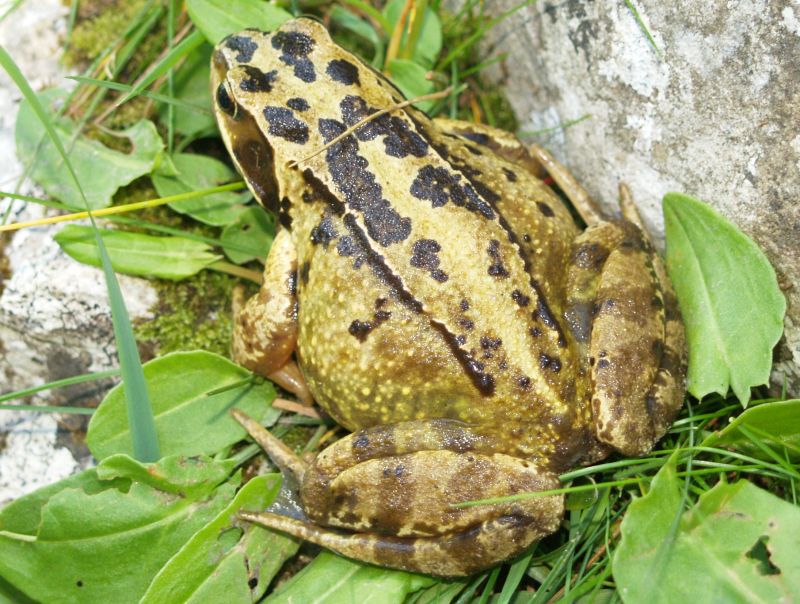
European Common Frog Rana temporaria.jpg
Conservation status
Least Concern (IUCN 3.1) common frog 1 common frog
Scientific classification edit
Kingdom: Animalia
Phylum: Chordata
Class: Amphibia
Order: Anura
Family: Ranidae
Genus: Rana
Species: R. temporaria
Binomial name
Rana temporaria
Linnaeus, 1758
Subspecies
R. t. temporaria
R. t. honnorati
R. t. parvipalmata
Mapa Rana temporaria.png
Distribution of Rana temporaria in Europe
The common frog (Rana temporaria), also known as the European common frog,
European common brown frog, European grass frog, or simply a frog, is a
semi-aquatic amphibian of the family Ranidae, found throughout much of Europe as
far north as Scandinavia and as far east as the Urals, except for most of
Iberia, southern Italy, and the southern Balkans. The farthest west it can be
found is Ireland, where it has long been thought, erroneously, to be an entirely
introduced species. They are also found in Asia, and eastward to Japan.
Common frogs metamorphose through three distinct developmental life stages —
aquatic larva, terrestrial juvenile, and adult. They have corpulent bodies with
a rounded snout, webbed feet and long hind legs adapted for swimming in water
and hopping on land. Common frogs are often confused with the common toad Bufo
bufo, but frogs can easily be distinguished as they have longer legs, hop, and
have a moist skin, whereas toads crawl and have a dry 'warty' skin. The spawn of
the two species also differs in that frogspawn is laid in clumps and toadspawn
is laid in long strings.
Contents
1 Description
2 Distribution
3 Habitat
4 Reproduction
5 Development
6 Conservation status
7 Predators
8 References
9 External links
Description
The adult common frog has a body length of 6 to 9 centimetres (2.4 to 3.5 in)
common frog 2 common frog its back and flanks varying in colour from olive green
common frog 3 common frog to grey-brown, brown, olive brown, grey, yellowish and
rufous. common frog 4 common frog However, it can lighten and darken its skin to
match its surroundings. common frog 3 common frog Some individuals have more
unusual colouration—both black and red individuals have been found in Scotland,
and albino frogs have been found with yellow skin and red eyes. common frog 3
common frog During the mating season the male common frog tends to turn
greyish-blue (see video below). common frog 3 common frog The average mass is
22.7 g (0.80 oz); the female is usually slightly larger than the male. common
frog 5 common frog
Captive common frog tadpoles eating a crushed garden snail
Male during breeding season showing the nuptial pad, white throat and a blue
grey hue over the normal black and brown skin
The flanks, limbs and backs are covered with irregular dark blotches common frog
3 common frog and they usually sport a chevron-shaped spot on the back of their
neck and a dark spot behind the eye. common frog 4 common frog Unlike other
amphibians, common frogs generally lack a mid-dorsal band but, when they have
one, it is comparatively faint. common frog 4 common frog In many countries moor
frogs have a light dorsal band which easily distinguishes them from common
frogs. The underbelly is white or yellow (occasionally more orange in females)
and can be speckled with brown or orange. common frog 3 common frog The eyes are
brown with transparent horizontal pupils, and they have transparent inner
eyelids to protect the eyes while underwater, as well as a 'mask' which covers
the eyes and eardrums. common frog 3 common frog Although the common frog has
long hind legs compared to the common toad, they are shorter than those of the
agile frog with which it shares some of its range. The longer hind legs and
fainter colouration of the agile frog are the main features that distinguish the
two species.
Males are distinguishable from females as they are smaller and have hard
swellings, known as nuptial pads, on the first digits of the forelegs, used for
gripping females during mating. common frog 2 common frog common frog 3 common
frog During the mating season males' throats often turn white, and their overall
colour is generally light and greyish, whereas the female is browner, or even
red. common frog 4 common frog
Distribution
Rana temporaria in the United Kingdom
The common frog is found throughout much of Europe as far north as northern
Scandinavia inside the Arctic Circle and as far east as the Urals, except for
most of Iberia, southern Italy, and the southern Balkans. Other areas where the
common frog has been introduced include the Isle of Lewis, Shetland, Orkney and
the Faroe Islands. It is also found in Asia, and eastward to Japan. common frog
3 common frog common frog 6 common frog
The common frog has long been thought to be an entirely introduced species in
Ireland, common frog 7 common frog however, genetic analyses suggest that
particular populations in the south west of Ireland are indeed indigenous to the
country. common frog 8 common frog The authors propose that the Irish frog
population is a mixed group that includes native frogs that survived the last
glacial period in ice free refugia, natural post-glacial colonisers and recent
artificial introductions from Western Europe. common frog 8 common frog common
frog 9 common frog
Habitat
Outside the breeding season, common frogs live a solitary life in damp places
near ponds or marshes or in long grass. common frog 10 common frog They are
normally active for much of the year, only hibernating in the coldest months.
common frog 4 common frog In the most northern extremities of their range they
may be trapped under ice for up to nine months of the year, but recent studies
have shown that in these conditions they may be relatively active at
temperatures close to freezing. common frog 10 common frog In the British Isles,
common frogs typically hibernate from late October to January. They will
re-emerge as early as February if conditions are favourable, and migrate to
bodies of water such as garden ponds to spawn. common frog 7 common frog Where
conditions are harsher, such as in the Alps, they emerge as late as early June.
Common frogs hibernate in running waters, muddy burrows, or in layers of
decaying leaves and mud at the bottom of ponds or lakes primarily with a
current. The oxygen uptake through the skin suffices to sustain the needs of the
cold and motionless frogs during hibernation. common frog 3 common frog common
frog 4 common frog common frog 11 common frog
Reproduction
File:DutchCommonFrogsCroackingRanaTemporaria.ogv
Choir of greyish males and a few brownish females still present in a small pond
During the spring the frog's pituitary gland is stimulated by changes in
external factors, such as rainfall, day length and temperature, to produce
hormones which, in turn, stimulate the production of sex cells - eggs in the
females and sperm in the male. The male's nuptial pad also swells and becomes
more heavily pigmented. common frog 12 common frog Common frogs breed in
shallow, still, fresh water such as ponds, with spawning commencing sometime
between March and late June, but generally in April over the main part of their
range. common frog 4 common frog The adults congregate in the ponds, where the
males compete for females. The courtship ritual involves noisy vocalisations
(croaking) by large "choirs" of males. The females are attracted to the males
that produce the loudest and longest calls and enter the water, where the males
mill around and try to grasp them with their front legs — although they may
grasp anything of a similar size, such as a piece of wood. The successful male
climbs on the back of the female and grasps her under the forelegs with his
nuptial pads, in a position known as amplexus, and kicks away any other males
that try to grasp her. common frog 12 common frog He then stays attached in this
position until she lays her eggs, which he fertilises by spraying sperm over
them as they are released from the female's cloaca. common frog 3 common frog
The courtship rituals are performed throughout the day and night but spawning
typically takes place at night. The females lay between 1,000 and 2,000 eggs
which float in large clusters near the surface of the water. common frog 3
common frog common frog 13 common frog After mating the pairs separate, the
females will leave the water and the males will try to find another mate. Within
three or four days all the females will have laid their eggs and left the water
and the males disperse. common frog 12 common frog
Amplexus of a reddish female and male in breeding colors on a spawn covered pond
MENU0:00
Vocalisations
Development
In common with other amphibia the rate of development of the larvae is
influenced by temperature, with eggs and tadpoles in ponds at higher
temperatures developing faster than those at lower temperatures. common frog 14
common frog Newly hatched tadpoles are mainly herbivorous, feeding on algae,
detritus, plants and some small invertebrates, but they become fully carnivorous
once their back legs develop, feeding on small water animals or even other
tadpoles when food is scarce. common frog 4 common frog Juvenile frogs feed on
invertebrates both on land and in water but their feeding habits change
significantly throughout their lives and older frogs will eat only on land.
common frog 3 common frog Adult common frogs will feed on any invertebrate of a
suitable size, catching their prey on their long, sticky tongues, common frog 3
common frog although they do not feed at all during the short breeding season.
common frog 3 common frog Preferred foods include insects (especially flies),
common frog 4 common frog snails, slugs and worms. common frog 3 common frog
Conservation status
Common frogs are susceptible to a number of diseases, including Ranavirus and
the parasitic fungus Batrachochytrium dendrobatidis which has been implicated in
extinctions of amphibian species around the world. common frog 15 common frog
Loss of habitat and the effect of these diseases has caused the decline of
populations across Europe in recent years. common frog 15 common frog The common
frog is listed as a species of least concern on the IUCN Red List of Threatened
Species. common frog 1 common frog
Predators
Tadpoles are eaten by fish, beetles, dragonfly larvae and birds. Adult frogs
have many predators including storks, birds of prey, crows, gulls, ducks, terns,
herons, pine martens, stoats, weasels, polecats, badgers, otters and snakes.
common frog 16 common frog Some frogs are killed, but rarely eaten, by domestic
cats, and large numbers are killed on the roads by motor vehicles. common frog
17 common frog
For Doc Brown's
latest updates of pictures or science see https://twitter.com/docbrownchem
Doc Brown's
Science Website - GCSE Biology, GCSE & A Level Chemistry and GCSE Physics
TOP OF PAGE


 Enter
anything of interest
Enter
anything of interest *
*