Eurasian blue tit
From Wikipedia, the free encyclopedia
Jump to navigationJump to search
"Blue tit" redirects here. For the butterfly with this name, see Chliaria kina.
Eurasian blue tit
Eurasian blue tit Lancashire.jpg
MENU0:00
The calls of a blue tit
Conservation status
Least Concern (IUCN 3.1) blue tit 1 Eurasian blue tit
Scientific classification edit
Kingdom: Animalia
Phylum: Chordata
Class: Aves
Order: Passeriformes
Family: Paridae
Genus: Cyanistes
Species: C. caeruleus
Binomial name
Cyanistes caeruleus
(Linnaeus, 1758)
CyanistesCaeruleusDistribution.png
Eurasian blue tit range
African blue tit range
Synonyms
Parus caeruleus Linnaeus, 1758
Eurasian blue tit in Sweden, April 2018
The Eurasian blue tit (Cyanistes caeruleus blue tit 2 Eurasian blue tit ) is a
small passerine bird in the tit family, Paridae. It is easily recognisable by
its blue and yellow plumage and small size.
Eurasian blue tits, usually resident and non-migratory birds, are widespread and
a common resident breeder throughout temperate and subarctic Europe and western
Asia in deciduous or mixed woodlands with a high proportion of oak. They usually
nest in tree holes, although they easily adapt to nest boxes where necessary.
Their main rival for nests and in the search for food is the larger and more
common great tit.
The Eurasian blue tit prefers insects and spiders for its diet. Outside the
breeding season, they also eat seeds and other vegetable-based foods. The birds
are famed for their skill, as they can cling to the outermost branches and hang
upside down when looking for food.
Contents
1 Taxonomy
1.1 Subspecies
1.2 Hybrids
2 Description
3 Distribution and habitat
4 Behaviour and ecology
4.1 Breeding
4.2 Diet
4.3 Voice
4.4 Learnt Behaviours
4.5 Predators and natural threats
4.6 Parasites
5 Status and conservation
6 Cultural Significance
7 References
8 External links
Taxonomy
The Eurasian blue tit was described by Carl Linnaeus in 1758 in the 10th edition
of his Systema Naturae under the binomial name Parus caeruleus. blue tit 3
Eurasian blue tit Parus is the classical Latin for a tit and caeruleus is the
Latin for dark blue or cerulean. blue tit 4 Eurasian blue tit Two centuries
earlier, before the introduction of the binomial nomenclature, the same Latin
name had been used by the Swiss naturalist Conrad Gesner when he described and
illustrated the blue tit in his Historiae animalium of 1555. blue tit 5 Eurasian
blue tit
In 2005, analysis of the mtDNA cytochrome b sequences of the Paridae indicated
that Cyanistes was an early offshoot from the lineage of other tits, and more
accurately regarded as a genus rather than a subgenus of Parus. blue tit 6
Eurasian blue tit The current genus name, Cyanistes, is from the Ancient Greek
kuanos, "dark blue". blue tit 4 Eurasian blue tit The African blue tit (Cyanistes
teneriffae) was formerly considered conspecific.
Subspecies
There are currently at least nine recognised subspecies: blue tit 7 Eurasian
blue tit
C. c. caeruleus – (Linnaeus, 1758): the nominate subspecies, occurring in
Continental Europe to northern Spain, Sicily, northern Turkey and northern Urals
C. c. obscurus – (Pražák, 1894): found in Ireland, Britain and Channel Islands
blue tit 8 Eurasian blue tit
C. c. ogliastrae – (Hartert, 1905): found in Portugal, southern Spain, Corsica
and Sardinia
C. c. balearicus – (von Jordans, 1913): found on Majorca Island (Balearic
Islands)
C. c. calamensis – (Parrot, 1908): found in southern Greece, Pelopónnisos,
Cyclades, Crete and Rhodes
C. c. orientalis – Zarudny & Loudon, 1905: found in southern European Russia
(Volga River to central and southern Urals)
C. c. satunini – Zarudny, 1908: found in the Crimean Peninsula, Caucasus,
Transcaucasia and northwestern Iran to eastern Turkey
C. c. raddei – Zarudny, 1908: found in northern Iran
C. c. persicus – (Blanford, 1873): found in the Zagros Mountains
Hybrids
Pleske's tit (Cyanistes pleskei) is a common hybrid between this species and the
azure tit, in western Russia. The cap is usually darker than the azure tit, and
the tail is paler than the Eurasian blue tit. blue tit 9 Eurasian blue tit
Description
The Eurasian blue tit is usually 12 cm (4.7 in), long with a wingspan of 18 cm
(7.1 in) for all genders, and weighs about 11 g (0.39 oz). blue tit 10 Eurasian
blue tit A typical Eurasian blue tit has an azure-blue crown and dark blue line
passing through the eye, and encircling the white cheeks to the chin, giving the
bird a very distinctive appearance. The forehead and a bar on the wing are
white. The nape, wings and tail are blue and the back is yellowish green. The
underparts is mostly sulphur-yellow with a dark line down the abdomen—the
yellowness is indicative of the number of yellowy-green caterpillars eaten, due
to high levels of carotene pigments in the diet. blue tit 11 Eurasian blue tit
The bill is black, the legs bluish grey, and the irides dark brown. The sexes
are similar, but under ultraviolet light, males have a brighter blue crown. blue
tit 12 Eurasian blue tit Young blue tits are noticeably more yellow.
Distribution and habitat
Reported range from ornithological observations.
Year-Round Range
Summer Range
Winter Range
There are currently around 20–44 million pairs in Europe. blue tit 13 Eurasian
blue tit
The Eurasian blue tit and the related hybrids are considered native species in
areas of the European continent with a mainly temperate or Mediterranean
climate, and in parts of the Middle East. These areas include Ireland, the
United Kingdom and most of the European Union and EFTA (except Malta, where they
are considered vagrant, and Iceland, where they are absent), plus: Albania,
Algeria, Andorra, Armenia, Azerbaijan, Belarus, Bosnia and Herzegovina, Georgia,
Iran, Iraq, Jordan, Kazakhstan, Lebanon, Libya, the Republic of Macedonia,
Moldova, Montenegro, Morocco, Russia, San Marino, Serbia, Syria, Tunisia,
Turkey, Vatican City and Ukraine. blue tit 14 Eurasian blue tit
In Great Britain the Eurasian blue tit is typically found in deciduous woodland,
parks, gardens and even in the centre of towns. blue tit 15 Eurasian blue tit
Behaviour and ecology
Juvenile in Pimlico, London
Eurasian blue and great tits form mixed winter flocks, and the former are
perhaps the better gymnasts in the slender twigs. A Eurasian blue tit will often
ascend a trunk in short jerky hops, imitating a treecreeper. As a rule the bird
roosts in ivy or evergreens, but in harsh winters will nest wherever there is a
suitable small hole, be it in a tree or nesting box. They are very agile and can
hang from almost anywhere.
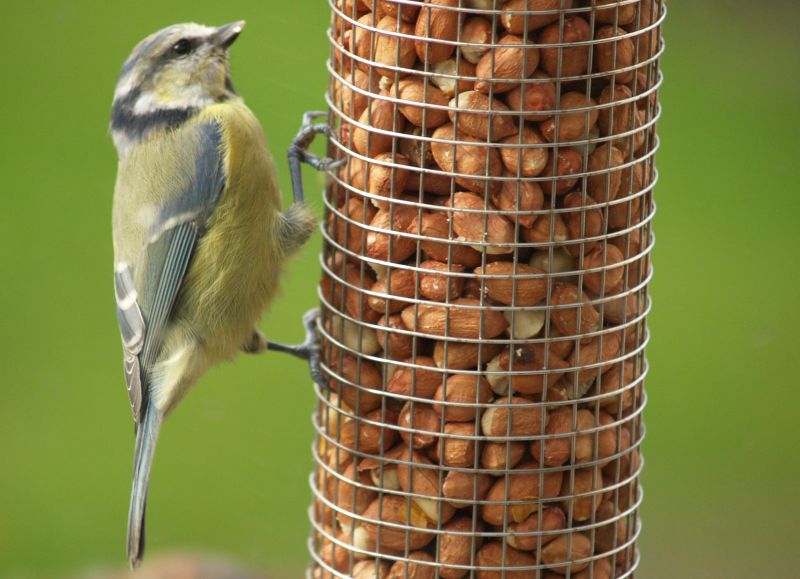
This is a common and popular European garden bird, due to its perky acrobatic
performances when feeding on nuts or suet. It swings beneath the holder, calling
"tee, tee, tee" or a scolding "churr".
Breeding
The Eurasian blue tit will nest in any suitable hole in a tree, wall, or stump,
or an artificial nest box, often competing with house sparrows or great tits for
the site. Few birds more readily accept the shelter of a nesting box; the same
hole is returned to year after year, and when one pair dies another takes
possession. It is estimated by the RSPB that there are 3,535,000 breeding pairs
in the UK. blue tit 13 Eurasian blue tit
Eggs are 14–18 mm (0.55–0.71 in) long and 10.7–13.5 mm (0.42–0.53 in) wide. Egg
size appears to depend mostly on the size of individual females and secondarily
on habitat, with smaller eggs found at higher altitudes. The clutch's total
weight can be 1.5 times as heavy as the female bird. blue tit 16 Eurasian blue
tit
The bird is a close sitter, hissing and biting at an intruding finger. In the
South West of England such behaviour has earned the Eurasian blue tit the
colloquial nickname "Little Billy Biter" or "Billy Biter", originating from the
UK. blue tit 17 Eurasian blue tit When protecting its eggs it raises its crest,
but this is a sign of excitement rather than anger, for it is also elevated
during nuptial display. The nesting material is usually moss, wool, hair and
feathers, and the eggs are laid in April or May. The number in the clutch is
often very large, but seven or eight are normal, and bigger clutches are usually
laid by two or even more hens. It is not unusual for a single bird to feed the
chicks in the nest at a rate of one feed every 90 seconds during the height of
the breeding season. In winter they form flocks with other tit species.
In an analysis carried out using ring-recovery data in Britain, the survival
rate for juveniles in their first year was 38%, while the adult annual survival
rate was 53%. blue tit 18 Eurasian blue tit From these figures the typical
lifespan is only three years. blue tit 10 Eurasian blue tit Within Britain, the
maximum recorded age is 10 years and 3 months for a bird that was ringed in
Bedfordshire. blue tit 19 Eurasian blue tit The maximum recorded age overall is
11 years and 7 months for a bird in the Czech Republic. blue tit 20 Eurasian
blue tit
Diet
File:Cyanistes caeruleus -garden bird feeder-8.ogv
Eating peanuts from a garden bird feeder in England
The Eurasian blue tit is a valuable destroyer of pests, though it is fond of
young buds of various trees, especially when insect prey is scarce, and may pull
them to bits in the hope of finding insects. It is a well-known predator of many
Lepidoptera species including the Wood Tiger moth. No species, however, destroys
more coccids and aphids, the worst foes of many plants. It takes leaf miner
grubs and green tortrix moths (Tortricidae). Seeds are eaten, as with all this
family, and blue tits in British urban areas have evolved the ability to digest
milk and cream. blue tit 21 Eurasian blue tit
Voice
MENU0:00
Calls of a blue tit
Eurasian blue tits use songs and calls throughout the year. blue tit 22 Eurasian
blue tit Songs are mostly used in late winter and spring to defend the territory
or to attract mates. Calls are used for multiple reasons. blue tit 23 Eurasian
blue tit Communication with other Eurasian blue tits is the most important
motivation for the use of calls. They inform one another on their location in
trees by means of contact-calls. They use alarm-calls to warn others (including
birds of other species such as the great tit, the European robin or the
treecreeper) about the presence of predators in the neighbourhood. Scolding, for
example, is used when a ground predator (e.g. fox, cat or dog), a low flying
predator or a perched owl are noticed. blue tit 24 Eurasian blue tit Sometimes
this is followed by mobbing behaviour in which birds gather together in flocks
to counter a predator. The alarm-whistle warns other birds about the proximity
of a Eurasian sparrowhawk, a northern goshawk, a common buzzard or other flying
predators that form a potential danger in the air. A series of high-pitched
'zeedling' notes are given by both partners before and during copulation. blue
tit 25 Eurasian blue tit The begging-call is used by juveniles to beg for food
from parents.
Learnt Behaviours
Eurasian blue tits are able to culturally transmit learning to other tit
species. An example of this, dating from the 1920s, is the ability to open milk
bottles with foil tops, to get at the cream underneath. blue tit 26 Eurasian
blue tit Such behaviour has been suppressed recently by the gradual change of
human dietary habits (low-fat or skimmed milk instead of full-fat), and the way
of getting them (from a supermarket in plastic containers with hard plastic
lids), instead of the milkman. blue tit 27 Eurasian blue tit In addition, the
instinct to strip bark from trees in search of insects has developed into a
tendency to peel building materials such as thatch, wallpaper, stucco and window
putty. blue tit 28 Eurasian blue tit
Predators and natural threats
The small size of the Eurasian blue tit makes it vulnerable to prey by larger
birds such as jays who catch the vulnerable fledglings when leaving the nest.
The most important predator is probably the sparrowhawk, closely followed by the
domestic cat. Nests may be robbed by mammals such as weasels and red squirrels,
as well as introduced grey squirrels in the UK.
The successful breeding of chicks is dependent on sufficient supply of green
caterpillars as well as satisfactory weather. Breeding seasons may be affected
badly if the weather is cold and wet between May and July, blue tit 29 Eurasian
blue tit particularly if this coincides with the emergence of the caterpillars
on which the nestlings are fed.
Parasites
A bald blue tit with mite
Eurasian blue tits are known to be host to feather mites, and rarely lice and
flat flies. In Europe, the only feather mite species known to live on the blue
tit host is Proctophyllodes stylifer. P. stylifer however seems to be of no
concern to the bird as, until now, it is only known to feed on dead feather
tissue. P. stylifer lives all its developmental stages, i.e. egg, larva,
protonymph, tritonymph and adult, within the plumage of the same host. The usual
sites where P. stylifer is encountered are the remiges and the rectrices of the
bird where they can be found tandemly positioned between the barbs of the
rachis. blue tit 30 Eurasian blue tit
Status and conservation
The Eurasian blue tit is classified as a least concern species on the IUCN Red
List (version 3.1), blue tit 1 Eurasian blue tit and as a Green Status species,
since 1996, by the Royal Society for the Protection of Birds in the United
Kingdom. blue tit 10 Eurasian blue tit blue tit 13 Eurasian blue tit
For Doc Brown's
latest updates of pictures or science see https://twitter.com/docbrownchem
Doc Brown's
Science Website - GCSE Biology, GCSE & A Level Chemistry and GCSE Physics
TOP OF PAGE


 Enter
anything of interest
Enter
anything of interest *
*