|
Doc Brown's
Advanced Organic Chemistry - SPECTROSCOPY
PART
15.5.1
uv and visible light absorption spectroscopy - origin of colour in
compounds
[Author
©
Dr
Phil Brown PhD:
Doc Brown's advanced level pre-university/college organic chemistry exam revision notes
on uv-visible spectroscopy may be useful-suitable for A level students of UK based AQA, CCEA, CIE, Edexcel,
IB, OCR, Salters and WJEC etc. advanced level
organic chemistry courses and for US K12 grade
11, grade 12 and AP honors chemistry courses: uv-visible
absorption molecular
spectroscopy
[updated
Mar 6th 2026 *]
email doc
brown *
[privacy
and cookies policies
and disclaimer]
Sub-Index of pages on
ultraviolet and visible spectroscopy
15.5.1
The origin of colour, the wavelengths of
visible light, our perception!
(this page)
15.5.2
uv-visible spectroscopy
theory, spectrometer, examples of absorption & reflectance spectra
explained
(separate page)
15.5.3
uv-visible absorption
spectra - index of examples: uses, applications, more on the
chemistry of colour
(separate page)
This section is indexed under
Doc Brown's Advanced Level Organic Chemistry
PART 15.5 Emission and absorption
spectroscopy including colorimetry and flame photometry
Organic Chemistry Part 15
SPECTROSCOPY, is mainly organic uv-visible spectra, but there are sections on the
emission and absorption spectroscopy of elements and inorganic
examples including transition metal complexes and colorimetry
I had already written a few
sections on visible absorption/emission spectroscopy before
writing Part 15 e.g.
Identifying and element
analysis from emission spectroscopy and flame photometry
Electron configuration
of transition metal ions and colour theory
Colorimetric analysis
and determining a transition metal complex ion formula
My spectroscopy section
continues to be developed
as the database builds up! I welcome any
Email
comments or suggestions for spectra
to write up on my website, BUT only for pre-university level.
All my advanced A level organic chemistry notes
SPECTROSCOPY INDEXES
This is a BIG
website, PLEASE take time to explore it [ SEARCH
BOX]
15.5.1
The origin of colour, wavelengths and colours of visible light - our perception!
Sub-index for this page
15.5.1
(a)
The
wavelengths and colours of the visible light spectrum
(b)
Why, and
how, do we see different colours?
(c)
Colour wheels,
complimentary colours and the wavelengths of visible light
(a) The
wavelengths of the colours of the
visible light spectrum

Table of the colours and wavelengths of the
visible light spectrum, every colour has its own range of
wavelengths and corresponding frequencies.
E, the energy of a photon in J, is given by
Planck's equation:
E = hv
h = Planck's constant = 6.63 x 10⁻³⁴
Js, v = frequency, Hz.
You need to be familiar with
inter-converting wavelengths and frequencies: c =
λ
c = speed of light,
3.0 x 10⁸ ms-1,
λ = wavelength, m, v = frequency, Hz
In my uv-visible
spectroscopy pages, wavelengths are usually quoted in
nanometres (1 nm = 1.0 x 10⁻⁹ m)
See
general spectroscopy index page
for examples of calculations
Below is a rough table guide to what colour is
transmitted if the specified colour is absorbed.
|
1. Colour that we
perceive |
2. ~Wavelength
range (
λ/nm) |
3. Colour on absorption |
|
Ultraviolet
(invisible) |
<380 (end of near uv
region, start of visible region) |
If column 1 colour is absorbed,
column 3 colour
is transmitted |
|
Violet |
380 - 435 |
Yellow |
|
Blue |
435 - 500 |
Yellow-orange |
|
Cyan (blue-green) |
500 - 520 |
Orange-red |
|
Green |
520 - 565 |
Purple (magenta) |
|
Yellow |
565 - 590 |
Violet-blue |
|
Orange |
590 - 625 |
Blue |
|
Red |
625 - 740 |
Blue-green |
|
Infrared
(invisible) |
>740 (start of ir
region, end of visible region) |
|
See a
colorimetric exercise for a similar table of
colour matching for analysis using a colorimeter.
It should be emphasised that the colour you perceive, and the
reason for it, is quite complex, as you will find out in my
discussions of individual spectra.
The table above, and colour wheels
illustrated in (b) and (c) are
only an
approximation to the predicted colour and what is actually
observed!
What is absorbed by, or transmitted through a material, in
the uv-visible region of the electromagnetic spectrum, all
depends on the energy of the electronic quantum levels of the
outer bonding/non-bonding electrons of the molecule.
See
The
in depth theory of uv-visible absorption and reflectance
spectra

A more visual representation of the wavelengths of the colours of
visible light in nanometres (1 nm = 1.0 x 10⁻⁹ m)).
(b)
Why and how do we see different colours?
The colour of an object depends on which
wavelengths of visible light are absorbed, transmitted or
reflected.
Complementary colours
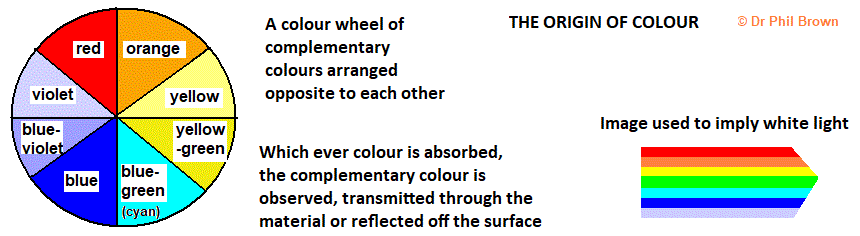
To a good approximation you can often predict a
colour or vice versa from what colours of visible light are
absorbed by use of a complementary colour wheel.
Which ever segment colour is absorbed from white
light, the
material will display the complementary colour in the opposite
segment.
e.g. something absorbing blue-violet will
look yellow-green
The
'extremes' of 'colour'

A material that is transparent to all visible
light wavelengths will appear colourless e.g. water,
ethanol, pure sodium chloride crystals, glass with no pigment,
Perspex plastic.
A material that reflects all visible light
wavelengths will appear an opaque white e.g. chalk,
titanium dioxide powder or any other 'white' mineral pigment.
A material that absorbs all visible light
wavelengths will appear an opaque black e.g. charcoal
or soot.
These are the 'extremes' in terms of 'colours',
but so-called 'coloured' materials owe their colour to what
wavelengths are absorbed, transmitted or reflected.
Examples of coloured liquids or solids
The diagrams below illustrate resulting colours from
absorption, transmission and reflectance of particular
wavelengths of visible light

A simple colour absorption-transmission diagram
of coloured liquids or solutions of materials.
more labels
1A
chlorophyll absorbs in the blue and red,
so appears green by transmitted light.
1B absorption in the green-yellow-red region
produces, in transmission, a violet-blue range of colour.
1C
carotene absorbs in the green and blue
and so appears as an
orange colour.
For more see
absorption spectra
on the more advanced theory page.
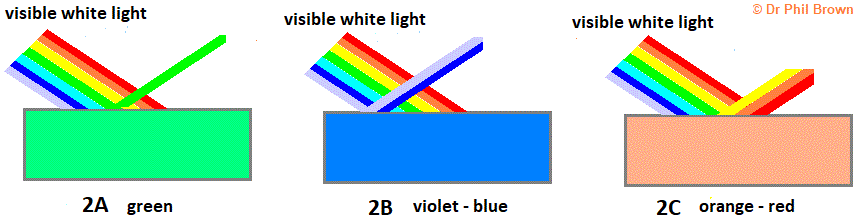
A simple colour absorption-reflectance diagram
of coloured solids
2A Absorption of e.g. red and blue on the
surface makes the object look green from the reflected light.
2B Absorption in the red-yellow-green on the
surface makes the object look a violet-blue colour.
2C Absorption on the surface of the blue-green
wavelengths makes the solid look orange-red
For more see
absorption reflectance
spectra on the more advanced theory page.

The diagram illustrates a comparison of a blue
solid pigment that is soluble in a solvent.
Absorption by the pigment in the yellow-red
region produces, by transmission, a blue coloured
solution e.g. of a dye.
Absorption by the pigment surface in the
yellow-red region produces, by reflectance, a blue
coloured solid.
See also
The uv-visible absorption spectra
of the photopigments in the human eye
(c) Colour wheels, complimentary
colours and the wavelengths of visible light

I
emphasise again that
the colour wheels
illustrated above are only an
approximation to the predicted colour and what is actually
observed!
The complexity of electronic excitations
from ultraviolet and visible light photons in organic
molecules or inorganic positive and negative ions doesn't
always produce the colour you expect, but the complementary
colour discs work well enough in most situations.
SPECTROSCOPY INDEXES
All Advanced Organic
Chemistry Notes
[WEBSITE SEARCH
BOX]
Index of my advanced
(pre-university) organic
chemistry revision notes
The chemistry of
alkanes and the petrochemical
industry
The
chemistry of alkenes
The
chemistry of haloalkanes
The
chemistry of
alcohols
The chemistry of aldehydes
and ketones
The
chemistry of carboxylic acids and derivatives
The chemistry of organo-nitrogen compounds
The chemistry of
aromatic compounds
|
Website content © Dr Phil Brown 2000+.
All copyrights reserved on revision notes, images, quizzes,
worksheets etc. Copying of website material is NOT permitted. Exam
revision summaries & references to science course specifications are
unofficial.
Website content © Dr Phil Brown 2000+. All
copyrights reserved on these organic chemistry exam revision
notes on theory of colour, these A level chemistry revision notes are suitable for use of pre-university students studying AQA advanced level
organic chemistry revision notes on theory of colour, Edexcel advanced level
organic chemistry revision notes on theory of colour, OCR advanced level
organic chemistry revision notes on theory of colour, IB advanced level
organic chemistry revision notes on theory of colour, WJEC (Eduqas) advanced level
organic chemistry revision notes on theory of colour, CIE Cambridge advanced level
organic chemistry revision notes on theory of colour, CCEA advanced level
organic chemistry revision notes on theory of colour, and useful for US grade 11
grade 12 AP honors
organic chemistry courses involving theory of colour, Doc Brown's
Chemistry Advanced Level Pre-University Chemistry Revision Study Notes for UK IB
KS5 A/AS GCE advanced A level organic chemistry students US K12 grade 11 grade 12 organic chemistry
courses uv visible spectroscopic methods
of analysis molecular structure determination uv & visible
spectroscopy organic and inorganic examples of uv absorption spectra and
visible emission, absorption and reflectance spectra, Explaining the
importance of uv-visible spectroscopy theory in theoretical chemistry, What you need to know about
uv-visible spectroscopy theory for theoretical chemistry, Explaining the use of
uv-visible spectroscopy theory knowledge in
theoretical chemistry, Examples of uv-visible spectroscopy theory explained when studying
theoretical chemistry, What is the significance of uv-visible
spectroscopy theory in theoretical
chemistry, What is the use of uv-visible spectroscopy theory in theoretical chemistry
Describing and explaining the theory of uv-visible spectroscopy theory when studying theoretical
chemistry, exam revision notes for uv-visible spectroscopy theory in exams, online help for
uv-visible spectroscopy theory,
revision notes for uv-visible spectroscopy theory, what do I need to learn for
uv-visible spectroscopy theory in exams?
revision summary for uv-visible spectroscopy theory, help in teaching
uv-visible spectroscopy theory, learning notes for uv-visible spectroscopy
theory,
help to pass the uv-visible spectroscopy theory exam, how to prepare for examination questions on
uv-visible spectroscopy theory?
Website content © Dr Phil Brown 2000+. All
copyrights reserved on revision notes, images, quizzes, worksheets etc. Copying
of website material is NOT permitted. Exam revision summaries & references to
science course specifications are unofficial.
Website content © Dr Phil Brown 2000+. All
copyrights reserved on these theoretical chemistry exam revision
notes on uv-visible spectroscopy theory, these A level chemistry revision notes are suitable for use of pre-university students studying AQA
advanced A level theoretical chemistry revision notes on uv-visible spectroscopy
theory, Edexcel advanced A
level theoretical chemistry revision notes on uv-visible spectroscopy theory, OCR advanced A level
theoretical chemistry revision notes on uv-visible spectroscopy theory, IB advanced A level theoretical
chemistry revision notes on uv-visible spectroscopy theory, WJEC (Eduqas) advanced A level theoretical
chemistry revision notes on uv-visible spectroscopy theory, CIE Cambridge advanced A level theoretical
chemistry revision notes on uv-visible spectroscopy theory, CCEA advanced A level theoretical chemistry revision notes on
uv-visible spectroscopy theory, and useful for US grade 11 grade 12 AP
honors theoretical chemistry courses involving uv-visible spectroscopy
theory |
|
