|
Doc Brown's
Advanced Organic Chemistry: PART 15.3.2
USES and
applications of of 1H
NMR spectroscopy
[Author
©
Dr Phil Brown PhD:
Doc Brown's advanced level organic chemistry exam revision notes
on applications of 1H NMR spectroscopy suitable for students of UK based A level and IB chemistry courses & US K12 grade
11, grade 12 and AP honors chemistry courses
[updated
Mar 6th 2026 *]
All my advanced A level organic chemistry notes
SPECTROSCOPY INDEXES
email doc
brown
*
[privacy policy, cookies
and disclaimer]
This is a BIG
website, you need to take time to explore it [ SEARCH
BOX]
15.3.1
The theory of H-1 NMR spectroscopy and
spectrometer - low and high resolution spectra
15.3.3
Index of
H-1 (proton) NMR spectra of organic compounds
15.3.4
Some simple NMR-IR
problem solving questions
15.3.2 The uses and
applications of 1H (proton) NMR Spectroscopy
Sub-index for this page
(a)
Indentifying molecules
(b)
Determination of molecular structure
(c)
Magnetic resonance
imaging (MRI scanning)
(d)
Chemical
kinetics - experimental studies of the speed of a chemical
reaction
(a)
Identifying molecules
You can match 1H NMR resonance signals
from an 'unknown' substance with a database of NMR spectra of
known well characterised compounds.
A computing data base can match many
signals (chemical shift, δ in ppm) to suggest possible
structures, ideally a unique 'fingerprint' NMR signal.
TOP OF PAGE
and sub-indexes
(b) Determination of
molecular structure
1H NMR spectroscopy is a very powerful
technique for the structural determination of molecules.
From the different chemical shifts you can
build up a picture of parts of a molecule's structure.
NMR spectroscopy is so accurate that the
structure of quite complex organic molecules can be worked out
when combined with other data such as molecular mass and % C, H
and O etc.
In a sense you are working backwards
from the point of view of interpreting high resolution 1H NMR
spectra explained in ...
The theory of H-1 NMR spectroscopy
- interpreting high resolution spectra
NMR analysis can used in many situations
including identifying molecules from natural materials e.g.
molecules in a plant fragrance, molecules involved in some
complex biosynthesis.
It is a non-destructive method of
investigating molecular structure, which is a particularly
useful for complex biological molecules e.g. nucleic acids,
including RNA and DNA, or proteins, can be studied using nuclear
magnetic resonance for weeks or months before using destructive
biochemical experiments.
TOP OF PAGE
and sub-indexes
(c)
Magnetic resonance imaging (MRI scanning)
An important scanning technique in
clinical medicine.
Collating the 1H NMR resonance signals
from sections of the human body is an important diagnostic tool
e.g. for medical problems associated with soft tissue and
collagen in bones.
An extremely powerful magnet is used to
generate a very strong magnetic field and the patient lies in
between the poles of this magnet and is subjected to pulses of
radio waves of around 40 MHz.
The hydrogen nuclei will re-emit the
absorbed the NMR frequencies.
The hydrogen nuclei in the soft tissue
have a different chemical shift to those in harder tissue,
giving contrasting contours of different emissions and a
computer can generate pictures of 'slices' of the parts of the
body being investigated.
Potential or actual problems can be
detected and diagnosed and the usually patient suffers no ill
effects from the radio waves and is a safe non-invasive medical
procedure.
MRI scanning also has the advantage of
generating images of the body which CT scans, ultrasound and
X-rays cannot.
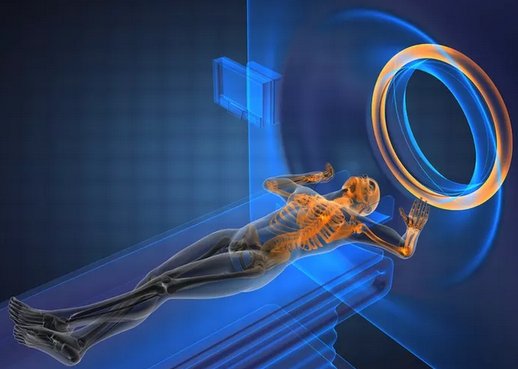 An MRI scanner
(Image credit:
<a href='http://www.shutterstock.com/pic.mhtml?id=98759036&src=id'>MRI
scan</a> via Shutterstock)
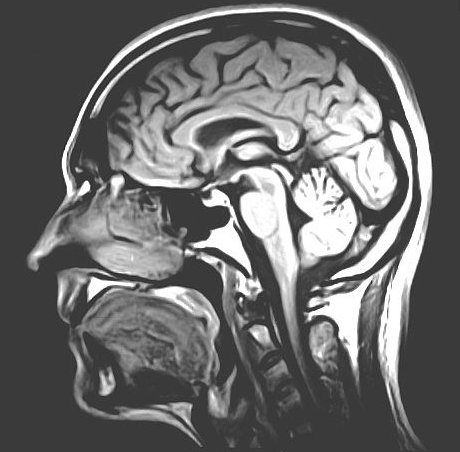 (Image
credit: Courtesy FONAR Corporation)
(Image
credit: Courtesy FONAR Corporation)
An MRI scan can reveals the gross
anatomical structure of the human brain.
The brain, spinal cord and
nerves, as well as muscles, ligaments, and tendons are seen much
more clearly with MRI than with regular x-rays and CT and for
this reason MRI is often used to image knee and shoulder
injuries.
A special kind of MRI scanning
is functional Magnetic Resonance Imaging (fMRI.) in which brain
structures can be observed and determine which areas of the
brain “activate” (consume more oxygen) during various cognitive
tasks. It is used to advance the understanding of brain function
and organization and offers an insight into assessing
neurological status and neurosurgical risk.
Because of the strong magnetic fields involved you have to be
care if any magnetic object is associated with the patient e.g.
People with implants, particularly those containing iron
e.g. pacemakers, vagus nerve stimulators, implantable
cardioverter- defibrillators, loop recorders, insulin pumps,
cochlear implants, deep brain stimulators, and capsules from
capsule endoscopy - non of these should not enter an MRI
machine.
TOP OF PAGE
and sub-indexes
(d)
Chemical kinetics - experimental studies of the speed of a chemical
reaction
If the reaction involves a change in
functional group, both involving a proton, you can follow the
change in intensity of chemical shifts that are specific to each
of the functional groups.
You can also following changes in
conformation, that is changes in the 3D orientation of a
molecule.
key words and phrases: What can you
use NMR for? What is MRI How does MRI work? How are molecules
identified with 1H NMR? How is 1H NMR used to investigate molecular
structure?
SPECTROSCOPY INDEXES
All Advanced Organic
Chemistry Notes
[WEBSITE SEARCH
BOX]
|
Website content © Dr
Phil Brown 2000+. All copyrights reserved on revision notes, images,
quizzes, worksheets etc. Copying of website material is NOT
permitted. Exam revision summaries & references to science course specifications
are unofficial.
Website content © Dr Phil Brown 2000+. All
copyrights reserved on revision notes, images, quizzes, worksheets etc. Copying
of website material is NOT permitted. Exam revision summaries & references to
A level chemistry course specifications are unofficial.
Website content © Dr Phil Brown 2000+. All
copyrights reserved on these organic chemistry exam revision
notes on applications uses of 1H NMR spectroscopy, these A level chemistry revision notes are suitable for use of pre-university students studying AQA advanced level
organic chemistry revision notes on applications uses of 1H NMR
spectroscopy, Edexcel advanced level
organic chemistry revision notes on applications uses of 1H NMR
spectroscopy, OCR advanced level
organic chemistry revision notes on applications uses of 1H NMR
spectroscopy, IB advanced level
organic chemistry revision notes on applications uses of 1H NMR
spectroscopy, WJEC (Eduqas) advanced level
organic chemistry revision notes on applications uses of 1H NMR
spectroscopy, CIE Cambridge advanced level
organic chemistry revision notes on applications uses of 1H NMR
spectroscopy, CCEA advanced level
organic chemistry revision notes on applications uses of 1H NMR
spectroscopy, and useful for US grade 11 grade 12 AP honors organic
chemistry courses involving applications uses of 1H NMR spectroscopy
Explaining the importance of applications uses of
1H NMR spectroscopy
in organic chemistry, What you need to know about applications uses of
1H NMR spectroscopy for organic
chemistry,
Explaining the use of applications uses of 1H NMR spectroscopy knowledge in organic chemistry, Examples of
applications uses of 1H NMR spectroscopy explained
when studying organic chemistry, What is
the significance of applications uses of 1H NMR spectroscopy in organic chemistry, What is the use of
applications uses of 1H NMR spectroscopy
in organic chemistry Describing and
explaining the theory of applications uses of 1H NMR spectroscopy when studying organic chemistry, exam revision
notes for applications uses of 1H NMR spectroscopy in exams, online help for
applications uses of 1H NMR spectroscopy, revision notes for
applications uses of 1H NMR spectroscopy,
what do I need to learn for applications uses of 1H NMR spectroscopy in exams? revision summary for
applications uses of 1H NMR spectroscopy, help in
teaching applications uses of 1H NMR spectroscopy, learning notes for
applications uses of 1H NMR spectroscopy, help to pass the
applications uses of 1H NMR spectroscopy exam, how to
prepare for examination questions on applications uses of 1H NMR
spectroscopy? |
|
