|
Doc Brown's
Advanced Chemistry: Part 14.7
Isomers of a given molecular formula
8 selected benzene ring
constitutional structural isomers of molecular formula
C9H12
[Author
©
Dr
Phil Brown GRIC, PhD:
Doc Brown's advanced level organic chemistry exam revision notes
suitable for students of UK advanced level chemistry courses, IB advanced
chemistry & US K12 grades
11-12 and AP honors chemistry courses: Molecular
spectroscopy and analysing the isomers of C9H12
[page updated
RE-EDIT]
Sub-index for
this page on selected aromatic isomers of
C9H12
(1)
Introduction to the isomerism of
C9H12
(2)
Details of selected aromatic isomers of
C9H12
(3)
Extra information about the selected
aromatic isomers of C9H12
(4)
Learning
objectives about the selected aromatic isomers of C9H12
(5)
Exam practise questions based on the alkyl substituted benzene
isomers of C9H12
Index of sets of isomers for a given
molecular formula
email doc
brown - comments - query?
*
[privacy policy, cookies
and disclaimer]
Associated organic chemistry page links
This is a big chemistry website, please allow time
to explore it
(1)
Introduction to the aromatic constitutional-structural isomers of molecular formula
C9H12
with a benzene ring

Introduction
to isomerism for aromatic compounds of molecular formula
C9H12
(see also summary
diagram)
Percent composition of
C9H12 based on atomic masses C= 12.01 H =
1.01 and Mr(C9H12) = 120.21
Element composition of C9H12 aromatic molecules: carbon =
89.92%
hydrogen = 10.08%
Empirical formula = molecular formula
= C9H12
of these aromatic
molecules
Structural isomerism
includes carbon chain variation (usually need a minimum of 4 C atoms),
change in position of a substituent or functional group and functional group
isomerism where the atoms have a different configuration, usually with
significant differences in chemical and physical properties.
The aromatic
isomerism of C9H12 described here is based on different carbon chain
arrangements, which, overlaps with the different positions of the alkyl
groups when there is more than one alkyl substituent in the C9H12 molecules
Stereoisomerism is
where molecules have the same basic constitutional structural formula, but
isomers differ in the 2D/3D arrangement of the atoms.
E/Z
stereoisomerism was called 'geometrical isomerism' e.g. cis
and trans isomers of alkenes or disubstituted cyclic alkanes
where there are 3D spatial variations that are not mirror images and not
super imposable.
Not applicable to the aromatic isomers of
C9H12 described
here.
R/S
stereoisomerism was called 'optical isomerism', the pairs of
isomers are called enantiomers which are 3D non-superimposable
mirror image forms of the molecule. The molecule must have a chiral centre
(a stereocentre), that is an asymmetric carbon atom with four
different atoms/groups attached to it.
Not applicable to the
aromatic isomers of C9H12 described here.
(2) Details of the
8 structural-constitutional isomers of the benzene ring C9H12 aromatic molecules
Although these 8 C9H12 isomers are primarily
considered as aromatic molecules - aromatic hydrocarbons called
arenes, they are sometimes named as aliphatic alkane compounds with
e.g. a phenyl substituent.
The abbreviated-condensed structural formula are
shown alongside the skeletal formula for the aromatic (benzene ring)
isomers of C9H12
The
expected number of 1H or 13C NMR peaks
and the integrated proton ratio quoted are based on
the structural formula of the given isomer.
(1) propylbenzene or
1-phenylpropane,


Number of low resolution
NMR
chemical shift
δ
signal peaks: 6 1H and
7 13C
(email
if disagree?)
1H NMR integrated ratio of peaks:
1 : 2 : 2
: 2 : 2 : 3 (aromatic:
alkyl, for equivalent protons)
For the 1H or 12C chemical environments of the
benzene ring C3 = C5 and C2 = C6.
Spectra can be used to distinguish
between the aromatic isomers of C8H10
e.g.
The infrared spectrum of
propylbenzene
The
infrared spectrum of
(1-methylethyl)benzene or 2-phenylpropane (Cumene)
The infrared spectrum of 1,3,5-trimethylbenzene
The mass
spectrum of propylbenzene
The mass
spectrum of (1-methylethyl)benzene or 2-phenylpropane (Cumene)
The mass
spectrum of 1,3,5-trimethylbenzene
The
H-1 NMR spectrum of propylbenzene
The H-1 NMR
spectrum of (1-methylethyl)benzene or 2-phenylpropane (Cumene)
The H-1
NMR spectrum of 1,3,5-trimethylbenzene
TheC-13 NMR spectrum
of propylbenzene
The C-13 NMR spectrum of
(1-methylethyl)benzene or 2-phenylpropane (Cumene)
The C-13 NMR spectrum of
1,3,5-trimethylbenzene
(2)
(1-methylethyl)benzene or
2-phenylpropane,
 ,
,

Number of low resolution
NMR
chemical shift
δ
signal peaks: 5 1H and
6 13C
(email
if disagree?)
1H NMR integrated ratio of peaks:
1 : 2 : 2
: 1 :
6 (aromatic:
alkyl, for equivalent protons)
For the 1H or 12C chemical environments of the
benzene ring C3 = C5 and C2 = C6 and the two methyl groups are
equivalent to each other.
See also
spectra links
(3)
1-ethyl-2-methylbenzene,
 ,
, 
Number of low resolution
NMR
chemical shift
δ
signal peaks: 7 1H and
9 13C
(email
if disagree?)
1H NMR integrated ratio of peaks:
1 : 1 : 1 : 1
: 3 : 2 : 3 (aromatic:
alkyl, for equivalent protons)
All of the 1H or 12C chemical environments are
different.
No symmetry in the molecule, so the maximum
number of possible chemical shifts should be observed.
(4)
1-ethyl-3-methylbenzene,
 ,
, 
Number of low resolution
NMR
chemical shift
δ
signal peaks: 7 1H and
9 13C
(email
if disagree?)
1H NMR integrated ratio of peaks:
1 : 1 : 1 : 1
: 3 : 2 : 3 (aromatic:
alkyl, for equivalent protons)
All of the 1H or 12C chemical environments are
different.
No symmetry in the molecule, so the maximum
number of possible chemical shifts should be observed.
(5) 1-ethyl-4-methylbenzene,
 ,
, 
Number of low resolution
NMR
chemical shift
δ
signal peaks: 5 1H and
7 13C
(email
if disagree?)
1H NMR integrated ratio of peaks:
2 :
2
: 3 : 2 : 3 (aromatic:
alkyl, for equivalent protons)
For the 1H or 12C chemical environments of the
benzene ring C2 = C4 and C3 = C5.
(6) 1,2,3-trimethylbenzene,
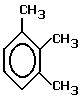 ,
,

Number of low resolution
NMR
chemical shift
δ
signal peaks: 4 1H and
6 13C
(email
if disagree?)
1H NMR integrated ratio of peaks:
1 : 2(1+1)
: 6(3+3)
: 3 (aromatic:
alkyl, for equivalent protons)
For the 1H or 12C chemical environments of the
benzene ring C1 = C3 and C4 = C6 and the two of the methyl
groups are equivalent to each other (on C1 and C3).
(7) 1,2,4-trimethylbenzene,
 ,
,

Number of low resolution
NMR
chemical shift
δ
signal peaks: 6 1H and
9 13C
(email
if disagree?)
1H NMR integrated ratio of peaks:
1 : 1 : 1
: 3 : 3 : 3 (aromatic:
alkyl, for equivalent protons)
All of the 1H or 12C chemical environments are
different.
No symmetry in the molecule, so the maximum
number of possible chemical shifts should be observed.
(8)
1,3,5-trimethylbenzene,
 ,
,

Number of low resolution
NMR
chemical shift
δ
signal peaks: 2 1H and
2 13C
(email
if disagree?)
1H NMR integrated ratio of peaks:
3(3x1)
: 9(3x3) (aromatic:
alkyl, for equivalent protons)
A highly symmetrical molecule, greatly reduced
maximum number of NMR peaks.
In fact this is the minimum chemical shifts
possible in any of the benzene ring isomers.
For the 1H or 12C chemical environments of the
benzene ring C1 = C3 = C5, C2 = C4 = C6 and all the methyl
groups are equivalent to each other (on C1, C3 and C5).
See also
spectra links
Other non-aromatic
isomers of C9H12
(i.e. C9H12 isomers with no benzene ring)
There are potentially hundreds of other 'non-aromatic'
isomers of formula C9H12, though many of these isomers are highly reactive
and very unstable and some may not exist at all (except
theoretically!).
Gopalpur Nagendrappa of Bangalore University, India has come up
with 217 theoretical isomers of C6H6 at
https://www.ias.ac.in/article/fulltext/reso/006/05/0074-0078 wow !!!!,
so goodness knows how many theoretical isomers there are of formula C9H12.
See also at the commercial molport website for isomers of
C9H12
https://www.molport.com/shop/molecular-formula/C9H12
BUT, beware, the website uses Kekule formulae for
benzene ring compounds and mixes condensed structural formulae with
skeletal formulae, so take care when interpreting these C9H12 isomer
formulae.
(3) EXTRA NOTES on the
benzene ring isomers of molecular formula C9H12
These are the only eight aromatic isomers
with formula C9H12
and a benzene ring.
Explanation of Structure and Properties of the
benzene ring isomers of C9H12
-
Benzene ring: Provides aromatic stability
and reactivity due to delocalized π electrons.
-
Alkyl substituents: Influence boiling
point, solubility, and reactivity. Methyl groups are electron-donating,
enhancing ring activation e.g. in electrophilic substitution of the benzene
ring.
-
Isomerism: Positional isomers differ in
physical properties (boiling point, density) and chemical behaviour
(reactivity in electrophilic substitution).
Uses and Applications of the benzene ring isomers
of C9H12
1.
Trimethylbenzenes
-
1,2,3-Trimethylbenzene (Hemimellitene):
-
1,2,4-Trimethylbenzene (Pseudocumene):
-
Most industrially significant isomer.
-
Used in production of phthalic anhydride,
a precursor for plasticizers and polyesters.
-
Solvent in paints, coatings, and inks.
-
1,3,5-Trimethylbenzene (Mesitylene):
2.
Ethylmethylbenzenes
Comparison Summary of the benzene ring isomers of
C9H12
|
Feature |
Trimethylbenzenes |
Ethylmethylbenzenes |
|
Industrial relevance |
High (especially
1,2,4-isomer) |
Moderate |
|
Common uses |
Solvents,
intermediates, fuel additives |
Solvents, fuel
additives |
|
Reactivity |
Higher due to methyl
activation |
Slightly lower due to
ethyl bulk |
|
Spectroscopic symmetry |
Mesitylene (1,3,5)
highly symmetric |
Less symmetric |
|
Toxicity & handling |
Moderate; flammable
and irritant |
Similar safety profile |
(4)
Learning objectives - questions to be answered?
Can you IUPAC name these isomers
of molecular formula C9H12?
Can you deduce the number of principal 1H chemical
shifts and proton ratio you would expect to see in the 1H NMR spectrum of
these C9H12 isomers?
Can you deduce the number of principal 13C chemical
shifts you would expect to see in the 13C NMR spectrum of these C9H12
isomers?
What are the
structural-constitutional isomers of C9H12?
What arene isomers have the
formula C9H12?
Draw and name the alkylbenzene isomers of C9H12
What aromatic hydrocarbons have the formula C9H12?
What benzene ring
molecules have the formula C9H12?
Can you write out the names of the aromatic isomers of formula
C9H12?
What are the possible
isomers of C9H12 aromatic molecules?
How do you work out the structure
of the isomers of molecular formula C9H12 aromatic molecules?
How do you draw the structural
formula and skeletal formula of the isomers of molecular formula
C9H12 aromatic molecules?
How do you name the isomers of molecular formula
C9H12 aromatic molecules?
How many structural
isomers are there of molecular formula C9H12 aromatic molecules?
How many carbon chain
isomers are there of molecular formula C9H12 aromatic molecules?
How many positional isomers are
there of molecular formula C9H12 aromatic molecules?
Are there any functional group
isomers with a molecular formula C9H12 aromatic molecules?
Do C9H12 aromatic molecules have any stereoisomers?
Are there any E/Z (geometrical)
aromatic isomers with a molecular formula C9H12?
Are there any R/S (optical)
aromatic isomers
(enantiomers) with a molecular formula C9H12?
This page will answer these questions
for molecular formula C9H12 aromatic molecules
(5)
QUESTIONS
|
Practise exam questions based on selected aromatic isomers of molecular formula C9H12
Jot
down your responses
with explanations!
ANSWERS
to the questions based on the isomers of
C9H12
If you think there are
any errors, please email me asap at
chem55555@hotmail.com
I don't mind if students/teachers do a selected printout
of these questions and answers.
Given six isomers of molecular formula
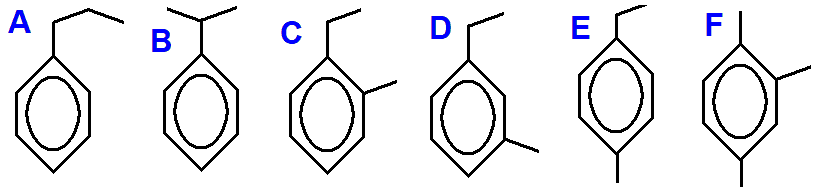
Q1 Name
A to F and draw the structural formula of B and D.
Q2 On
refluxing with aqueous sodium hydroxide/potassium
manganate(VII), which isomers will give the sodium salt of
benzoic acid? and give an exemplar equation using [O] in the
equation.
Q2 On
refluxing with aqueous dilute sulfuric acid/potassium
manganate(VII), which isomers will yield
benzene-1,4-dicarboxylic acid and give the simplified equation
using [O].
Q3 Can
any of the benzene based isomers of C9H12
exhibit E/Z (geometrical) or R/S (optical) isomerism?
If you think there are
any errors, please email me asap at
chem55555@hotmail.com
|
Associated organic chemistry links
Index of sets of isomers for a given
molecular formula
Molecular structure and nomenclature of aromatic
compounds
The chemistry of aromatic compounds
All my advanced Level pre-university
organic chemistry notes
IR, mass and H-1 and C-13 NMR
spectra of organic compounds
Isomerism: introduction, structural isomerism - chain,
positional, functional group, tautomerism
Stereoisomerism:
introduction, definition,
priority rules, E/Z isomerism (cis/trans isomerism)
Stereoisomerism - R/S isomerism (optical
isomerism) -
definition - examples explained This is a big chemistry website, please allow time
to explore it
Index of my advanced
(pre-college/university) organic
chemistry revision notes
Index
of all my spectroscopy pages
Index
of all my isomerism pages
The chemistry of
alkanes and the petrochemical
industry
The
chemistry of alkenes
The
chemistry of haloalkanes
The
chemistry of
alcohols
The chemistry of
aldehydes
and ketones The
chemistry of carboxylic acids and derivatives The chemistry of
organo-nitrogen compounds
The chemistry of
aromatic compounds
Summary diagram of isomerism which
links to details of the types of isomerism

|
Website content © Dr
Phil Brown 2000+. All copyrights reserved on revision notes, images,
quizzes, worksheets etc. Copying of Doc Brown's pre-university
advanced level chemistry website material is NOT
permitted. Exam revision summaries & references to science course specifications
are unofficial. These organic chemistry revision notes on
isomerism are
suitable for use of pre-university students studying AQA advanced level
chemistry constitutional isomers of C9H12, Edexcel advanced level
chemistry constitutional isomers of C9H12, OCR advanced level
chemistry constitutional isomers of C9H12, IB advanced level
chemistry constitutional isomers of C9H12, WJEC (Eduqas) advanced
level chemistry constitutional isomers of C9H12, CIE Cambridge advanced level chemistry
constitutional isomers of C9H12, US grade 11-12 AP honors
chemistry courses constitutional isomers of C9H12 and they will also prove useful to
1st year undergraduate students of chemistry including
constitutional isomers of C9H12. |
Keywords or phrases: how many isomers are
there of molecular formula C9H12 aromatic molecules? how do you name the isomers of
molecular formula C9H12 aromatic molecules? what is the molecular structure of the
isomers of C9H12 aromatic molecules, what type of isomerism is exhibited by molecules
of formula C9H12 aromatic molecules, the carbon chain
isomers of C9H12 aromatic molecules, comparing
the spectra of isomers of molecular formula C9H12 aromatic
molecules how many structural isomers of
C9H12 aromatic molecules can you draw? how many structural isomers does
C9H12 aromatic molecules have?
what are the possible isomers of C9H12 aromatic molecules? revision notes on
isomerism of C9H12 aromatic molecules the molecular structure of
the isomers of C9H12 aromatic molecules how to draw the
structural formula of isomers of C9H12 aromatic molecules, how to draw the displayed
formula of isomers of C9H12 aromatic molecules, how to draw the
skeletal formula of isomers of C9H12 aromatic molecules, how to name the isomers of molecular formula
C9H12 aromatic molecules,
R/S optical isomers
enantiomers of C9H12 aromatic molecules cycloalkenes and alkynes R/S
optical isomers cis trans stereoisomers of C9H12 aromatic
molecules E/Z geometrical isomers of molecular formula
C9H12 aromatic molecules (geometric cis/trans
isomers), molecules isomeric with molecular formula C9H12 aromatic
molecules, structural isomers of molecular
formula C9H12 aromatic molecules,
which types of isomerism are exhibited by molecules isomeric with
molecular formula C9H12 aromatic molecules alkyl positional isomers of
C9H12 aromatic molecules branched carbon chain alkene isomers of
C9H12 aromatic molecules,
positional isomers isomeric with molecular formula C9H12 aromatic
molecules,
which types of isomerism are exhibited by molecules isomeric with
molecular formula C9H12 aromatic molecules alkyl positional isomers of
C9H12 aromatic molecules cycloalkenes and alkynes branched carbon
chain cycloalkene isomers of molecular formula C9H12 aromatic
molecules
arenes of formula C9H12 aromatic hydrocarbons of formula C9H12
alkylbenzenes of formula C9H12
|
ANSWERS
Practise exam questions based on selected aromatic isomers of molecular formula C9H12
If you think there are
any errors, please email me asap at
chem55555@hotmail.com
Given six isomers of molecular formula
Q1 Name
A to F and draw the structural formula of B and D.
ANSWERS
A propylbenzene,
B
(1-methylethyl)benzene,
C
1-ethyl-2-methylbenzene
D 1-ethyl-3-methylbenzene,
E
1-ethyl-4-methylbenzene,
E
1,2,3-trimethylbenzene.
B
and D
Q2 On
refluxing with aqueous sodium hydroxide/potassium
manganate(VII), which isomers will give the sodium salt of
benzoic acid? and give an exemplar equation using [O] in the
equation.
ANSWERS
A and B, all alkyl groups
become oxidised to the -COOH carboxylic acid group leaving the
stable benzene ring.
e.g.
C6H5CH2CH2CH3
+ 9[O] + NaOH ===> C6H5COONa
+ 4H2O + 2CO2
Q2 On
refluxing with aqueous dilute sulfuric acid/potassium
manganate(VII), which isomers will yield
benzene-1,4-dicarboxylic acid and give the simplified equation
using [O].
ANSWERS
Only E,
alkyl groups in the 1,4 positions
+ 9[O]
===>
 + 3H2O + CO2
Q3 Can
any of the benzene based isomers of C9H12
exhibit E/Z (geometrical) or R/S (optical) isomerism?
ANSWERS
None,
no open chain C=C or chiral carbon in any of the eight isomers.
If you think there are
any errors, please email me asap at
chem55555@hotmail.com
|
|
