|
Doc Brown's
Advanced A level Chemistry: Part 14.7 Isomerism in organic chemistry
The 14 Constitutional
isomers and associated stereoisomers of molecular formula C5H12O
[Author
©
Dr
Phil Brown PhD:
Doc Brown's advanced A level organic chemistry exam revision notes
suitable for students of UK A level chemistry courses,
IB advanced chemistry & US K12 grade
11, grade 12 and AP honors chemistry courses: Molecular
spectroscopy and analysing the isomers of C5H12O
[page updated
RE-EDIT]
Sub-index for this
page on the isomers of C5H12O
Details of the constitutional isomers and
stereoisomers of
C5H12O
Extra notes and key points about the isomers of
C5H12O
Multiple choice quiz of basic questions on
the isomers of C5H12O
(with answers!)
email
doc brown - comments - query?
[privacy policy, cookies
and disclaimer]
Associated organic chemistry page links
Index of sets of isomers for a given
molecular formula
This is a big chemistry website, please allow time
to explore it
The
14 aliphatic non-cyclic (open chain) alcohol and ether
constitutional structural isomers of molecular formula C5H12O
Introduction to isomerism for molecular formula
C5H12O
(see also summary
diagram)
Percent mass composition of
C5H12O based on
the relative atomic masses
C= 12.01 H =
1.01 O = 16.00 and Mr(C5H12O) =
88.17
Element composition of
C5H12O by mass:
68.11% carbon * 13.74%
hydrogen * 18.15% oxygen
Empirical formula
= molecular formula of
C5H12O

Structural isomerism
includes (a) carbon chain variation (usually need a minimum of 4 C atoms),
(b) change in position of a substituent or functional group and
(c) functional group
isomerism where the atoms have a different configuration, usually with
significant differences in chemical and physical properties.
All three are applicable
for isomers of
C5H12O
(a) carbon chain variation and variation of C-O-C chains
in ethers rather than C-C-C
(b) variation of position of hydroxy/alcohol (OH) and
methoxy (OCH3) groups in the carbon chain.
(c) functional group isomerism -
alcohol
C-O-H group and ether C-O-C linkage
Stereoisomerism is
where molecules have the same basic constitutional structural formula, but
isomers differ in the 2D/3D arrangement of the atoms.
E/Z
stereoisomerism was called 'geometrical isomerism' e.g. cis
and trans isomers of alkenes or disubstituted cyclic alkanes
where there are 3D spatial variations that are not mirror images and not
super imposable.
E/Z geometrical isomerism
not possible with isomers of
C5H12O
R/S
stereoisomerism was called 'optical isomerism', the pairs of
isomers are called enantiomers which are 3D non-superimposable
mirror image forms of the molecule. The molecule must have a chiral centre
(a stereocentre), that is an asymmetric carbon atom with four
different atoms/groups attached to it.
4 of the constitutional isomers can exhibit R/S
optical isomerism.
Note
There are a total of 14 constitutional isomers of
molecular formula C5H12O.
4 of the constitutional can exhibit R/S optical isomerism
- examples of stereoisomerism, pairs of enantiomers (3 alcohols and 1 ether).
Therefore, there are a
total of 18 distinct isomers
of molecular formula C5H12O
In terms of constitutional isomers, there are
8 alcohols
(3 exhibit R/S optical isomerism) and
6 ethers
(1 exhibits R/S optical isomerism), so there are 8
stereoisomers.
C5H12O
isomers are a good example of
functional group
isomerism (alcohol C-O-H linkage, ether C-O-C linkage)
Details
of the 14 constitutional isomers of molecular
formula
C5H12O
(including the 4 that can form pairs of R/S
'optical' isomers, enantiomers, and assignment rule quoted)
There are eight isomeric alcohols and six
isomeric ethers of formula
C5H12O
They are all open chain aliphatic compounds.
The
8 alcohols: molecules (1) to (8) Functional group C-OH
(alcohol, suffix 'ol' in IUPAC names)
(1)
pentan-1-ol,
1-pentanol,
n-pentyl alcohol
 ,
,
 ,
,
 ,
,
 is a linear primary alcohol
Number of low resolution
NMR chemical shift
δ
signal peaks: 6 1H
and 5 13C
(email
if disagree?)
1H NMR proton ratio of integrated peak areas:
3 : 2 : 2 : 2 2 : 1 (for equivalent protons)
(2)
pentan-2-ol,
2-pentanol,
 ,
,
 ,
,

(a linear secondary alcohol),
that will exhibit optical (R/S) isomerism,
the 2nd carbon atom is a chiral centre.
 R (left) and S (right)
The R/S stereoisomers of pentan-2-ol
(enantiomers, optical
isomers)
From the CIP assignment priority rule for R/S
isomers:
8O >
6C6C >
6C1H > 1H
Number of low resolution
NMR chemical shift
δ
signal peaks: 6 1H
and 5 13C
(email
if disagree?)
1H NMR proton ratio of integrated peak areas:
3 : 1 : (1) : 2 : 2 : 3 (for equivalent protons)
(3)
pentan-3-ol, 3-pentanol
 ,
,
 ,
,

A
linear secondary alcohol
Number of low resolution
NMR chemical shift
δ
signal peaks: 4 1H
and 3 13C
(email
if disagree?)
1H NMR proton ratio of integrated peak areas:
6 (3+3) : 4
(2+2) : 1 : (1) (for equivalent protons)
(4)
2-methylbutan-1-ol,
2-methyl-1-butanol,
 ,
,
 ,
,

A branched primary
alcohol that will exhibit optical (R/S) isomerism,
the 2nd carbon atom C2 is a chiral centre.
Number of low resolution
NMR chemical shift
δ
signal peaks: 6 1H
and 5 13C
(email
if disagree?)
1H NMR proton ratio of integrated peak areas:
3 : 2 : 1 : (3) : 2 : 1 (for equivalent protons)
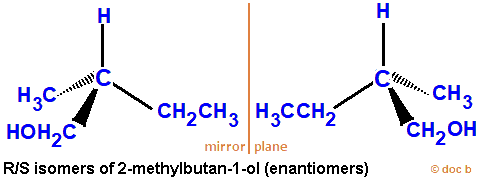 R (left), S (right)
The R/S stereoisomers of
2-methylbutan-1-ol (enantiomers, optical
isomers)
From the CIP assignment priority rule for R/S
isomers:
6C8O >
6C6C >
6C1H > 1H
(5)
3-methylbutan-1-ol,
3-methyl-1-butanol,
 ,
,
 ,
,

A
branched primary alcohol
Number of low resolution
NMR chemical shift
δ
signal peaks: 5 1H
and 4 13C
(email
if disagree?)
1H NMR ratio of integrated peak areas:
6 (3+3) : 1 : 2 : 2 : 1 (for equivalent protons)
(6)
2-methylbutan-2-ol, 2-methyl-2-butanol,
 ,
,
 ,
,

A tertiary alcohol
Number of low resolution
NMR chemical shift
δ
signal peaks: 4 1H
and 4 13C
(email
if disagree?)
1H NMR ratio of integrated peak areas:
6 (3+3) : (1) : 2 : 3 (for equivalent protons)
(7)
3-methylbutan-2-ol,
3-methyl-2-butanol,
 ,
,

 , A branched secondary alcohol, will exhibit optical (R/S) isomerism
 R (left), S (right)
The R/S stereoisomers of
3-methylbutan-2-ol (enantiomers, optical
isomers, C2 is chiral)
From the CIP assignment priority rule for R/S
isomers:
8O >
6C6C >
6C1H > 1H
Number of low resolution
NMR chemical shift
δ
signal peaks: 5 1H
and 4 13C
(email
if disagree?)
1H NMR proton ratio of integrated peak areas:
6 (3+3) : 1 : 1 : 1 : 3 (for equivalent protons)
(8)
2,2-dimethylpropan-1-ol,
2,2-dimethyl-1-propanol,
 ,
,

 , A branched primary alcohol
Number of low resolution
NMR chemical shift
δ
signal peaks: 3 1H
and 3 13C
(email
if disagree?)
1H NMR ratio of integrated peak areas:
9 (3x3) : 2 : 1 (for equivalent protons)
The ethers: molecules (9) to (14)
Functional group: ether linkage
C-O-C
(prefix alkoxy in IUPAC name)
(9)
1-methoxybutane,
butyl methyl ether,
linear ether
 ,
,
 ,
,

Number of low resolution
NMR chemical shift
δ
signal peaks: 5 1H
and 5 13C
(email
if disagree?)
1H NMR proton ratio of integrated peak areas: 3 : 2 : 2
: 2 : 3 (for equivalent protons)
(10)
2-methoxybutane,
sec-butyl methyl ether
 ,
,
 ,
,

This branched ether will exhibit optical (R/S) isomerism,
C2 carbon atom is chiral
 R (left), S (right)
The R/S stereoisomers of
2-methoxybutane (enantiomers, optical
isomers)
From the CIP assignment priority rule for R/S
isomers:
8O >
6C6C >
6C1H > 1H
Number of low resolution
NMR chemical shift
δ
signal peaks: 5 1H
and 5 13C
(email
if disagree?)
1H NMR ratio of integrated peak areas:
3 : 1 : 3 : 2 : 3 (for equivalent protons)
(11)
1-ethoxypropane, ethyl
propyl ether,
linear ether, chain of C and O atoms
 ,
,
 ,
,

Number of low resolution
NMR chemical shift
δ
signal peaks: 5 1H
and 5 13C
(email
if disagree?)
1H NMR proton ratio of integrated peak areas: 3 : 2 : 2
: 2 : 3 (for equivalent protons)
(12)
2-ethoxypropane, ethyl isopropyl
ether,
a branch ether
 ,
,
 ,
,

Number of low resolution
NMR chemical shift
δ
signal peaks: 4 1H
and 4 13C
(email
if disagree?)
1H NMR proton ratio of integrated peak areas: 3 : 2 : 1
: 6 (3+3) (for equivalent protons)
(13)
1-methoxy-2-methylpropane
,
iso-butyl methyl ether,

 ,
,  A branched ether.
Number of low resolution
NMR chemical shift
δ
signal peaks: 4 1H
and 4 13C
(email
if disagree?)
1H NMR proton ratio of integrated peak areas: 3 : 2 : 1
: 6 (3+3) (for equivalent protons)
(14)
2-methoxy-2-methylpropane,
tert-butyl methyl ether,
 ,
,
 ,
,
 ,
A branched ether.
,
A branched ether.
Number of low resolution
NMR chemical shift
δ
signal peaks: 2 1H
and 3 13C
(email
if disagree?)
1H NMR ratio of integrated peak areas: 9
(3x3) : 3 (for equivalent protons)
Extra information
about the isomers of molecular formula
C5H12O
Constitutional Isomers of
C5H12O
The molecular formula
C5H12O
gives rise to 14 constitutional isomers: 8 alcohols and 6 ethers.
Four of these can exhibit R/S optical stereoisomerism (pairs of enantiomers,
optical isomers), therefore there are a total of 18 distinct isomers.
Eight of these are alcohols (–OH functional group), six are
ethers (R–O–R′ functional group), and three alcohols and one ether are
optically active (have a chiral centre, an asymmetric carbon atom attached
to four different atoms or groups).
| IUPAC Name |
Type |
Structural
Isomerism Subtype |
Chiral |
| Pentan-1-ol |
Alcohol |
Functional group;
positional |
No |
| Pentan-2-ol |
Alcohol |
Functional group;
positional |
Yes |
| Pentan-3-ol |
Alcohol |
Functional group;
positional |
No |
| 2-Methylbutan-1-ol |
Alcohol |
Functional group;
chain;
positional |
Yes |
| 3-Methylbutan-1-ol |
Alcohol |
Functional group;
chain;
positional |
No |
| 2-Methylbutan-2-ol |
Alcohol |
Functional group;
chain;
positional |
No |
| 3-Methylbutan-2-ol |
Alcohol |
Functional group;
chain; positional |
Yes |
|
2,2-Dimethylpropan-1-ol |
Alcohol |
Functional group;
chain, most branched |
No |
| 1-Methoxybutane |
Ether |
Functional group,
positional |
No |
| 2-Methoxybutane |
Ether |
Functional group;
positional |
Yes |
|
1-Methoxy-2-methylpropane |
Ether |
Functional group;
chain;
positional |
No |
|
2-Methoxy-2-methylpropane |
Ether |
Functional group;
chain;
positional |
No |
| 1-Ethoxypropane |
Ether |
Functional group;
chain;
positional |
No |
| 2-Ethoxypropane |
Ether |
Functional group;
chain;
positional |
No |
Types
of Isomerism Exhibited
by isomers of molecular formula
C5H12O
1. Structural (Constitutional)
Isomerism
• Chain isomerism: differences in carbon-skeleton branching
(e.g., pentan-1-ol vs. 2-methylbutan-1-ol).
• Positional isomerism: same skeleton but functional group in different
positions (e.g., pentan-2-ol vs. pentan-3-ol).
• Functional-group isomerism: same formula but different functional groups
(alcohols versus ethers).
2. Stereoisomerism
• R/S Optical isomerism: three alcohols (pentan-2-ol, pentan-3-ol,
2-methylbutan-1-ol, 3-methylbutan-2-ol and one ether (2-methoxybutane), each contain one chiral
center and thus exist as enantiomeric pairs.
Physical Properties: Trends and Comparisons
of the isomers of molecular formula
C5H12O
• Boiling points (see data table below):
-
Alcohols (hydrogen-bond donors/acceptors) have much higher
bps than their ether isomers.
-
Within alcohols, increased branching lowers bpts (e.g.,
2-methylbutan-1-ol bp < pentan-1-ol bpt).
• Solubility in water:
• Density & viscosity:
A detailed table
of the 14 isomers of C5H12O (8 alcohols and 6 ethers),
including their IUPAC names, boiling points and dipole moments
|
IUPAC Names |
Type |
Boiling Point (°C) |
~Dipole Moment (D) |
|
1-Pentanol, pentan-1-ol |
Alcohol |
138 |
~1.6 |
|
2-Pentanol, pentan-2-ol |
Alcohol |
119 |
~1.8 |
|
3-Pentanol, pentan-3-ol |
Alcohol |
115 |
~1.8 |
|
2-Methyl-1-butanol,
2-methylbutan-1-ol |
Alcohol |
131 |
~1.6 |
|
3-Methyl-1-butanol,
3-methylbutan-1-ol |
Alcohol |
131 |
~1.6 |
|
2-Methyl-2-butanol,
2-methylbutan-2-ol |
Alcohol |
102 |
~1.7 |
|
3-Methyl-2-butanol,
3-methylbutan-2-ol |
Alcohol |
113 |
~1.7 |
|
2,2-dimethyl-1-propanol, 2,2-dimethylpropan-1-ol |
Alcohol |
113 |
~1.6 |
|
1-methoxybutane |
Ether |
90 |
~1.3 |
|
2-methoxybutane |
Ether |
92 |
~1.3 |
|
1-ethoxypropane |
Ether |
93 |
~1.3 |
|
2-ethoxypropane |
Ether |
94 |
~1.3 |
|
1-methoxy-2-methylpropane |
Ether |
95 |
~1.3 |
|
2-methoxy-2-methylpropane |
Ether |
96 |
~1.3 |
Notes:
-
Melting and boiling points are approximate and can
vary slightly depending on purity and measurement conditions.
-
Dipole moments are estimated based on structural
features and available data; ethers tend to have lower dipole moments than
alcohols due to lack of hydrogen bonding.
-
The alcohols tend to have higher boiling points than their
isomeric ether due to hydrogen bonding via the OH group, absent in ethers.
-
The alcohols also tend to have lower dipole moments than
their isomeric ethers due to the more polar -OH group, absent in ethers.
Chemical Reactivity and Relative
Reactivity
of the isomers of molecular formula
C5H12O
• Alcohols:
-
React with carboxylic acids to give useful esters -
solvents, fragrances etc.
-
Oxidation trend: primary → aldehyde → carboxylic acid; secondary →
ketone; tertiary resist oxidation under mild conditions.
-
Dehydration trend: tertiary > secondary > primary (tertiary
dehydrate most readily via E1 mechanism).
-
Substitution (SN1/SN2): tertiary > secondary for SN1;
primary favour SN2.
• Ethers:
-
Cannot react with carboxylic acids to give useful esters.
-
Generally inert to base/weak acid; cleaved by strong
acids (HI, HBr) via SN1 or SN2, depending on substitution.
-
Resistant to oxidation and dehydration.
• Relative reactivity ranking (in typical substitution):
tertiary alcohol > secondary alcohol > primary alcohol >> ethers.
Uses
and Applications
of the isomers of molecular formula
C5H12O
• Pentanols: solvents, flavour/fragrance (ester) precursors,
intermediates in ester synthesis.
• Branched alcohols: plasticizers, high-octane fuel additives (e.g.,
2-methylbutan-2-ol derivatives).
• MATE (2-methoxy-2-methylpropane): octane booster in gasoline.
• Ethyl-propyl ethers: specialty solvents in organic synthesis and
fragrances.
Common
Student Misconceptions involving the isomers of
C5H12O
• “Only straight-chain alcohols exist” (overlooking branched
isomers).
• Confusing ether isomer count with alcohols; forgetting functional-group
isomers.
• Failing to recognize chiral centres in secondary alcohols on
non-symmetrical chains.
• Misnumbering substituents due to chain-end symmetry.
Exam
Revision Tips for questions involving the isomers of
C5H12O
-
Draw systematically:
-
Learn definitions and examples of chain, positional,
functional-group, and optical isomerism.
-
Practice CIP rules for assigning R/S configurations to
chiral alcohols.
-
Tabulate boiling-point trends vs. branching and functional
group.
-
For mechanism questions (AP, IB HL):
-
Outline oxidation, substitution, dehydration mechanisms.
-
Connect tertiary alcohols to SN1/E1 pathways; primary to
SN2/E2.
-
Board-specific pointers:
-
AQA/Edexcel/OCR/WJEC/CCEA: expect drawing all isomers
and naming under timed conditions.
-
CIE/IB: focus on stereochemistry, optical activity
calculations, specific rotation.
-
AP Honors: integrate mechanistic arrow-pushing with
kinetics (rate laws) for SN1/SN2, acid-catalyzed conversions.
Practice multiple choice questions based on
the isomers of
C3H6O
A set of randomized,
technically rich multiple-choice questions based on the
isomers of C5H12O
(alcohols and ethers), tailored for A-level and
pre-university chemistry courses including AQA,
Edexcel, OCR, WJEC, CCEA, CIE, IB, and AP Chemistry. Each
question includes:
- Structural, physical, or
chemical differences
- Spectroscopic distinctions (¹H
NMR, ¹³C NMR, IR)
- Esterification, solubility,
boiling point trends
- Distractor analysis and exam
tips
You may
have to sketch out some molecular structures to work out the
answer.
Jot
down your responses and check out the answers
ANSWERS
to the questions based on the isomers of C5H12O
If you think there are
any errors, please email me asap at
chem55555@hotmail.com
1. Which isomer of
C5H12O
would show the fewest signals in a 13C NMR spectrum?
- pentan-1-ol
- 2-methylbutan-2-ol
- 1-methoxybutane
- 1-ethoxypropane
2. Which isomer is readily oxidised to an aldehyde?
- pentan-1-ol
- pentan-2-ol
- 2-methylbutan-2-ol
- 1-methoxybutane
3. Which isomer would show a broad O–H stretch in its IR spectrum
around 3300 cm⁻¹?
- pentan-1-ol
- 1-methoxybutane
- 2-ethoxypropane
- 1-methoxy-2-methylpropane
4. Which isomer is most likely to form an ester with ethanoic acid?
- 2-methoxybutane
- 2-methylbutan-2-ol
- pentan-1-ol
- 1-ethoxypropane
5. Which isomer has the lowest boiling point?
- pentan-1-ol
- pentan-2-ol
- 2-methylbutan-2-ol
- 2-ethoxypropane
6. Which isomer would show a triplet and quartet in its ¹H NMR
spectrum due to an ethyl group?
- pentan-1-ol
- pentan-2-ol
- 1-ethoxypropane
- 2-methylbutan-2-ol
7. Which isomer has a tertiary alcohol group?
- pentan-2-ol
- 3-methylbutan-2-ol
- 2-methylbutan-2-ol
- pentan-1-ol
8. Which isomer would show no O–H stretch in IR and no exchangeable
proton in ¹H NMR?
- pentan-1-ol
- pentan-2-ol
- 2-ethoxypropane
- 3-methylbutan-1-ol
9. Which isomer would readily give a ketone on oxidation?
- pentan-1-ol
- pentan-2-ol
- 2-methylbutan-2-ol
- 1-methoxybutane
10. Which isomer would show the greatest number of non-equivalent
hydrogen environments in 1H NMR?
- pentan-1-ol
- pentan-3-ol
- 3-methylbutan-2-ol
- 2,2-dimethylpropan-1-ol
11. Which isomer is most likely to undergo dehydration to form a
stable alkene?
- pentan-1-ol
- pentan-2-ol
- 2-methylbutan-2-ol
- 3-methylbutan-1-ol
12. Which isomer would show a singlet in ¹H NMR for three equivalent
methyl groups?
- 2,2-dimethylpropan-1-ol
- 3-methylbutan-2-ol
- pentan-2-ol
- 1-methoxybutane
13. Which isomer would not readily oxidise to an aldehyde or ketone?
- pentan-1-ol
- pentan-2-ol
- 2-methylbutan-2-ol
-
2,2-dimethylpropan-1-ol
14. Which isomer would show a strong C–O stretch in IR but no O–H
stretch?
- pentan-1-ol
- pentan-2-ol
- 2-ethoxypropane
- 3-methylbutan-1-ol
15. Which isomer would show only four distinct 1H NMR
signals?
- pentan-1-ol
- 1-ethoxypropane
- 1-methoxybutane
- 2-ethoxypropane
16. Which isomer has the most branched carbon skeleton?
- 2-methylbutan-2-ol
- pentan-1-ol
- pentan-2-ol
- 1-methoxybutane
17. Which isomer would show the fewest peaks in 1H NMR
due to symmetry?
- 2-methylbutan-2-ol
- pentan-1-ol
- pentan-2-ol
- 1-methoxybutane
18. Which isomer would show the highest boiling point?
- pentan-1-ol
- 2-ethoxypropane
- 2-methylbutan-2-ol
- 1-methoxybutane
ANSWERS
to the questions based on the isomers of C5H12O
|
Learning objectives - questions to be answered about
molecular formula
C5H12O?
How many constitutional isomers are there of formula
C5H12O?
How do you draw the skeletal structure of isomers of C5H12O?
How do you draw the structural formula of isomers of C5H12O?
Can you recognise the different functional groups in the isomers
of C5H12O?
How do you name the isomers of C5H12O?
How do you work out the structure
of the isomers of molecular formula C5H12O?
How do you draw the structural
formula and skeletal formula of the isomers of molecular formula
C5H12O?
How do you name the isomers of molecular formula
C5H12O?
How many aliphatic structural
isomers are there of molecular formula C5H12O?
How many aliphatic carbon chain
isomers are there of molecular formula C5H12O?
How many positional isomers are
there of molecular formula C5H12O?
How many E/Z (geometrical) isomers
are there of molecular formula C5H12O?
How many R/S (optical) isomers
(enantiomers) of molecular formula C5H12O?
Are there any functional group
isomers with a molecular formula C5H12O?
Does C5H12O have any stereoisomers?
This page will answer
these questions
for molecular formulae
C5H12O
ANSWERS to the Practice multiple choice questions based on
the isomers of
C3H6O
If you think there are
any errors, please email me asap at
chem55555@hotmail.com
1. Which isomer of
C5H12O
would show the fewest signals in a 13C NMR spectrum?
- pentan-1-ol
5 13C
δ
- 2-methylbutan-2-ol
4 13C
δ
- 1-methoxybutane
5 13C
δ
- 1-ethoxypropane
5 13C
δ
Answer: B.
2-methylbutan-2-ol
Explanation: More symmetrical; fewer unique
carbon environments.
Distractors:
- A: Linear alcohol → more
distinct carbons.
- C/D: Ethers and branched
alcohols → more environments.
Tip: Count unique carbon types, not total
atoms.
2. Which isomer is readily oxidised to an aldehyde?
- pentan-1-ol
- pentan-2-ol
- 2-methylbutan-2-ol
- 1-methoxybutane
Answer: A.
pentan-1-ol
Explanation: B & C oxidised to ketones, D
not readily oxidised
Misconception: Mixing up class of alcohol with
oxidation product
-
Oxidation: primary → aldehyde → carboxylic acid; secondary →
ketone; tertiary resist oxidation under mild conditions.
3. Which isomer would show a broad O–H stretch in its IR spectrum
around 3300 cm⁻¹?
- pentan-1-ol
- 1-methoxybutane
- 2-ethoxypropane
- 1-methoxy-2-methylpropane
Answer: A.
pentan-1-ol
Explanation: Alcohols show broad O–H
stretch; ethers do not.
Tip: Ethers lack O–H bonds.
4. Which isomer is most likely to form an ester with ethanoic acid?
- 2-methoxybutane
- 2-methylbutan-2-ol
- pentan-1-ol
- 1-ethoxypropane
Answer: C.
pentan-1-ol
Explanation: Primary alcohols esterify
easily.
Distractors:
- A/D: Ethers don’t esterify.
- B: Tertiary alcohols tend to
resist esterification.
5. Which isomer has the lowest boiling point?
- pentan-1-ol
- pentan-2-ol
- 2-methylbutan-2-ol
- 2-ethoxypropane
Answer: D.
2-ethoxypropane
Explanation: Ethers lack hydrogen bonding →
lower boiling points.
Tip: Alcohols > ethers in boiling point due to
H-bonding.
6. Which isomer would show a triplet and quartet in its ¹H NMR
spectrum due to an ethyl group?
- pentan-1-ol
- pentan-2-ol
- 1-ethoxypropane
- 2-methylbutan-2-ol
Answer: C.
1-ethoxypropane
Explanation: The 'isolated' ethyl group of
the ethoxy group gives this characteristic splitting.
Tip: Look for e.g. -O–CH2CH3
pattern, but NOT part of a longer alkyl chain, a bit subtle!
7. Which isomer has a tertiary alcohol group?
- pentan-2-ol
- 3-methylbutan-2-ol
- 2-methylbutan-2-ol
- pentan-1-ol
Answer: C.
2-methylbutan-2-ol
Explanation: OH attached to tertiary carbon.
Tip: Tertiary alcohols resist oxidation.
8. Which isomer would show no O–H stretch in IR and no exchangeable
proton in ¹H NMR?
- pentan-1-ol
- pentan-2-ol
- 2-ethoxypropane
- 3-methylbutan-1-ol
Answer: C.
2-ethoxypropane
Explanation: Ethers lack O–H groups.
9. Which isomer would readily give a ketone on oxidation?
- pentan-1-ol
- pentan-2-ol
- 2-methylbutan-2-ol
- 1-methoxybutane
Answer: B.
pentan-2-ol
Explanation:
-
Oxidation: primary → aldehyde → carboxylic acid; secondary →
ketone; tertiary resists oxidation under mild conditions.
10. Which isomer would show the greatest number of non-equivalent
hydrogen environments in 1H NMR?
- pentan-1-ol
6 1H
δ
- pentan-3-ol
4 1H
δ
- 3-methylbutan-2-ol
5 1H
δ
- 2,2-dimethylpropan-1-ol
3 1H
δ
Answer: A.
pentan-1-ol
Explanation: Linear structure → more
distinct environments.
B is symmetrical C-C-C(OH)-C-C, C
and D have equivalent methyl groups
11. Which isomer is most likely to undergo dehydration to form a
stable alkene?
- pentan-1-ol
- pentan-2-ol
- 2-methylbutan-2-ol
- 3-methylbutan-1-ol
Answer: C.
2-methylbutan-2-ol
Explanation: Tertiary alcohols dehydrate the
most easily → more stable carbocation in mechanism.
12. Which isomer would show a singlet in ¹H NMR for three equivalent
methyl groups?
- 2,2-dimethylpropan-1-ol
- 3-methylbutan-2-ol
- pentan-2-ol
- 1-methoxybutane
Answer: A.
2,2-dimethylpropan-1-ol
Explanation: Three methyls attached to same
carbon → singlet, no adjacent C-H proton.
13. Which isomer would not readily oxidise to an aldehyde or ketone?
- pentan-1-ol
- pentan-2-ol
- 2-methylbutan-2-ol
-
2,2-dimethylpropan-1-ol
Answer: C.
2-methylbutan-2-ol
Explanation: tertiary alcohol
-
Oxidation: primary → aldehyde → carboxylic acid; secondary →
ketone; tertiary resist oxidation under mild conditions.
14. Which isomer would show a strong C–O stretch in IR but no O–H
stretch?
- pentan-1-ol
- pentan-2-ol
- 2-ethoxypropane
- 3-methylbutan-1-ol
Answer: C.
2-ethoxypropane
Explanation: Ethers show C–O stretch but
lack O–H.
15. Which isomer would show only four distinct 1H NMR
signals?
- pentan-1-ol
6 1H
δ
- 1-ethoxypropane
5 1H
δ
- 1-methoxybutane
5 1H
δ
- 2-ethoxypropane
4 1H
δ
Answer: D.
2-ethoxypropane
Explanation: The most symmetrical molecule,
two equivalent methyl groups
16. Which isomer has the most branched carbon skeleton?
- 2-methylbutan-2-ol
- pentan-1-ol
- pentan-2-ol
- 1-methoxybutane
Answer: A.
2-methylbutan-2-ol
Explanation: Tertiary carbon with three
methyl groups.
17. Which isomer would show the fewest peaks in 1H NMR
due to symmetry?
- 2-methylbutan-2-ol
4 1H
δ
- pentan-1-ol
6 1H
δ
- pentan-2-ol
6 1H
δ
- 1-methoxybutane
5 1H
δ
Answer: A.
2-methylbutan-2-ol
Explanation: High symmetry → fewer unique H
environments, two equivalent methyl groups.
18. Which isomer would show the highest boiling point?
- pentan-1-ol
- 2-ethoxypropane
- 2-methylbutan-2-ol
- 1-methoxybutane
Answer: A.
pentan-1-ol
Explanation: Strong hydrogen bonding and
linear structure, C is more compact, B & D lack OH group to
facilitate the stronger intermolecular hydrogen bonding.
ANSWERS
to the questions based on the isomers of C5H12O
|
Associated organic chemistry links
Advanced Level pre-university
organic chemistry notes
IR, mass and H-1 & C-13 NMR
spectra of organic compounds
Index of sets of isomers for a given
molecular formula
The molecular structure and naming of aliphatic ALCOHOLS including isomeric ethers
INDEX of ALL revision notes on the chemistry of ALCOHOLS (and mention of ethers) For isomerism in organic chemistry, see also the
notes
Isomerism: introduction, structural isomerism - chain,
positional, functional group, tautomerism
Stereoisomerism:
introduction, definition,
priority rules, E/Z isomerism (cis/trans isomerism)
Stereoisomerism - R/S isomerism (optical
isomerism) -
definition - examples explained email doc
brown - comments - query?
This is a big chemistry website, please allow time
to explore it
Index of advanced
(pre-university) organic
chemistry revision notes
The chemistry of
alkanes and the petrochemical
industry
The
chemistry of alkenes
The
chemistry of organic halogen compounds
The
chemistry of
alcohols
The chemistry of
aldehydes
and ketones The
chemistry of carboxylic acids and derivatives
The chemistry of
organo-nitrogen compounds
The chemistry of
aromatic compounds
A summary chart of isomerism

|
Website content © Dr Phil Brown 2000+. All copyrights reserved on revision
notes, images, quizzes, worksheets etc. Copying of Doc Brown's pre-university
advanced level chemistry website material is NOT permitted. Exam revision
summaries & references to science course specifications are unofficial. These
organic chemistry revision notes on isomerism (alcohol and ether isomers of C5H12O)
are suitable for use of
pre-university students studying AQA advanced level chemistry, Edexcel advanced
level chemistry, OCR advanced level chemistry, IB advanced level chemistry, WJEC
(Eduqas) advanced level chemistry, CIE advanced level chemistry, US grade 11-12
AP honors chemistry courses and they will also prove useful to 1st year
undergraduate students of chemistry. |
Keywords or phrases: how many isomers are
there of molecular formula C5H12O? how do you name the isomers of
molecular formula C5H12O? what is the molecular structure of the
isomers of C5H12O, what type of isomerism is exhibited by molecules
of formula C5H12O, how do you work out the isomers of molecular
formula C5H12O, what are the structural isomers of C5H12O, the carbon chain
isomers of C5H12O in the homologous series of alkanes, comparing
the spectra of isomers of molecular formula C5H12O how many structural isomers of
C5H12O can you draw? how many structural isomers does C5H12O have?
what are the possible isomers of C5H12O? revision notes on
isomerism of C5H12O molecules, isomerism in
aliphatic alcohols, isomerism in aliphatic ethers, alcohol
isomers of C5H12O, ether isomers of C5H12O the molecular
structure of the isomers of C5H12O
R/S optical isomers enantiomers of C5H12O,
isomers of C5H12O of molecular mass 88 ethers alcohols molecules isomeric with molecular formula C5H12O, structural isomers of molecular formula C5H12O, optical isomers R/S enantiomers isomeric with molecular formula C5H12O, positional isomers isomeric with molecular formula C5H12O, which types of isomerism are exhibited by molecules isomeric with molecular formula C5H12O alkyl positional isomers of C5H12O branched carbon chain ethers alcohols isomers of C5H12O
|
