|
Doc Brown's
Advanced Chemistry: Part 14.7
The
constitutional-structural isomers of molecular formula
C5H11F,
C5H11Cl, C5H11Br
and
C5H11I
[Author
©
Dr
Phil Brown GRIC, PhD: Doc
Brown's advanced level organic chemistry exam revision notes suitable
for students of UK advanced level chemistry courses, IB advanced
chemistry & US K12 grades 11-12 and AP honors chemistry courses: Molecular
spectroscopy and analysing the isomers of C5H11X
(X = halogen)
[page updated
RE-EDIT]
Sub-index
for this page on the isomers of
C5H11X
(X = halogen)
(a)
Introduction to the 8 constitutional-structural
isomers of formula C5H11X
(b)
Details of
the 8 constitutional isomers of molecules of formulae
C5H11X
(c)
EXTRA
NOTES constitutional isomers of molecules of C5H11X
(X = halogen)
(d)
Learning objectives - questions to be answered?
(e)
Practise exam questions
based on isomers of
C5H11X
(X = halogen)
Associated organic chemistry page links
Index of sets of isomers for a given
molecular formula
This is a big chemistry website, please allow time
to explore it
email doc
brown - comments - query?
*
[privacy policy, cookies
and disclaimer]
(a) Introduction to the 8 constitutional-structural
isomers for each molecular formula
C5H11F,
C5H11Cl, C5H11Br
or
C5H11I

Relative molecular mass and
percent composition of
C5H11X
(X = halogen)
based on atomic masses:
C 12.01,
H 1.01, F 19.00, Cl 35.45,
Br 79.90, I 126.90
|
Formula of compound |
Relative molecular
mass |
%
carbon |
%
hydrogen |
%
halogen |
|
C5H11F |
90.16 |
66.61 |
12.32 |
21.07 |
|
C5H11Cl |
106.61 |
56.33 |
10.42 |
33.25 |
|
C5H11Br |
151.06 |
39.75 |
7.36 |
52.89 |
|
C5H11I |
198.06 |
30.32 |
5.61 |
64.07 |
Empirical formula = molecular formula =
C5H11X
(where X = a single halogen atom)
If applicable
(see isomerism
summary at the end of the page)
Structural isomerism
- isomers of the same specific molecular formula, based on different connectivity's of the constituent atoms
(the constitutional isomers), so
they cannot be spatially identical (but sometimes can be defined as having the same shape).
This includes (a)
carbon chain variation (usually need a minimum of 4 atoms),
(b) change in position of a substituent or functional group and
(c) functional group isomerism where the atoms have a different
connectivity configuration, usually with significant differences in
chemical and physical properties e.g.
The isomers here are based on (a) carbon chain variation and
(b) halogen atom position.
You might consider the terms primary, secondary and tertiary
as minor functional group isomerism?
Stereoisomerism - isomers
based on the same connectivity of the atoms (same constitutional
formula), but in some way, they are 2D or 3D spatially different
non-superimposable images (e.g. E/Z
'geometrical' isomers or mirror image R/S 'optical' isomers)
E/Z stereoisomerism
was called 'geometrical isomerism' e.g.
cis (= Z) and
trans (= E) isomers of alkenes
or disubstituted cyclic alkanes where there are 2D/3D spatial variations
that are not mirror images and not super imposable.
This is not possible for these open chain
saturated aliphatic compounds.
e.g. because there is no >C=C< double bond in these
molecules/
R/S stereoisomerism
was called 'optical isomerism', the pairs of isomers are called
enantiomers, which are 3D non-superimposable mirror image forms of the
molecule (enantiomers).
The molecule must have a chiral centre
(a stereocentre), that is an asymmetric carbon atom with four different
atoms/groups attached to it.
There are
several R/S optical
isomers.
NOTE
Some of the isomers described may be highly
reactive and very thermodynamically unstable e.g. due to weak highly strained
bonds and some may not even exist at all (except theoretically of course!).
The images of
C5H11X (X =
F, Cl, Br and I)
presented are theoretical, in the sense that some may be
so unstable as not to exist, but I think you will find all of them,
on the internet.
The are only
8
constitutional-structural isomers of molecular formula
C5H11X (X =
F, Cl, Br and I),
irrespective of any E/Z or R/S isomerism that may be possible.
They are all
saturated open chain aliphatic
compounds derived from halogen mono-substitution products of alkane hydrocarbons
with the formula C5H12
Since three of the constitutional structural
isomers exhibit R/S isomerism, there are
a total
of 11 different distinct isomers for each C5H11X
formula.
(b) Details of
the 8 constitutional isomers of molecules of formulae
C5H11F,
C5H11Cl, C5H11Br
and
C5H11I
(includes stereoisomers and brief notes on 1H NMR and 13C NMR spectra data)
and any possible stereoisomers, which happen to be all R/S 'optical'
isomers.
They are all
saturated mono-substituted products of alkanes i.e.
they are all monosubstituted haloalkane.
(1) CH3CH2CH2CH2CH2X,
abbreviated
structural formula,
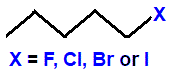 , skeletal formula , skeletal formula
1-fluoropentane, 1-chloropentane, 1-bromopentane,
1-iodopentane
Primary haloalkanes (primary halogenoalkanes)
e.g.
 , ,
 , ,

Number of low resolution
NMR chemical shift
δ
signal peaks: 5 1H
and 5 13C
(email
if disagree?)
1H NMR ratio of peaks: 3 : 2 : 2 : 2 : 2 (for equivalent protons)
Index of
1H NMR spectra organic
compounds and
Index of
13C NMR spectra organic
compounds
(2) CH3CH2CH2CHXCH3,
abbreviated
structural formula,
 , skeletal formula , skeletal formula
2-fluoropentane, 2-chloropentane, 2-bromopentane,
2-iodopentane
Secondary haloalkanes (secondary halogenoalkanes)
Can form R/S isomers, 2nd carbon atom is chiral.
CIP assignment priority rule for R/S isomers:
ZX
> 6C6C
> 6C1H > 1H (X = halogen, Z = 9, 17, 35, 53)
e.g.
 , ,
 , ,

Number of low resolution
NMR chemical shift
δ
signal peaks: 5 1H
and 5 13C
(email
if disagree?)
1H NMR ratio of peaks: 3 : 2 : 2 : 1 : 3 (for equivalent protons)
(3) CH3CH2CHXCH2CH3,
abbreviated
structural formula,
 , skeletal formula , skeletal formula
3-fluoropentane, 3-chloropentane, 3-bromopentane,
3-iodopentane
Secondary haloalkanes (secondary halogenoalkanes)
e.g.
 , ,
 , ,

Number of low resolution
NMR chemical shift
δ
signal peaks: 3 1H
and 3 13C
(email
if disagree?)
1H NMR ratio of peaks: 6
(3+3) : 4 (2+2) : 1 (for equivalent protons)
(4)
CH3CH2CH(CH3)CH2X,
abbreviated
structural formula,
 , skeletal formula , skeletal formula
1-fluoro-2-methylbutane,
1-chloro-2-methylbutane, 1-bromo-2-methylbutane, 1-iodo-2-methylbutane
Primary haloalkanes (primary halogenoalkanes)
Can form R/S isomers, 2nd carbon atom is chiral.
CIP assignment priority rule for R/S isomers:
6CZX >
6C6 > 6C1H >
1H (X = halogen, Z = 9, 17, 35, 53)
e.g.
 , ,
 , ,

Number of low resolution
NMR chemical shift
δ
signal peaks: 5 1H
and 5 13C
(email
if disagree?)
1H NMR ratio of peaks: 3 : 2 : 1 : 3 : 2 (for equivalent protons)
(5)
(CH3)2CHCH2CH2X,
abbreviated
structural formula,
 , skeletal formula , skeletal formula
1-fluoro-3-methylbutane,
1-chloro-3-methylbutane, 1-bromo-3-methylbutane, 1-iodo-3-methylbutane
Primary haloalkanes (primary halogenoalkanes)
Number of low resolution
NMR chemical shift
δ
signal peaks: 4 1H
and 4 13C
(email
if disagree?)
1H NMR ratio of peaks: 6
(3+3) : 1 : 2 : 2 (for equivalent protons)
(6) CH3CH2CX(CH3)2,
abbreviated
structural formula,
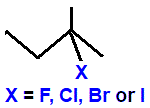 , skeletal formula , skeletal formula
2-fluoro-2-methylbutane, 2-chloro-2-methylbutane,
2-bromo-2-methylbutane, 2-iodo-2-methylbutane
Tertiary haloalkanes (tertiary halogenoalkanes)
e.g.
 , ,
 , ,

Number of low resolution
NMR chemical shift
δ
signal peaks: 3 1H
and 4 13C
(email
if disagree?)
1H NMR ratio of peaks: 3 : 2 : 6
(3+3) (for equivalent protons)
(7) (CH3)2CHCHXCH3,
abbreviated
structural formula,
 , skeletal formula , skeletal formula
2-fluoro-3-methylbutane, 2-chloro-3-methylbutane,
2-bromo-3-methylbutane, 2-iodo-3-methylbutane
Secondary haloalkanes (secondary halogenoalkanes)
Can form R/S isomers, 2nd carbon atom is chiral.
CIP assignment priority rule for R/S isomers:
ZX
> 6C6C > 6C1H >
1H (X = halogen, Z = 9, 17, 35, 53)
e.g.
 , ,
 , ,

Number of low resolution
NMR chemical shift
δ
signal peaks: 4 1H
and 4 13C
(email
if disagree?)
1H NMR ratio of peaks: 6
(3+3) : 1 : 1 : 3 (for equivalent protons)
(8) (CH3)3CCH2X,
abbreviated
structural formula,
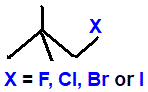 , skeletal formula , skeletal formula
1-fluoro-2,2-dimethylpropane, 1-chloro-2,2-dimethylpropane,
1-bromo-2,2-dimethylpropane, 1-iodo-2,2-dimethylpropane
Primary haloalkanes (primary halogenoalkanes)
e.g.
 , ,
 , ,

Number of low resolution
NMR chemical shift
δ
signal peaks: 2 1H
and 3 13C
(email
if disagree?)
1H NMR ratio of peaks: 9(3x3) : 2 (for equivalent protons)
(c) EXTRA
NOTES
constitutional isomers of molecules of
C5H11X
(X = halogen)
Number
of constitutional isomers (monohalo‑pentanes)
All monosubstituted
halopentanes (C5H11F,
C5H11Cl, C5H11Br
and
C5H11I)
have the same set of constitutional isomers: eight distinct structural
isomers in total.
These arise from placing one
halogen atom on every non‑equivalent carbon of the three inequivalent C5
skeletons (n‑pentane, 2‑methylbutane, 2,2‑dimethylpropane) and accounting
for symmetry.
Summary list and description of the eight constitutional isomers (how they
differ)
-
1‑halopentane (halogen on
terminal carbon of n‑pentane) — primary, unbranched.
-
2‑halopentane (halogen on C‑2
of n‑pentane) — secondary, unbranched; chiral centre when Hs differ.
-
3‑halopentane (halogen on C‑3
of n‑pentane) — secondary, unbranched; centrally placed.
-
1‑halomethylbutane (halogen on
terminal of 2‑methylbutane, commonly named 1‑halopentane isomer variant) —
primary on a branched chain.
-
2‑halomethylbutane (halogen on
C‑2 of 2‑methylbutane) — secondary, branched; can be stereogenic.
-
3‑halomethylbutane (halogen on
C‑3 of 2‑methylbutane) — secondary/primary depending on numbering
convention; non‑equivalent to other positions.
-
1‑haloneopentyl (halogen on a
terminal carbon of the neopentyl skeleton) — primary but highly hindered
(neopentyl).
-
2‑haloneopentyl (halogen on
the quaternary‑adjacent carbon is impossible; the only unique halogen
position on 2,2‑dimethylpropyl gives the neopentyl isomer set above) —
practical enumeration yields eight unique structures in total when symmetry
is removed.
Types
of isomerism exhibited and explanation
-
Structural (constitutional)
isomerism: different connectivity of C and X (position of halogen and
branching) — the primary class for these formulas.
-
Positional isomerism: same
carbon skeleton but halogen on different carbon atoms (1‑, 2‑, 3‑
positions).
-
Chain (skeletal) isomerism:
straight chain versus branched chains (n‑pentane, 2‑methylbutane,
2,2‑dimethylpropane).
-
Stereoisomerism (where
relevant): some secondary halides create chiral centres (e.g.,
2‑halopentane) and therefore enantiomers; diastereomers are possible only
where more than one stereogenic element exists (rare here for
monosubstituted species).
Differences in physical properties (linked to structure and halogen)
-
Boiling point: increases with
halogen polarizability/size (F < Cl < Br < I) for the same constitutional
isomer because of larger London dispersion forces for heavier halogens.
Branching lowers boiling point for a given halogen due to reduced surface
area.
-
Density: increases with
heavier halogen (iodides densest).
-
Polarity and dipole moment:
depends on halogen electronegativity and substitution position; 1‑halides
often have different molecular dipoles than internal halides (2‑ or 3‑).
-
Volatility & vapour pressure:
branched isomers are generally more volatile than straight‑chain isomers;
fluorides tend to be less polarizable and therefore lower boiling than
heavier halides for comparable connectivity.
Differences in chemical reactions and relative reactivity
-
Nucleophilic substitution
(SN1/SN2): reactivity order for leaving group ability is I > Br > Cl >> F;
iodides and bromides undergo SN2 or SN1 more readily under comparable
conditions, fluorides are poorest leaving groups and often require special
conditions. Secondary halides (e.g., 2‑halopentane) can undergo both SN1 and
SN2 depending on solvent and nucleophile; primary halides favour SN2;
tertiary (not present here) favour SN1.
-
Elimination (E2/E1): secondary
halides are more prone to elimination under strong base/heat than primary
halides. Vicinal H availability and steric hindrance influence elimination
rates.
-
Radical reactions (homolytic
cleavage/halogen exchange): C–X bond strength decreases down the group (C–F
strongest, C–I weakest), so radical cleavage and radical substitution are
easier for bromides/iodides.
-
Organometallic formation:
iodides and bromides are readily converted to Grignard or organolithium
reagents (or by halogen–metal exchange), chlorides less so, fluorides rarely
directly.
-
Chemoselectivity and steric
effects: neopentyl halides (sterically hindered primary halides) are
unusually unreactive in SN2 despite being primary because steric hindrance
blocks backside attack.
Uses
and applications linked to isomer structure and halogen identity
-
For C5H11F,
C5H11Cl, C5H11Br
and
C5H11I
-
Fluorides: used in specialty
organofluorine chemistry, medicinal chemistry leads (modifying metabolic
stability and lipophilicity), and where strong C–F bond confers stability.
Less useful as leaving groups or direct synthetic handles.
-
Chlorides: common as chemical
intermediates, solvents or feedstocks; used where moderate stability and
moderate reactivity are required.
-
Bromides: widely used as
synthetic electrophiles for substitution, radical chemistry, and preparation
of organometallic reagents; preferred for many laboratory transformations.
-
Iodides: highly reactive
electrophiles and excellent substrates for rapid substitution, halogen–metal
exchange and radiolabelling; often used when high reactivity is required in
synthesis.
-
Structural isomer application
notes: primary linear halides often serve as good SN2 substrates (except
bulky neopentyl); secondary internal halides are chosen when SN1 or
elimination is desired; branched isomers are chosen when steric
stabilization or lower volatility is required.
Student misconceptions to highlight and exam tips
-
“All primary halides react
fastest in all substitutions” — false: neopentyl primary halides are poor
SN2 substrates due to steric hindrance.
-
“Fluorides behave like other
halides in substitution” — false: fluoride is a very poor leaving group in
protic conditions and C–F bonds are exceptionally strong.
-
“Leaving‑group ability equals
nucleophilicity” — false: nucleophilicity and leaving‑group ability are
related but not identical properties and depend on solvent and
base/nucleophile.
-
“All isomers have identical
boiling points because formula is same” — false: branching, position of
halogen and halogen identity strongly affect boiling point and density.
-
Learn the three backbone types
for C5 and systematically place the halogen at non‑equivalent positions to
generate the eight isomers; practise drawing them quickly and naming them
IUPAC correctly.
-
Memorise the leaving‑group
trend I > Br > Cl >> F and link it to bond strength and polarizability in
exam answers.
-
Use structural features to
predict mechanism: primary → SN2 likely; secondary → SN1 or SN2 depending on
conditions; discuss steric hindrance explicitly for neopentyl cases.
-
In comparative questions
mention both physical (bpt, density, polarity) and chemical (reactivity,
mechanism preference) differences and link each point to a structural
reason.
-
For stereochemistry questions
identify possible chiral centres (e.g., 2‑halopentane) and state whether
enantiomers exist. Draw quick wedge/dash sketches when asked.
-
Practice short explanation
answers: e.g., “2‑bromopentane is more reactive than 1‑bromopentane in SN1
because the secondary carbocation is more stable” — then add a one‑line
structural justification.
(d)
Learning objectives - questions to be answered?
Can you IUPAC name these isomers?
Can you deduce the number of principal 1H chemical shifts and
proton ratio you would expect to see in the NMR spectrum of these isomers?
Can you deduce the number of principal 13C chemical shifts you
would expect to see in the NMR spectrum of these isomers?
How do you draw the structural formula
and skeletal formula of the isomers of molecular formula C5H11F C5H11Cl
C5H11Br C5H11I?
How many aliphatic structural isomers
are there of halogen compounds with molecular formula C5H11F C5H11Cl
C5H11Br C5H11I?
How many aliphatic carbon chain isomers
are there of halogen compounds with molecular formula C5H11F C5H11Cl
C5H11Br C5H11I?
How many positional isomers are there
of organic halogen molecules with molecular formula C5H11F C5H11Cl
C5H11Br C5H11I?
How many E/Z (geometrical) isomers are
there of molecular formula C5H11F C5H11Cl C5H11Br C5H11I?
How many R/S (optical) isomers
(enantiomers) of molecular formula C5H11F C5H11Cl C5H11Br C5H11I?
Are there any halocycloalkene isomers of
formula C5H11F C5H11Cl C5H11Br C5H11I?
Are there any cyclic haloalkene isomers
of formula C5H11F C5H11Cl C5H11Br C5H11I?
Are there any cyclo haloalkane isomers
of formula C5H11F C5H11Cl C5H11Br C5H11I?
Are there any halodiene isomers of
molecular formula C5H11F C5H11Cl C5H11Br C5H11I?
Are there any haloalkyne isomers of
molecular formula C5H11F C5H11Cl C5H11Br C5H11I?
Are there any functional group isomers
with a molecular formula C5H11F C5H11Cl C5H11Br C5H11I?
Do C5H11F C5H11Cl
C5H11Br C5H11I organic halogen
molecules have any stereoisomers?
Are there any E/Z (geometrical) isomers
with a molecular formula C5H11F C5H11Cl C5H11Br C5H11I?
Are there any R/S (optical) isomers
(enantiomers) with a molecular formula C5H11F C5H11Cl C5H11Br C5H11I?
This page
will answer these questions for molecular formula
C5H11F C5H11Cl C5H11Br C5H11I
|
(e) QUESTIONS
Practise exam questions
based on isomers of molecular formula
the isomers of C5H11X
(X = halogen)
Jot
down your responses and check out the answers
ANSWERS
to the questions based on the isomers of
C5H11X
(X = halogen)
If you think there are
any errors, please email me asap at
chem55555@hotmail.com
I don't mind if students/teachers do a selected printout
of these questions and answers.
You are given four pairs of haloalkane isomers,
answer the questions with as much reasoning as possible.
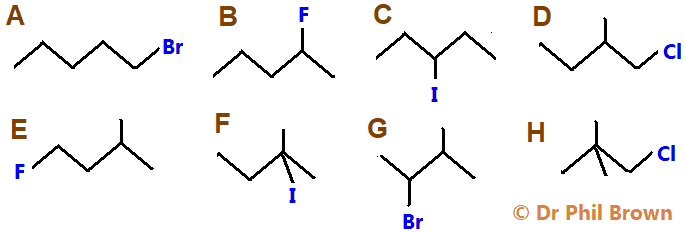
Q1 Name A
to H with IUPAC names and give their classification as
primary (prim), secondary (sec) or tertiary (tert).
Q2 (a) Which will on hydrolysis aqueous sodium hydroxide,
will yield a secondary alcohol?
(b)
Write a skeletal formula equation for one of the
hydrolysis reactions and state the name of the product
and what type of mechanism pathway the reaction will
take.
(c) Explain
which of them is likely to react the fastest and which
the slowest irrespective of the mechanistic pathway the
hydrolysis takes.
(d) Which is
the only one to yield a tertiary alcohol on hydrolysis
Q3 Which of the molecules will form a pair of R/S
('optical') isomers? and quote their chiral centre.
Q4
Which of C and F would react the fastest on refluxing
with aqueous sodium hydroxide?
Q5
Which of E and H would react the fastest on refluxing
with aqueous sodium hydroxide?
If you think there are
any errors, please email me asap at
chem55555@hotmail.com
I don't mind if students/teachers do a selected printout
of these questions and answers.
|
Associated organic chemistry links
Index of sets of isomers for a given
molecular formula
The molecular structure and naming of
HALOALKANES (how
to name and draw alkane structures)
The molecular structure and
naming of ALKANES (how
to name and draw alkane structures)
The molecular structure and naming
of ALKENES
(how to name and draw alkene structures)
Index of revision notes on the chemistry
HALOALKANES
including reactions
Index of revision notes
on the chemistry of ALKANES and the petrochemical
industry
Index of revision notes on the chemistry ALKENES
including reactions and polymers
Advanced Level pre-university
organic chemistry notes
IR, mass and H-1 and C-13 NMR
spectra of organic compounds
For isomerism in organic chemistry, see also the
notes
Isomerism: introduction, structural isomerism - chain,
positional, functional group, tautomerism
Stereoisomerism:
introduction, definition,
priority rules, E/Z isomerism (cis/trans isomerism)
Stereoisomerism - R/S isomerism (optical
isomerism) -
definition - examples explained
This is a big chemistry website, please allow time
to explore it
Index of my advanced
(pre-college/university) organic
chemistry revision notes
Index
of all my spectroscopy pages
Index
of all my isomerism pages
The chemistry of
alkanes and the petrochemical
industry
The
chemistry of alkenes
The
chemistry of haloalkanes
The
chemistry of
alcohols
The chemistry of aldehydes
and ketones
The
chemistry of carboxylic acids and derivatives
The chemistry of organo-nitrogen compounds
The chemistry of
aromatic compounds
A summary chart of isomerism

|
Website
content © Dr Phil Brown 2000+. All copyrights reserved on Doc
Brown's Chemistry revision notes, images, quizzes, worksheets etc.
Copying of website material is NOT permitted. Advanced
level pre-university/college organic chemistry
revision notes
The isomerism of molecular formulae
C5H11F,
C5H11Cl, C5H11Br
and
C5H11I.
All
suitable for
chemistry students taking the WJEC advanced A level chemistry, CCEA
advanced A level chemistry, Cambridge CIE advanced A level chemistry, AQA
advanced A level chemistry, Edexcel advanced A level chemistry, OCR
advanced A level chemistry, Salters advanced A level chemistry, IB
advanced level chemistry, US grade 11-12 K12 AP Honors chemistry courses |
Keywords or phrases: how many isomers are
there of halogen compounds of molecular formula C5H11F C5H11Cl
C5H11Br C5H11I? what is the
structure of the halogen compound isomers of molecular formula how do you name the isomers of
molecular formula C5H11F C5H11Cl C5H11Br C5H11I? what is the molecular structure of the
isomers of C5H11F C5H11Cl C5H11Br C5H11I, what type of isomerism is exhibited by molecules
of formula C5H11F C5H11Cl C5H11Br C5H11I, how do you work out the isomers of haloalkanes
formula C5H11F C5H11Cl C5H11Br C5H11I, what are the structural isomers of
C5H11F C5H11Cl C5H11Br C5H11I, the carbon chain
isomers of C5H11F C5H11Cl C5H11Br C5H11I in the homologous series of alkanes, comparing
the many structural isomers does C5H11F C5H11Cl C5H11Br C5H11I have?
what are the possible isomers of C5H11F C5H11Cl C5H11Br C5H11I? revision notes on
isomerism of C5H11F C5H11Cl C5H11Br C5H11I molecules, the molecular structure of
the isomers of C5H11F C5H11Cl C5H11Br C5H11I how to draw the
structural formula of isomers of C5H11F C5H11Cl C5H11Br C5H11I, how to draw the displayed
formula of isomers of C5H11F C5H11Cl C5H11Br C5H11I, how to draw the skeletal formula of
halogenoalkane compound isomers of formula C5H11F C5H11Cl
C5H11Br C5H11I, how to name the isomers of molecular formula
C5H11F C5H11Cl C5H11Br C5H11I,
R/S optical isomers enantiomers of C5H11F C5H11Cl C5H11Br C5H11I isomeric with molecular formula
C5H11F C5H11Cl C5H11Br C5H11I, structural isomers of molecular
formula C5H11F C5H11Cl C5H11Br C5H11I, optical isomers R/S enantiomers isomeric with molecular
formula C5H11F C5H11Cl C5H11Br C5H11I, positional isomers isomeric with halocycloalkenes,
haloalkanes, haloalkynes, haloalkenes of molecular formula
C5H11F C5H11Cl C5H11Br C5H11I,
which types of isomerism are exhibited by molecules of formula
C5H11F C5H11Cl C5H11Br C5H11I alkyl positional isomers of C5H11F
C5H11Cl C5H11Br C5H11I branched carbon chain
isomers of C5H11F C5H11Cl C5H11Br C5H11I,
stereoisomers of molecular formula C5H11F C5H11Cl C5H11Br C5H11I,
optical isomers R/S enantiomers isomeric with molecular
formula C5H11F C5H11Cl C5H11Br C5H11I, positional isomers isomeric with molecular formula
C5H11F C5H11Cl C5H11Br C5H11I,
which types of isomerism are exhibited by C5H11F C5H11Cl C5H11Br
C5H11I halogen atom positional isomers of C5H11F C5H11Cl C5H11Br
C5H11I, how to work out the halogen compound names of isomers of
C5H11F C5H11Cl C5H11Br C5H11I
|
ANSWERS to the practise exam questions
based on isomers of molecular formula
the isomers of C5H11X
(X = halogen)
If you think there are
any errors, please email me asap at
chem55555@hotmail.com
I don't mind if students/teachers do a selected printout
of these questions and answers.
You are given four pairs of haloalkane isomers,
answer the questions with as much reasoning as possible.
Q1 Name A
to H with IUPAC names and give their classification as
primary (prim), secondary (sec) or tertiary (tert).
ANSWERS
A
1-bromopentane (prim),
B
2-fluoropentane (sec),
C
3-iodopentane (sec)
D
1-chloro-2-methylbutane (prim),
E
1-fluoro-3-methylbutane (prim),
F
2-iodo-2-methylbutane (tert)
G
2-bromo-3-methylbutane (sec),
H
1-chloro-2,2-dimethylpropane (prim)
Q2 (a) Which will on hydrolysis aqueous sodium hydroxide,
will yield a secondary alcohol?
(b)
Write a skeletal formula equation for one of the
hydrolysis reactions and state the name of the product
and what type of mechanism pathway the reaction will
take.
(c) Explain
which of them is likely to react the fastest and which
the slowest irrespective of the mechanistic pathway the
hydrolysis takes.
(d) Which is
the only one to yield a tertiary alcohol on hydrolysis
ANSWERS:
(a) B,
C and
G,
sec haloalkane gives sec alcohol (so prim gives prim and
tert gives tert)
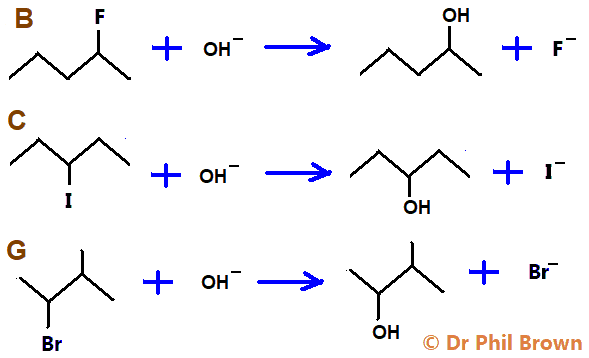
(b) Nucleophilic substitution reactions to
give:
B
yields pentan-2-ol,
C
yields pentan-3-ol,
G
yields 3-methylbutan-2-ol
(c) C
would react the fastest because the C-I bond
is weaker than either the C-F or the C-Br bond, so the
activation will be the lowest.
B would
react the slowest because the C-F bond is
stronger than the C-Br or C-I bond, so the activation
will be the highest.
It is worth noting that the reactivity order does NOT
fit in with trend in polarity i.e. C-F > C-Br > C-I
because of the decreasing electronegativity difference.
It is the bond enthalpy trend that determines the
reactivity trend C-I > C-Br > C-Cl > C-F, as the halogen
atomic radius decreases, the bond length decreases and
the bond enthalpy increases.
Nucleophilic
substitution by water/hydroxide ion [SN1
or SN2,
hydrolysis to give alcohols]
Q3 Which of the molecules will form a pair of R/S
('optical') isomers? and quote their chiral centre.
ANSWERS:
B, D and G,
all have C2 stereocentres i.e. in these cases, all the
C2 carbon atoms have four different atoms/groups
attached the same chiral carbon atom.
Q4
Which of C and F would react the fastest on refluxing
with aqueous sodium hydroxide?
ANSWER:
F
because, for the same halogen atom, tertiary haloalkanes
react faster than secondary haloalkanes (and faster than
primary haloalkanes).
Nucleophilic
substitution by water/hydroxide ion [SN1
or SN2,
hydrolysis to give alcohols]
Q5
Which of E and H would react the fastest on refluxing
with aqueous sodium hydroxide?
ANSWER:
H
because the C-Cl bond enthalpy is less than the C-F bond
enthalpy, so the H reaction has a lower activation
energy - note you are comparing two primary haloalkanes
- fair test!
Nucleophilic
substitution by water/hydroxide ion [SN1
or SN2,
hydrolysis to give alcohols]
If you think there are
any errors, please email me asap at
chem55555@hotmail.com
I don't mind if students/teachers do a selected printout
of these questions and answers.
|
|
