|
Part 7.3
The chemistry of
AROMATIC COMPOUNDS - sources, synthesis
& physical properties of arenes
(aromatic hydrocarbons)
[Author
© Dr
Phil Brown PhD: Doc
Brown's exam revision notes suitable
for A level chemistry students of advanced pre-university/college advanced level organic chemistry courses:
aromatic
chemistry revision notes on sources, synthesis and physical properties of arenes
[aromatic page updated Mar 7th 2026 *]
email doc
brown - comments - query?
*
[privacy, cookies and disclaimer]
All my advanced level
aromatic chemistry notes
All my advanced A level organic
chemistry notes
Part 7.3
Sources &
synthesis of arenes by alkylation & physical properties of arenes (aromatic
hydrocarbons) and use of benzene in fuels
Sub-index for this page on the sources
and physical properties of arene hydrocarbons
7.3.1
What are arenes?
7.3.2
Structure and physical
properties of selected arene hydrocarbons
7.3.3
Arenes from the
petrochemical industry - catalytic
cracking
7.3.4
Arenes from the
petrochemical industry - Reforming
7.3.5
Arenes from the
petrochemical industry - Use of disproportionation
7.3.6
Synthesis using an
arene and a halogenoalkane (a Friedel Crafts alkylation reaction) and mechanism
7.3.7
Synthesis using an
arene and an alkene (a Friedel Crafts alkylation reaction) and mechanism
7.3.8
Combustion of benzene
and methylbenzene - use in fuels
7.3.1 What are arenes?
  Arenes are aromatic
hydrocarbons, with one or more benzene rings, consisting of molecules
made up of only carbon and hydrogen atoms. Examples are listed in
the 7.3.2 table below.
Arenes are aromatic
hydrocarbons, with one or more benzene rings, consisting of molecules
made up of only carbon and hydrogen atoms. Examples are listed in
the 7.3.2 table below.
The term "aromatic"
originally referred to their pleasant smells (e.g., from cinnamon bark,
wintergreen leaves, vanilla beans and anise seeds), but now implies a
particular sort of delocalized bonding.
Aromatic hydrocarbons (or sometimes
called arenes or aryl hydrocarbons) are hydrocarbons with sigma bonds and
delocalized π electrons (indicated by the central complete circle) between
the carbon atoms forming the benzene ring.
You can also have fused ring polyaromatic
arenes e.g. naphthalene
 which are normally drawn in Kekule style.
The term alkylbenzenes refers to
molecules in which a hydrogen atom in the benzene ring is replaced by an
aliphatic alkyl group e.g. the arenes methylbenzene and ethylbenzene (above
top-right).
TOP OF PAGE and
sub-index
7.3.2 The structure and physical properties of selected arenes
| Name of arene |
Structure |
Mpt/oC |
Bpt/oC |
Comments |
| benzene |
|
6 |
80 |
The simplest arene hydrocarbon and the simplest possible
aromatic compound. |
| methylbenzene |
 |
-95 |
111 |
The simplest alkyl substituted derivative of benzene |
| ethylbenzene |
|
-94 |
136 |
|
| propylbenzene |
 |
-100 |
159 |
These first four arenes show an expected steady increase in
boiling point with increase in alkyl chain length. |
| 1,2-dimethylbenzene
1,3-dimethylbenzene
1,4-dimethylbenzene |
   |
-25
-47
13 |
144
139
138 |
You would need a very effective fractional distillation column
to separate these three positional isomers of dimethylbenzene.
They are isomeric with ethylbenzene. |
| naphthalene |
C10H8 |
79 |
218 |
Simplest example of a fused system of two or more benzene rings.
These are usually displayed in the Kekule style of formula. |
| anthracene |
 C14H10
 |
216 |
340 |
A fused system of three benzene rings. |
| |
|
|
|
|
Notes of the physical properties of arene hydrocarbons
(a) At room temperature arenes are colourless liquids or white
solids.
The main force between arene molecules like benzene and
methylbenzene are instantaneous dipole - induced dipole, so their
boiling points are relatively low for the size of the molecule (e.g. in
number of electrons).
The simplest (smallest) arene is benzene, C6H6,
has 42 electrons, so the intermolecular forces are strong enough to
make it a liquid at room temperature and it boils at 80oC.
The pentane molecule, C5H12,
also has 42 electrons and boils at 36oC.
The higher boiling point of benzene suggests that it
is more polarizable than pentane because of he delocalised pi
electron orbitals, and this also fits in with arenes susceptibility to
electrophilic attack.
(b) All arenes are insoluble in water ...
... and the lower members have a
density of less than water (<1.0 g/cm3).
Arenes like benzene and methylbenzene are non-polar
molecules and cannot hydrogen bond with water, in fact there cannot be
any permanent dipole - permanent dipole attractions between arenes and
highly polar water, so they are immiscible with water, no solvation
process possible.
The hydrophobic hydrocarbon molecules 'attempt' to
disrupt the strong hydrogen bonding between water molecules, without any
significant compensating solute - solvent intermolecular forces.
(c)
They all have a variety of strong hydrocarbon odours - from
a petrol like odour to 'mothballs'!
Many more complex aromatic compounds in nature can have
pleasant aromas - which is where the term aromatic originates.
The fumes or benzene should not be breathed in, it is a
carcinogenic compound, despite being used as a small percentage in
petrol.
TOP OF PAGE and
sub-index
7.3.3 Arenes from the petrochemical industry
- Catalytic cracking
Catalytic cracking
Catalytic cracking using zeolites produces
more branched alkanes,
alkenes, cyclic alkanes and cyclic aromatic compounds with a benzene ring.
e.g.
  an aliphatic
cycloalkane hydrocarbon,
an aliphatic
cycloalkane hydrocarbon,
and
 an
aromatic benzene derivative
an
aromatic benzene derivative
TOP OF PAGE and
sub-index
7.3.4 Arenes from
the petrochemical industry - Reforming
Converting linear alkane molecules into
cyclic hydrocarbons (cycloalkanes and aromatic molecules - have a
benzene ring). The products have the same number of carbon atoms
as the reactants, but less hydrogen atoms and a ring structure.
Naphtha is the chemical feedstock (C6
- C10 alkanes) and passed over a Pt/Al2O3
catalyst at 500oC. The hydrogen formed is recycled to
minimise 'coking' (thermal decomposition to give a carbon deposit on
the catalyst). The following equations are depicted
using structural formulae and skeletal formulae e.g.
(a)
hexane ===> 1st cyclohexane ===> 2nd benzene
1st
  +
H2 +
H2
 +
H2 +
H2
then 2nd
 + 3H2 + 3H2
+ 3H2
This reforming reaction probably goes through the
dehydrogenation sequence.
hexane ==> cyclohexane ==> cyclohexene ==>
cyclohexa-1,3-diene ==> benzene
  or
or
 in old 'Kekule' style
(b)
heptane or 2-methylhexane
or 3-methylhexane ===>
methylcyclohexane ===> methylbenzene

or

or

 +
H2
+ 3H2 +
H2
+ 3H2
methylbenzene is usually shown as
the benzene ring is 'skeletal' and the methyl group 'structural'
in terms of skeletal formulae this reforming reaction
would be shown as ...
 or
or
 or
or

 + H2
+ H2
 +
3H2 (dehydrogenation reactions)
+
3H2 (dehydrogenation reactions)
If asked to write the full equation don't
forget the hydrogens for these dehydrogenation reactions!
and check whether structural formulae or
skeletal formulae are required.
TOP OF PAGE and
sub-index
7.3.5 Arenes from the
petrochemical industry - use disproportionation
Disproportionation is said to occur, when a
reactant is transformed into two or more dissimilar products.
2
+
 ,
,
,
,

(mixture of three isomeric products)
This is not a redox disproportionation
reaction, but it does involve two identical molecules reacting together to give
two different products with no other reactant or product involved.
The reaction
is a way of producing a mixture of 1,2-dimethylbenzene, 1,3-dimethylbenzene and
1,4-dimethylbenzene from methylbenzene. If you need less methylbenzene and more
benzene or dimethylbenzenes, this is the way to do it.
TOP OF PAGE and
sub-index
7.3.6 Synthesis using an
arene plus a halogenoalkane (a Friedel Crafts alkylation reaction)
If an arene like benzene or methyl benzene is refluxed with
a liquid halogenoalkane (or gas passed into the mixture) in the presence of
an metal halide catalyst, an alkyl group is substituted into the benzene
ring.
Catalysts include anhydrous aluminium chloride,
aluminium bromide, iron(III) chloride or iron(III) bromide.
You can think of the catalyst AlCl3, AlBr3,
FeCl3 or FeBr3 as the alkyl group carriers.
Despite their catalytic status, these compounds are
not easy to recycle, and relatively high temperatures may be
required, so the search is on to find much 'greener' catalysts
which can be more readily recycled and operate at a lower
temperature by offering a lower activation energy mechanistic
route.
The halogenoalkanes can be chloro-alkanes (cheaper) or
bromoalkanes.
The preparation must be done under anhydrous conditions and
dry laboratory apparatus because aluminium chloride hydrolyses in the
presence of water.
The process is called
alkylation.
Examples of aromatic
Friedel Crafts alkylation substitution reactions
(a)
+ CH3CH2CH2Cl ===>
 + HCl
+ HCl
benzene + 1-chloropropane == AlCl3
==> 2-phenylpropane + hydrogen chloride
(2-phenylpropane is formed in preference to
propylbenzene - see mechanism below for reason)
(b)
+ CH3Cl ===>

 + HCl
+ HCl
methylbenzene +
chloromethane ===> 1,2-
or 1,2- or 1,4-dimethylbenzene + hydrogen chloride
Three positional structural isomers of
C8H10 formed in different
proportions.
Note that if the atom of initial substituent group is
directly bonded to the benzene ring does not have any π
bonding the ring is usually activated compared to benzene
itself, which is why it is difficult to stop further substitution. The
methyl group tends to increase the electron density of the ring and more
so at the 2, 4 and 6 positions, compared to the 3 and 5 positions.
Therefore in methylbenzene, the 2 and 4 positions become the preferred
substitution points for alkylation in the benzene ring of methylbenzene
(For more details on the theory of electrophilic substitution see
section 7.14).
(c)
+ CH3CH2Br ===>


 + HBr
+ HBr
methylbenzene + bromoethane ==
AlBr3 ==> 1-ethyl-2/3/4-methylbenzene
Three positional structural isomers of molecular formula
C9H12 formed in different proportions.
The alkylation of naphthalene
another Friedel-Crafts reaction of an aromatic hydrocarbon
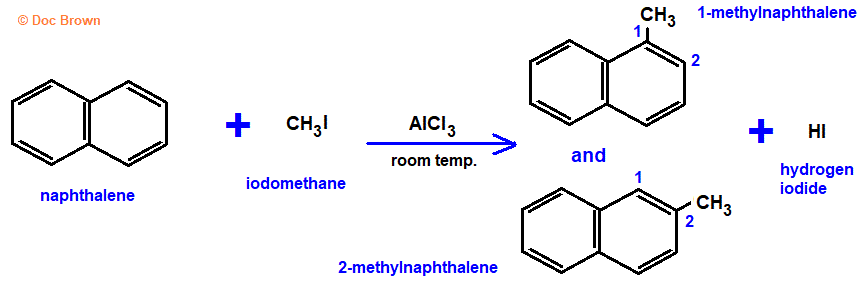
Naphthalene readily reacts at room temperature with
haloalkanes in the presence of aluminium chloride catalyst.
The principal products from iodomethane/AlCl3 are
1-methylnaphthalene and 2-methylnaphthalene.
The reaction is of little use in synthesis because of
further alkylation substitution - the methyl groups release electron charge
into the aromatic ring system (+ I effect) making the product even more
reactive than the original naphthalene - these reactions are in principle
the same electrophilic substitution reactions undergone by benzene and
methylbenzene.
The mechanism of alkylation of benzene and methylbenzene
The nature of electrophilic substitution reactions
and why aromatic compounds undergo them rather than addition was introduced
in section 7.2
Structure of benzene and an introduction to
electrophilic substitution in arenes
Note that the catalyst aluminium chloride (AlCl3) has a vacant orbital and can
act as a Lewis acid, accept a pair of electrons, and, in this context,
facilitate the formation of a more powerful electrophile [alkyl R]+
in step
(1) of this acylation
of benzene electrophilic substitution mechanism. Its the same situation for
the catalysts AlBr3, FeCl3 and FeBr3.

The mechanism of a Friedel Crafts alkylation - an
electrophilic substitution reaction. R and R' = H or alkyl
[mechanism
23 above] If R' = H, benzene would form
methylbenzene if chloromethane was used.
Step (1)
The weakly polar and uncharged
halogenoalkane molecule is not a strong enough an electrophile to
disrupt the
pi
electron system
of the benzene ring.
The aluminium chloride reacts with the
halogenoalkane molecule to form a carbocation which is a much
stronger
electron pair accepting electrophile than the original
haloalkane.
Step (2)
An electron pair from the
delocalised π
electrons of the
benzene ring forms a covalent C-C bond with the electron pair accepting
carbocation forming a second highly unstable carbocation.
It is very
unstable because the stable pi electron arrangement of the benzene ring
is partially broken to give a 'saturated' C (top right of ring).
Step (3) is a proton transfer, as the
tetrachloroaluminate(III) ion [formed in step (1)], abstracts a
proton from the highly unstable intermediate carbocation to give the
alkyl-aromatic product, hydrogen chloride gas and re-forms the
aluminium chloride catalyst.
In forming the substituted product, rather than an
addition product, the stable delocalised pi electron system of the
benzene ring is reformed.
If R' = CH3 methylbenzene:
C6H5CH3
+ R3C-Cl ===> R3C-C6H4CH3
+ HCl
When R' is alkyl, a mixture of polysubstituted alkyl aromatic compounds are formed.
e.g. using
chloromethane, 1,2- or 1,3- or 1,4-dimethylbenzene will be
formed,
so if R=H, the mechanism above would show the formation of
1,2-dimethylbenzene.
The overall alkylation
reaction is the substitution of -H by -CR3
It is actually quite difficult to stop the alkylation going
beyond one substituent i.e. alkylating benzene will also produce
dimethylbenzenes because alkyl substituent activate the benzene ring.
For more on 'activation' of benzene see
section
7.14 for reactivity
explanations and orientation of products
Below, mechanism diagram 80G shows the
mechanistic pathway in more detail of forming ethylbenzene from chloroethene
and benzene,
full blue arrows
clearly showing all the electron shifts and the pairs of electrons involved.
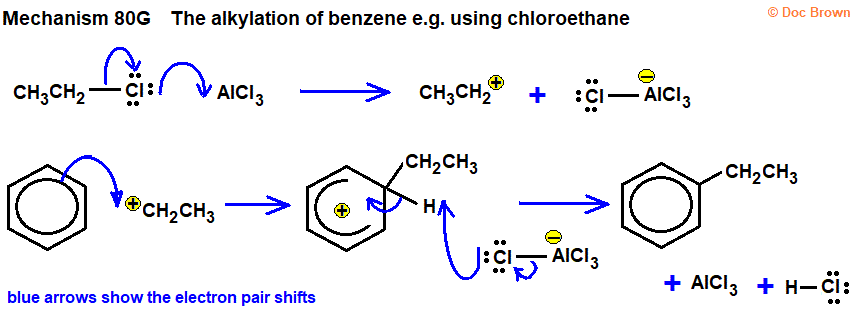
Mechanism diagram 80G shows the alkylation of benzene
using chloroethene to make ethylbenzene.
Initially the aluminium chloride catalyst generates the
ethyl carbocation - the electrophile - electron pair acceptor, a more
powerful electrophile that the original chloroethane.
The ethyl carbocation accepts a pair of electrons from the pi
orbital of benzene to form a covalent C-C bond and part of the benzene
ring is now saturated - so you no longer have the extra stability of the
pi electron ring of the original benzene molecule.
The 2nd carbocation loses a proton to give the three
products - the desired benzene compound, hydrogen chloride and the
regenerated aluminium chloride catalyst.
In forming the substituted product, rather than an
addition product, the stable delocalised pi electron system of the
benzene ring is reformed.
It is an electrophilic substitution mechanism using an aluminium chloride catalyst which generates an
ethyl carbocation - the electrophile that attacks the pi orbitals of the
benzene ring.
It is a typical alkylation Friedel-Crafts reaction
synthesis route.
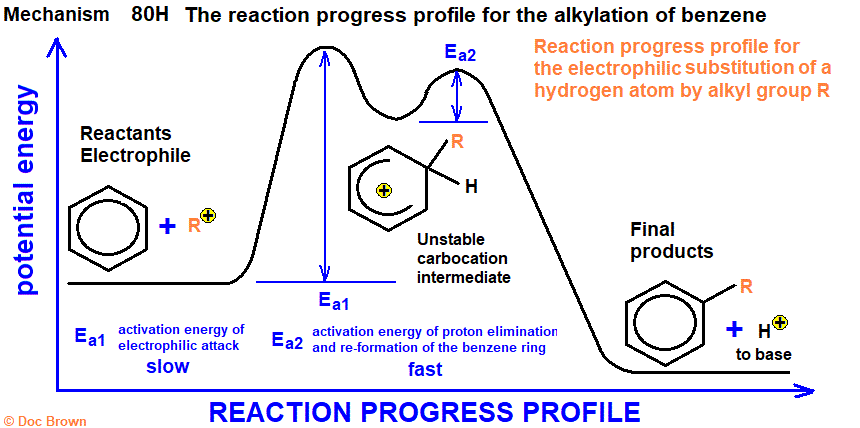
The reaction progress profile for the alkylation of benzene
via an electrophilic substitution mechanism involving an unstable
carbocation intermediate. This a typical reaction progress profile for a
Friedel-Crafts alkylation synthesis reaction. Note the two transition state
'humps'.
Below, mechanism diagram 80J shows the
mechanistic pathway in more detail of forming 2-phenylpropane from
1-chloropropane
and benzene,
full blue arrows
clearly showing all the electron shifts and pairs of electrons involved.
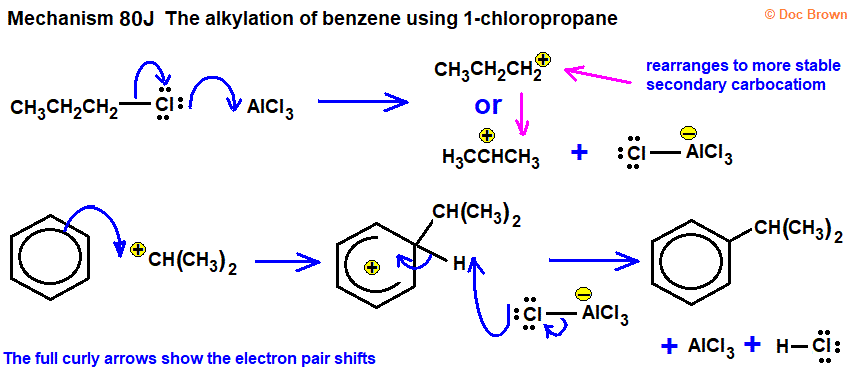
Mechanism diagram 80J shows the alkylation of benzene
using 1-chloropropane to make 2-phenylpropane.
Initially the aluminium chloride catalyst generates the
alkyl cation - the electrophile - electron pair acceptor, a more
powerful electrophile than the original 1-chloropropane.
The alkyl cation accepts a pair of electrons from the pi
orbital of benzene to form a covalent C-C bond and part of the benzene
ring is now saturated - so you no longer have the extra stability of the
benzene ring of delocalised pi electrons.
The 2nd carbocation loses a proton to give the three
products - the desired benzene compound, hydrogen chloride and the
regenerated aluminium chloride catalyst.
Note that in forming the alkyl substituted benzene
derivative the very stable ring of pi electrons of the benzene ring
is reformed - substitution preferred to addition.
The electrophilic substitution mechanism involves an aluminium chloride catalyst which generates a
carbocation from the 1-chloropropane molecule.
Note that the more stable secondary propyl carbocation
is formed in this Friedel-Crafts alkylation reaction synthesis. This
results in very little propylbenzene from a primary propyl cation in the
products.
You get the same major product of 2-phenylpropane if you
used 2-chloropropane as the alkyl group source.
TOP OF PAGE and
sub-index
7.3.7 Synthesis using an
arene plus an alkene (another Friedel Crafts alkylation reaction)
Arenes like benzene and methylbenzene will react with
alkenes to produce substituted alkyl-arenes.
The catalyst is a mixture of hydrogen chloride and aluminium chloride and is another example
of a Friedel Crafts alkylation reaction e.g.
(i)
+ CH3CH=CH2 ===>
benzene + propene == AlCl3
==> propylbenzene and
2-phenylpropane
Two positional/chain structural isomers of molecular
formula C9H12 formed in different
proportions.
However, the minority product is propylbenzene and the
majority product is 2-phenylpropane (which is also called
1-methylethylbenzene, in industry commonly known as cumene).
For the explanation of the majority product, see the 2nd
mechanism further down the page.
(ii)
+ CH2=CH2 ===>
methylbenzene + ethene ==
AlCl3 ==> 1-ethyl-2/3/4-methylbenzene
Three positional/chain structural isomers of molecular
formula C9H12 formed in different
proportions.
As one of the
most important alkylbenzenes, ethylbenzene is predominantly
synthesized by alkylation of benzene with ethene using an acid
catalyst - this fits in with the mechanism described below where
protonation of ethene yields the ethyl carbocation, the electrophile
that attacks the pi bond electron cloud of benzene.
Alkylation of aromatic compounds by
this method is an important step in the synthesis of certain type of
detergent - sulfonic acids and their salts -
see 7.7
Ring sulfonation of arenes, properties & uses of
sulfonic acids
The first step is to react benzene with a long chain
linear alkene of typically 10 to 14 carbon atoms i.e. length of R + R' =
8 to 12 in the diagram below.

The alkylbenzene product is then sulfonated and
neutralised to make the sodium salt, which acts as a surfactant (lowers
surface tension of water) - in this case the sodium
alkylbenzenesulfonate salt is an example of a synthetic detergent.
For more on sulfonic acids
see 7.7
Ring sulfonation of arenes, properties & uses of
sulfonic acids
Mechanism
of alkylation of aromatic compounds using alkenes as the alkyl group source
via a AlCl3/HCl catalytic mixture e.g.
(1)
Producing ethylbenzene form benzene and ethene.
Step 1. Generation of a carbocation electrophile
AlCl3 + HCl +
CH2=CH2 ===> CH3-CH2+
+ AlCl4-
The hydrogen chloride (δ+H-Clδ-)
donates a proton to ethene to form an ethyl carbocation.
The ethyl carbocation can be generated with
other acid catalysts.
Step 2. Electrophilic attack of the ethyl
carbocation on the pi electron cloud of the benzene ring and the
expulsion of the proton to reform the more stable aromatic benzene
ring.
CH2-CH2+ +
C6H6 ===> C6H5CH2CH3
+ H+
Step 3. The regeneration of the catalyst from the
expelled proton - to complete the 'catalytic cycle'.
H+ + AlCl4-
===> AlCl3 + HCl
The tetrachloroaluminate(III) ion picks up the
proton before it can combine with the carbocation to form
chloroethane.
Below, mechanism diagram 80K shows the
mechanistic pathway in more detail of forming ethylbenzene from ethene
and benzene,
full blue arrows
clearly showing all the electron shifts and pairs of electrons involved.
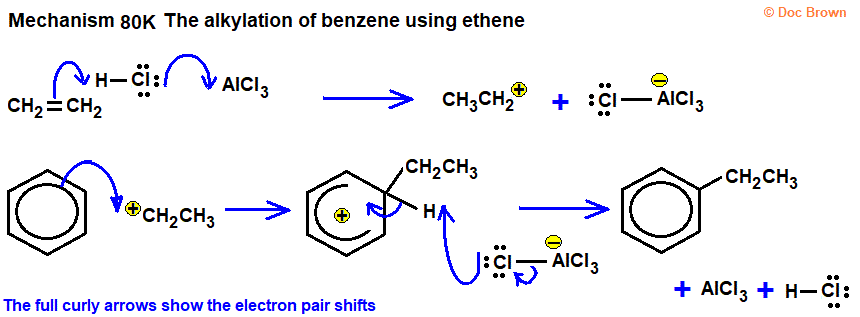
The alkylation of benzene using ethene to make ethylbenzene.
An electrophilic substitution mechanism involving hydrogen chloride,
aluminium chloride and the generation of an ethyl carbocation. It is
Friedel-Crafts alkylation synthesis reaction.
The 2nd stage of the mechanism is no different from if
you had started with chloroethene (see
mechanism 80G),
so I've haven't repeated the details.
(2)
Producing 2-phenylpropane (cumene) from
benzene and propene
Step 1. Generation of a carbocation electrophile
AlCl3 + HCl +
CH3CH=CH2 ===> CH3-C+HCH3
+ AlCl4-
The hydrogen chloride (δ+H-Clδ-)
donates a proton to propene to form mainly the secondary
carbocation.
Note the formation of the more stable secondary
carbocation, rather than the less stable primary carbocation CH3CH2CH2+,
which explains why propylbenzene is the minor product, and why
the major product is 2-phenylpropane.
Step 2. Electrophilic attack of the carbocation on
the pi electron cloud of the benzene ring and the expulsion of the
proton to reform the more stable aromatic benzene ring.
CH3C+HCH3
+ C6H6 ===> C6H5CH(CH3)2
+ H+
Step 3. The regeneration of the catalyst from the
expelled proton - to complete the 'catalytic cycle'.
H+ + AlCl4-
===> AlCl3 + HCl
The tetrachloroaluminate(III) ion picks up the
proton before it can combine with the carbocation to form
2-chloropropane.
Below, the full mechanism diagram 80L shows the
mechanistic pathway in more detail the formation of 2-phenylpropane from
propene and benzene,
full blue arrows
clearly showing all the electron shifts and pairs of electrons involved.

The mechanistic pathway of alkylation of benzene using
propene to make 2-phenylpropene.
The electrophilic substitution mechanism involving
hydrogen chloride aluminium chloride and the more stable secondary
propyl carbocation. It is an alkylation Friedel-Crafts reaction synthesis.
Note that the more stable secondary propyl carbocation
is formed in this Friedel-Crafts alkylation reaction synthesis. This
results in very little propylbenzene from a primary propyl cation in the
products.
The alkyl carbocation is a more powerful
electrophile (electron pair acceptor) than the original alkene
molecule.
The carbocation accepts a pair of the pi electrons
to form a C-C bond. The 2nd intermediate carbocation now has a
saturated carbon atom, destroying the original stable ring of pi
electrons.
A proton is lost to reform the stable pi electron
ring of the benzene ring of newly formed alkyl substituted benzene
derivative. 'Waste' hydrogen chloride is formed and the aluminium
chloride catalyst regenerated.
2-phenylpropane (isopropylbenzene, cumene), is manufactured from propene
and benzene
using a solid phosphoric acid, AlCl3 or zeolite catalyst.
Unfortunately, because the initial alkyl group activates
the ring, you get lots of
disubstituted products.
For more on 'activation' of benzene see
section
7.14 for reactivity
explanations and orientation of products
TOP OF PAGE and
sub-index
7.3.8
Combustion of benzene and methylbenzene
Benzene and alkylbenzenes are used in vehicles fuels to produce various blends of
petrol (gasoline)
They both increase the octane rating of petrol.
With excess air (oxygen source) you should get complete combustion to
carbon dioxide and water.
Benzene:
C6H6(l)
+ 7½O2(g) ===> 6CO2(g) +
3H2O(l)
Methylbenzene:
C6H5CH3(l) + 9O2(g)
===> 7CO2(g) + 4H2O(l)
However, if there is a deficiency of oxygen, carbon soot will be formed
in a very smoky flame, or particulates from a car exhaust.
e.g.
C6H6(l)
+ 1½O2(g) ===> 6C(s) + 3H2O(l)
Website content © Dr
Phil Brown 2000+. All copyrights reserved on Doc Brown's Chemistry revision notes, images,
quizzes, worksheets etc. Copying of website material is NOT
permitted. Doc Brown's chemistry of aromatic compounds exam revision notes,
Website content © Dr Phil Brown 2000+. All
copyrights reserved on revision notes, images, quizzes, worksheets etc. Copying
of website material is NOT permitted. Exam revision summaries & references to
science course specifications are unofficial.
Website content © Dr Phil Brown 2000+. All
copyrights reserved on these organic chemistry exam revision
notes on Friedel Crafts alkylation of benzene and methylbenzene physical
properties of benzene and methylbenzene, these A level chemistry revision notes are suitable for use of pre-university students studying AQA advanced level
organic chemistry revision notes on Friedel Crafts alkylation of
benzene and methylbenzene physical properties of benzene and
methylbenzene, Edexcel advanced level
organic chemistry revision notes on Friedel Crafts alkylation of
benzene and methylbenzene physical properties of benzene and
methylbenzene, OCR advanced level
organic chemistry revision notes on Friedel Crafts alkylation of
benzene and methylbenzene physical properties of benzene and
methylbenzene, IB advanced level
organic chemistry revision notes on Friedel Crafts alkylation of
benzene and methylbenzene physical properties of benzene and
methylbenzene, WJEC (Eduqas) advanced level
organic chemistry revision notes on Friedel Crafts alkylation of
benzene and methylbenzene physical properties of benzene and
methylbenzene, CIE Cambridge advanced level
organic chemistry revision notes on Friedel Crafts alkylation of
benzene and methylbenzene physical properties of benzene and
methylbenzene, CCEA advanced level
organic chemistry revision notes on Friedel Crafts alkylation of
benzene and methylbenzene physical properties of benzene and
methylbenzene, and useful for US grade 11 grade 12 AP honors
organic chemistry courses involving Friedel Crafts
alkylation of benzene and methylbenzene physical properties
of benzene and methylbenzene,
Explaining the importance of
catalytic cracking and reforming to produce benzene and
methylbenzene
in organic chemistry, What you need to know about catalytic cracking and
reforming to produce benzene and methylbenzene for organic
chemistry,
Explaining the use of catalytic cracking and reforming to produce
benzene and methylbenzene knowledge in organic chemistry, Examples of
catalytic cracking and reforming to produce benzene and
methylbenzene explained
when studying organic chemistry, What is
the significance of catalytic cracking and reforming to produce benzene
and methylbenzene in organic chemistry, What is the use of
catalytic cracking and reforming to produce benzene and
methylbenzene
in organic chemistry Describing and
explaining the theory of catalytic cracking and reforming to produce
benzene and methylbenzene when studying organic chemistry, exam revision
notes for catalytic cracking and reforming to produce benzene and
methylbenzene in exams, online help for catalytic cracking
and reforming to produce benzene and methylbenzene, revision notes for
catalytic cracking and reforming to produce benzene and
methylbenzene,
what do I need to learn for catalytic cracking and reforming to produce
benzene and methylbenzene in exams? revision summary for
catalytic cracking and reforming to produce benzene and
methylbenzene, help in
teaching catalytic cracking and reforming to produce benzene and
methylbenzene, learning notes for catalytic cracking and
reforming to produce benzene and methylbenzene, help to pass the
catalytic cracking and reforming to produce benzene and
methylbenzene exam, how to
prepare for examination questions on catalytic cracking and reforming to
produce benzene and methylbenzene?
[SEARCH
BOX]
All my advanced level
aromatic chemistry revision notes
All my advanced A level organic
chemistry notes |
|
