|
Advanced A level physical chemistry extra exam revision notes
on:
INDEX comparing types of
crystal structure and their properties
(a few extra notes and links to other detailed notes)
[Author
©
Dr Phil Brown PhD:
Doc Brown's chemistry exam revision notes
suitable for students of UK
AQA, Edexcel, OCR, WJEC and CCEA pre-university/college advanced A level chemistry
courses on chemical bonding & structure, ~US grades 11-12 chemistry [age
updated April 21st 2026
*]
All my advanced level chemistry revision notes
All my
structure and bonding notes
Part 6.
Extra advanced level chemical bonding notes
[email
doc b: any comment/query?] *
[privacy policy, cookies,
disclaimer] * [SEARCH
science website]
Sub-index of
types of crystal structures
You need to be able to ...
Be able to relate the melting point and
conductivity of materials to the type of structure and the bonding present, explain the energy changes associated
with changes of state and draw diagrams to represent these
structures involving specified numbers of particles.
There are two tables at
the end summarising various structures and their properties.
Abbreviations used: mpt. melting point,
bpt. boiling point
6.4.1
Ionic lattice (giant
ionic lattice)
6.4.2
Covalent molecular
crystals (small molecules)
6.4.3
Giant covalent lattice
(a type of macromolecular molecule lattice)
6.4.4
Giant metallic lattice
6.4.5
More on the enthalpy changes for physical changes
of state for various structures
6.4.1
Ionic lattice (giant ionic lattice) e.g.
The structure and properties of sodium chloride
and other ionic compounds are discussed in detail on my
IONIC BONDING page.
Extra A level notes on sodium
chloride
Sodium chloride: mpt.
801oC/1074K, enthalpy of fusion
29 kJ mol-1,
bpt. 1467oC/1740K,
enthalpy of vaporisation
171 kJ mol-1
The relative high melting and boiling
points and large enthalpies for the state changes are due to very strong
bonding between the ions in the crystal lattice.
You need to be able to write the electron
configuration of ions in terms of s, p and d orbital notation.
e.g. sodium ion Na+ is 1s22s2p6,
[Ne], and the chloride ion Cl- is 1s22s2p63s23p6,
[Ar]
More on
electron configuration of ions and
oxidation states
6.4.2
Covalent molecular
crystals (small molecules) e.g.
Iodine and water
The electronic structure and properties
of simple molecular elements/compounds including water are discussed on my
COVALENT
BONDING page.
Iodine and water (apart from hydrogen
bonding) have the typical properties described and explained on the above page.
Extra A level notes on molecular
lattices
Iodine

The molecular lattice of iodine
consists of a neat arrangement of molecules in the crystal lattice which is
held together by the weak intermolecular forces. Being a non-polar molecule,
the weak intermolecular bonding is due to instantaneous dipole - induced
dipole interactions (the weakest of the Van der Waals forces).
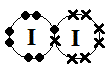 The
iodine atoms in the I2 molecule are joined by a single covalent
bond - one electron short of a noble gas configuration. The
iodine atoms in the I2 molecule are joined by a single covalent
bond - one electron short of a noble gas configuration.
Iodine: mpt. 114oC,
enthalpy of fusion 15.7
kJ mol-1, bpt. 184oC,
enthalpy of vaporisation 44
kJ mol-1
Iodine tends to sublime at temperatures
approaching 114oC and only melts under pressure, low
melting/boiling/sublimation points and low state change enthalpies due to
weak intermolecular bonding.
Water

Ice is a molecular lattice where the
small covalent water molecules are held together by hydrogen bonds.
This is discussed in detail on my
hydrogen bonding page,
including the anomalous density behaviour.
Water: mpt. 0oC/273
K, enthalpy of fusion 6.02
kJ mol-1, bpt. 100oC/373K,
enthalpy of vaporisation 41.1
kJ mol-1,
Low melting/boiling points and low state
change enthalpies due to weak intermolecular bonding.
Links to pages on
intermolecular bonding forces for relatively low melting/boiling 'simple'
covalent molecular elements and compounds
Introduction to intermolecular forces
- intermolecular bonding
Detailed comparative discussion of boiling points of 8 organic molecules
Boiling point plots for six
organic
homologous series and explaining the trends and differences
Other case studies of
boiling points related to intermolecular forces for a variety of compounds
Evidence and theory
for hydrogen bonding in simple covalent hydrides
6.4.3
Giant covalent lattice
(a type of macromolecular molecule lattice)
e.g.
The structure and properties of diamond
and graphite are fully described on my
giant
covalent structures page
Extra A level notes on giant
covalent structures like diamond and graphite
Carbon (diamond)
The structure and properties
 Diamond Diamond
Carbon (diamond): mpt ~3900oC,
bpt. ?, enthalpy of vaporisation ? ~715
kJ mol-1 ?, but its big!
You can only melt or boil diamond under
great pressure, otherwise it sublimes.
Very high melting point and high enthalpy
of vaporisation/sublimation due extremely strong 3D covalent bond network.
Carbon (graphite)
 graphite graphite
Carbon (graphite): mpt. ~3900oC,
bpt. ?, enthalpy of sublimation 715
kJ mol-1
You can only melt or boil graphite under
great pressure, otherwise it sublimes.
Very high melting point and high enthalpy
of vaporisation/sublimation due extremely strong 2D covalent bond network.
6.4.4
Giant metallic lattice e.g.
magnesium
The structure and properties of metal
structures are described on my
metallic bonding page
Extra notes on metallic structures
like magnesium
 magnesium
metal lattice magnesium
metal lattice
Magnesium metal: mpt. 650oC enthalpy of fusion
8.95 kJ mol-1,
bpt. 1107oC, enthalpy of vaporisation 132
kJ mol-1
Relatively high melting/boiling point and
enthalpy of vaporisation due to strong metallic bonding.
|
6.4.5 More on the enthalpy changes for physical changes
of state
for various structures
-
Changes of physical state i.e. gas <==>
liquid <==> solid are also accompanied by energy changes.
-
To melt a solid, or boil/evaporate a liquid, heat energy must be absorbed or
taken in from the surroundings, so these are endothermic energy changes. The system is heated to effect these changes.
-
To condense a gas, or
freeze a solid, heat energy must be removed or given out to the
surroundings, so these are exothermic energy changes. The system
is cooled to effect these changes. -
Generally speaking, the greater the forces between the
particles, the greater the energy needed to effect the state change AND the
higher the melting point and boiling point.
A comparison of
energy needed to melt or boil different types of substance
ΔHmelt is the energy needed to melt 1 mole of the
substance (formula mass in g).
Hvap
is the energy needed to vaporise by evaporation or boiling 1 mole of the
substance (formula mass in g).
For simple small covalent molecules, the energy
absorbed by the material is relatively small to melt or vaporise the
substance and the bigger the molecule the greater the inter–molecular
forces.
-
These forces are weak compared to the chemical bonds holding atoms together in
a molecule itself.
-
Relatively low energies are needed to melt or vapourise
them.
-
These substances have relatively low melting points and
boiling points.
For strongly bonded 3D networks e.g.
-
(i) an
ionically bonded lattice of ions (ionic
bonding),
-
(ii) a covalently bonded lattice of
atoms (covalent
bonding – giant covalent structures),
-
(iii) and a metal lattice of ions and free outer electrons
(metallic
bonding),
-
the
structures are much stronger in a continuous way because of the continuous
chemical bonding throughout the structure.
-
Consequently, much greater energies are required to melt or vaporise
the material.
-
This is why they have so much higher melting points and
boiling points.
|
|
Substance |
formula |
Type of bonding,
structure and attractive forces operating |
Melting point K (Kelvin) = oC + 273 |
Energy needed to melt substance |
Boiling point K (Kelvin)
= oC + 273 |
Energy needed to boil substance |
|
methane |
CH4 |
small covalent molecule –
very weak intermolecular forces |
91K/–182oC |
0.94kJ/mol |
112K/–161oC |
8.2kJ/mol |
|
ethanol ('alcohol') |
C2H5OH |
larger covalent molecule than methane, greater, but still weak
intermolecular forces |
156K/–117oC |
4.6kJ/mol |
352K/79oC |
43.5kJ/mol |
|
sodium chloride |
Na+Cl– |
ionic lattice, very strong
3D ionic bonding due to
attraction between (+) and (–) ions |
1074K/801oC |
29kJ/mol |
1740K/1467oC |
171kJ/mol |
|
iron |
Fe |
strong 3D bonding by
attraction of metal ions (+) with free delocalised outer electrons (–) |
1808K/1535oC |
15.4kJ/mol |
3023K/2750oC |
351kJ/mol |
|
silicon dioxide (silica) |
SiO2 |
giant covalent structure,
strong continuous 3D bond network of O-Si-O bonds |
1883K/1610oC |
46.4kJ/mol |
2503K/2230oC |
439kJ/mol |
COMPARISON OF VARIOUS STRUCTURES and their PROPERTIES
| |
Giant lattice |
covalent molecular |
| Ionic |
Covalent network |
Metallic |
simple molecular |
macromolecular |
|
Examples |
compounds of metals
combined with non-metals eg NaCl, K2O |
Group 4 eg carbon C (diamond &
graphite), silica SiO2, some thermosetting polymers |
metals like magnesium Mg
and iron Fe |
some non-metal elements
and non-metal + non-metal compounds eg O2, H2O |
polymers eg
poly(ethene), PVC, proteins, DNA |
|
Type of particles and
bonding |
strong ionic bonds,
strong electrostatic attraction between oppositely charged ions |
2D or 3D network of
strong covalent bonds between atoms (mutual attraction of two +ve
nuclei to shared -ve electrons |
strong metallic bond,
lattice of positive metal ions strongly attracted to a 'sea' of
surrounding delocalised negative electrons |
small molecules with strong
intramolecular covalent bonds eg O=O, O-H within the molecule, BUT weak
inter-molecular bonds of attraction between the molecules |
strong intramolecular
covalent bonds but weak intermolecular bonds - but stronger than in
small simple molecules |
|
Melting point and
boiling point |
high, strong electrostatic attraction
between ions |
very high, strong
covalent bond network |
generally high (except mercury and
some group 1 metals) |
low due to weak
intermolecular forces |
moderately high and tend to decompose
on strong heating - smell! |
|
Electrical
conductivity |
only conduct (electrolytes) when
molten or dissolved in water - ions then are mobile |
rarely conduct, graphite
and graphenes are important exception |
conduct when solid or
liquid conduct via delocalised electrons |
do not conduct, no ions
or mobile electrons |
do not normally conduct, but there
some 'smart' plastic materials that can |
| Solubility in water |
many soluble - ions can
be hydrated (solvated by polar water molecules) |
insoluble |
insoluble but some react
eg group 1 alkali metals, but this is a dissolving-reaction |
most are insoluble, but, if it is a
polar molecule that can hydrogen bond with water, dissolving can occur
eg ammonia or ethanol |
usually insoluble. but you can make
special water soluble polymers with polar -OH groups on the polymer
chain |
| Solubility in non-polar solvents |
insoluble |
insoluble |
insoluble |
often soluble |
tend to be insoluble |
| Hardness - physical strength |
hard but brittle |
3D structure very hard,
2D graphite soft and slippery! |
usually hard but malleable except
mercury and some group 1 metals |
usually relatively soft
crystals |
quite variable, but usually flexible,
can be quite hard in high % of crystallinity |
| Structure type |
ionic |
giant covalent |
metallic |
small molecules |
macromolecules |
[SEARCH
BOX]
|
Website content © Dr
Phil Brown 2000+. All copyrights reserved on revision notes, images,
quizzes, worksheets etc. Copying of website material is NOT
permitted. Exam revision summaries & references to science course specifications
are unofficial. Chemistry bonding notes for GCSE and A level
chemistry courses,
Website content © Dr Phil Brown 2000+. All
copyrights reserved on revision notes, images, quizzes, worksheets etc. Copying
of website material is NOT permitted. Exam revision summaries & references to
A level chemistry course specifications are unofficial.
Website content © Dr Phil Brown 2000+. All
copyrights reserved on these physical-theoretical chemistry exam revision
notes on comparing different types of crystal structures & their physical
properties, these A level chemistry revision notes are suitable for use of pre-university students studying AQA advanced level
physical-theoretical chemistry revision notes on comparing enthalpy
changes of state values for different crystal structures, Edexcel advanced level
physical-theoretical chemistry revision notes on comparing different
types of crystal structures & their physical properties, OCR advanced level
physical-theoretical chemistry revision notes on comparing enthalpy
changes of state values for different crystal structures, IB advanced level
physical-theoretical chemistry revision notes on comparing different
types of crystal structures & their physical properties, WJEC (Eduqas) advanced level
physical-theoretical chemistry revision notes on comparing different
types of crystal structures & their physical properties, CIE Cambridge advanced level
physical-theoretical chemistry revision notes on comparing enthalpy
changes of state values for different crystal structures, CCEA advanced level
physical-theoretical
chemistry revision notes on comparing different types of crystal structures &
their physical properties, and useful for US grade 11 grade 12 AP honors
physical-theoretical chemistry courses involving comparing enthalpy
changes of state values for different crystal structures
Explaining the importance of comparing different
types of crystal structures & their physical properties
in physical-theoretical chemistry, What you need to know about
comparing enthalpy changes of state values for different crystal
structures for
physical-theoretical
chemistry,
Explaining the use of comparing different types of crystal structures &
their physical properties knowledge in physical-theoretical chemistry, Examples of
comparing enthalpy changes of state values for different crystal
structures explained
when studying physical-theoretical chemistry, What is
the significance of comparing different types of crystal structures &
their physical properties in physical-theoretical chemistry, What is the use of
comparing enthalpy changes of state values for different crystal
structures
in physical-theoretical chemistry Describing and
explaining the theory of comparing different types of crystal structures
& their physical properties when studying physical-theoretical chemistry, exam revision
notes for
comparing enthalpy changes of state values for different crystal
structures in exams, online help for
comparing different types of crystal structures & their physical
properties, revision notes for
comparing enthalpy changes of state values for different crystal
structures,
what do I need to learn for comparing different types of crystal
structures & their physical properties in exams? revision summary for
comparing enthalpy changes of state values for different crystal
structures, help in
teaching comparing different types of crystal structures & their
physical properties, learning notes for
comparing enthalpy changes of state values for different crystal
structures, help to pass the
comparing different types of crystal structures & their physical
properties exam, how to
prepare for examination questions on
comparing enthalpy changes of state values for different crystal
structures? |
|
 For searching