|
3f. Describing and explaining the covalent bonding in the hydrogen chloride
molecule HCl
[Author
©
Dr Phil Brown GRIC, PhD:
Doc Brown's chemistry exam revision notes on
chemical bonding and
covalent molecules - hydrogen chloride,
suitable for students of UK GCSE Science level
AQA, Edexcel, OCR, WJEC and CCEA GCSE chemistry
courses, ~US grades 9-10 chemistry, also useful for more advanced
pre-university A level chemistry courses
[covalent bonding page updated
RE-EDIT]
[email doc
b with any query ]
*
[privacy policy, cookies,
disclaimer]
*
]SEARCH
science website]
Foundation
tier (easier)
m/c QUIZ on structure, properties & chemical bonding
of materials
Higher
tier (harder) m/c QUIZ on structure, properties and chemical bonding of
materials
INDEX of notes on
Covalent Bonding: small molecules and properties
OR
What next?
Covalent bonding diagram for HYDROGEN
CHLORIDE covalent molecule,
molecular formula HCl
* metals \ non-metals (zig-zag line)
|
Pd |
metals |
Part of the modern Periodic Table
Pd = period,
Gp = group |
metals => non–metals |
|
Gp1 |
Gp2 |
Gp3 |
Gp4 |
Gp5 |
Gp6 |
Gp7 |
Gp0 |
|
1 |
1H Note
that hydrogen does not readily fit into any group but is a
non-metal |
2He |
|
2 |
3Li |
4Be |
atomic number
Chemical Symbol
e.g. 4Be |
5B |
6C |
7N |
8O |
9F |
10Ne |
|
3 |
11Na |
12Mg |
13Al |
14Si |
15P |
16S |
17Cl |
18Ar |
|
4 |
19K |
20Ca |
21Sc |
22Ti |
23V |
24Cr |
25Mn |
26Fe |
27Co |
28Ni |
29Cu |
30Zn |
31Ga |
32Ge |
33As |
34Se |
35Br |
36Kr |
|
5 |
37Rb |
38Sr |
39Y |
40Zr |
41Nb |
42Mo |
43Tc |
44Ru |
45Rh |
46Pd |
47Ag |
48Cd |
49In |
50Sn |
51Sb |
52Te |
53I |
54Xe |
|
6 |
55Cs |
56Ba |
Transition Metals |
81Tl |
82Pb |
83Bi |
84Po |
85At |
86Rn |
|
The
covalent molecule hydrogen chloride from the non-metals hydrogen combining with
chlorine |
One
atom of hydrogen (1) combines with one atom of chlorine (2.8.7) to form the molecule of the
compound
hydrogen chloride HCl
Both hydrogen and
chlorine
have one electron short of a full outer shell (2 for H, 8 for Cl), so both atoms share an
electron to have full outer shells.
 and and
 combine to form
 where hydrogen is electronically like helium (2) and chlorine like argon (2.8.8).
 The hydrogen chloride molecule
is held together by the strong hydrogen–chlorine single covalent bond
by sharing electrons, H–Cl (displayed formula). Note that the two inner shells
of chlorine's electrons (2.8.7) are NOT shown (see chlorine atom
diagram in example 2. The hydrogen chloride molecule
is held together by the strong hydrogen–chlorine single covalent bond
by sharing electrons, H–Cl (displayed formula). Note that the two inner shells
of chlorine's electrons (2.8.7) are NOT shown (see chlorine atom
diagram in example 2.
The Venn style diagram on the right is the
best style for the diatomic molecule hydrogen chloride,
clearly showing the sharing of the pairs of electrons for the single covalent bonds in
the hydrogen chloride molecule (in a sort of Venn diagram style).
Electronically, hydrogen
(1) becomes like helium (2) and chlorine (2.8.7) becomes like argon (2.8.8),
so the hydrogen and chlorine atoms effectively have full outer shells in
forming the covalent bonds when the atoms share their outer electrons. The
two inner shells of chlorine's electrons are not shown, only the outer
shells of electrons are involved in the covalent bonding here.
 (Lewis diagram of hydrogen chloride)
simplified 'dot and cross' electronic diagram for the covalently bonded
hydrogen chloride molecule.
(Lewis diagram of hydrogen chloride)
simplified 'dot and cross' electronic diagram for the covalently bonded
hydrogen chloride molecule.
 is
the full 'dot and cross' electronic diagram for the covalent bonding in the
hydrogen chloride molecule - all the electrons are shown. is
the full 'dot and cross' electronic diagram for the covalent bonding in the
hydrogen chloride molecule - all the electrons are shown.
The electronic dot & cross Lewis diagrams for covalent bonding in
hydrogen chloride.
All the
other hydrogen halides will be similar e.g. hydrogen fluoride HF, hydrogen
bromide HBr and hydrogen iodide HI.
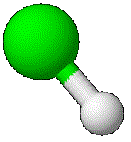 AND AND
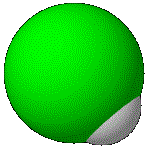
ball and stick model of hydrogen chloride
AND
space-filling model of hydrogen chloride
Note:
Hydrogen chloride gas is a true covalent substance consisting of small
HCl molecules.
If the gas is dissolved in a hydrocarbon solvent like hexane or
methylbenzene it remains as covalent HCl molecules and because there are no ions present,
the solution does not conduct electricity.
However, if hydrogen chloride gas is
dissolved in water, things are very different and the HCl molecules split
into ions.
Hydrochloric acid is formed which consists of a solution
of hydrogen ions (H+) and chloride ions (Cl–).
The solution then conducts electricity and passage of a d.c. current causes
electrolysis to take place forming hydrogen and chlorine.
See also advanced A-level chemistry notes on the
shapes of molecules
Explaining the properties of small
covalently bonded molecules
Hydrogen bromide and hydrogen iodide
(also group 7 halogen halides and
another example of a group pattern in the periodic table)
In terms of the outer
electrons, the electronic diagrams are identical for hydrogen bromide and
hydrogen iodide
i.e. a single covalent bond joins the two halogen atoms together.
HBr
H-Br and
HI H-I
In all the above diagrams
you can swap Cl with a Br or an I
atom.
Comments on hydrogen chloride
Melting point of hydrogen chloride -114
oC
Boiling point of hydrogen chloride -85
oC
You would expect low values
because of the weak intermolecular forces between small covalent molecules
like chlorine.
Hydrogen chloride is a very acidic
choking colourless gas at room temperature.
Don't
confuse HCl(g) gas with HCl(aq) which is hydrochloric acid solution.
Reminder:
How to work out formula of covalent compounds without going through some
demanding electronic thinking is described on the "Elements, Compounds and Mixtures"
page and it is followed by a section on naming compounds.
Extra information
about Hydrogen Chloride Gas e.g. for GCSE/IGCSE Level Chemistry Revision Notes
Properties of
hydrogen chloride
- Formula:
HCl
- Molecular form:
Covalent, diatomic molecule (H–Cl)
- Physical properties:
- Colourless gas
- Sharp, pungent smell
- Denser than air
- Highly soluble in water → forms
hydrochloric acid (HCl(aq))
- Chemical properties:
- Acidic when dissolved in water (strong
acid, fully ionises: HCl → H+ + Cl-)
- Reacts with ammonia gas → forms dense
white fumes of ammonium chloride (NH4Cl)
Laboratory
Preparation
- Method:
React concentrated hydrochloric acid with a solid ionic chloride and a
dehydrating agent
- Example: NaCl + H2SO4(conc.)
→ NaHSO4 + HCl↑
- Collection:
By downward delivery (denser than air, soluble in water so cannot be
collected over water)
- Tests:
- Turns damp blue litmus paper red
(acidic gas)
- Forms white fumes with ammonia gas
Industrial
Manufacture
- Chlor-alkali industry
(by-product):
- Direct synthesis:
- H2 + Cl2 → 2HCl
(exothermic reaction, controlled conditions)
- Other processes:
- As a by-product in organic
chlorination reactions
Uses of Hydrogen
Chloride
- Hydrochloric acid manufacture:
Dissolving HCl gas in water
- Chemical industry:
Production of PVC, dyes, pharmaceuticals
- Laboratory reagent:
Acidification, preparation of chlorides
- Food industry:
Hydrochloric acid used in processing (E507 additive)
- Testing for ammonia gas:
White fumes of ammonium chloride
Typical Exam Board
Requirements
|
Key Focus Areas |
| Properties, lab prep, test with
ammonia, hydrochloric acid formation |
| Lab preparation, downward delivery,
tests, industrial manufacture |
| Detailed industrial processes, direct
synthesis, hydrochloric acid uses |
| Properties, lab prep, hydrochloric
acid, test with ammonia |
| Properties, preparation, industrial
manufacture, hydrochloric acid |
| Lab prep, tests, hydrochloric acid,
environmental/industrial context |
| Hydrogen chloride in the chemical
industry, hydrochloric acid, environmental impact |
Student Exam Tips
- Always distinguish between HCl
(gas) and HCl(aq) (hydrochloric acid).
- Collection method:
Downward delivery (denser than air, soluble in water).
- Tests:
Damp blue litmus → red; ammonia gas → white fumes.
- Industrial manufacture:
Remember direct synthesis (H2 + Cl2 → 2HCl).
- Equations:
Balance carefully, especially in lab prep reactions.
- Exam wording:
“Hydrogen chloride gas dissolves in water to form hydrochloric acid” — don’t
confuse the two.
Common
Misconceptions
- Thinking hydrogen chloride gas
is hydrochloric acid (it only becomes hydrochloric acid when dissolved
in water).
- Assuming HCl can be collected over
water (it is highly soluble, so this is incorrect).
- Forgetting HCl is covalent in the
gas phase (students sometimes assume ionic because it forms ions in
solution).
- Confusing “test for hydrogen
chloride” with “test for hydrochloric acid” — litmus test is for the gas,
not the solution.
- Believing HCl gas is harmless (it is
corrosive and toxic).
What
next?
Test yourself with practice exam questions on chemical bonding?
Foundation
tier (easier)
m/c QUIZ on structure & bonding
& properties of materials
Higher
tier (harder) m/c QUIZ on structure & bonding & properties of materials
Recommend next:
The covalent bonding in the water and
hydrogen sulfide molecules
Explaining the properties of small
covalently bonded molecules
Sub-index for
Part 3.
Covalent Bonding: small molecules & properties
Index for
ALL chemical
bonding and structure notes
All my
GCSE level chemistry revision
notes
All my advanced level pre-university chemistry revision notes
Email doc
brown - comment? query?
Use My Google search box
how do
describe the covalent bonding in hydrogen chloride HCl how do you draw and
construct the covalent bonding diagram for hydrogen chloride HCl, how to explain
the dot and cross electronic diagram for the covalent compound molecule hydrogen
chloride HCl, the properties of hydrogen chloride HCl, the uses of hydrogen
chloride HCl, the manufacture of hydrogen chloride HCl, laboratory preparation
of hydrogen chloride HCl
|
 For searching