|
STATES OF MATTER -
properties of gases and liquids (fluids) and solids
23.
Graham's Law of Diffusion and calculations using the formula to calculate the relative rates
of diffusion of two gases - descriptions of diffusion rate experiments and exam practice questions
[Author
©
Dr WP Brown PhD:
Doc Brown's chemistry exam revision notes on
states of matter - physical properties of gases, liquids and solids,
suitable for students of
UK
advanced level chemistry students aged ~16-18, IB chemistry courses and US grades 11-12 K12
AP honors courses
[page updated Dec 1st 2025]
INDEX of all my notes on the states of matter
Sub-index for this page on diffusion
23a Graham's Law
of diffusion and formula
23b Molecular
mass, speeds and kinetic energy
23c
Demonstrations of diffusion and relative rate of diffusion calculations
23d
Examples of using diffusion to separate gaseous molecules
23e
Fick's
1st Law of Diffusion and links to diffusion contexts in biology
23a. Graham's Law of Diffusion
and calculation formula
-
Diffusion, or the
'self–spreading' of molecules, naturally arises out of their constant chaotic
movement of particles in all directions, though on a time average basis, more molecules
will move in the direction of a region of lower concentration down a diffusion
gradient if such a
situation exists e.g. initially after 'pouring bromine vapour into air' in gas jars.
-
See part 4.
What is diffusion?
Particle model and examples
of demonstrating diffusion in gases
-
Molecules of differing
molecular mass diffuse at different rates.
-
The smaller the molecular mass, the
greater the average speed of the molecules at constant temperature.
-
The greater the average speed of the
particles the greater their rate of diffusion.
-
See notes on the
Maxwell–Boltzmann distribution of molecular velocities.
-
This conceptually explains Graham's Law
of diffusion, explained below.
-
It has been shown
that, assuming ideal gas behaviour and constant temperature,
the relative rate of diffusion of a gas through any medium e.g.
open space, porous materials or a mixture of gases through a tiny hole
(effusion) is inversely
proportional to the square root of its density.
-
rate of diffusion
 1/√d
1/√d
-
and
-
rate of diffusion
1/√Mr
-
because the density of an
ideal gas is proportional to its molecular mass,
-
so
the relative
rate of
diffusion of a gas is also inversely proportional to the square root of its
molecular mass*.
-
* PV = nRT, PV = m/MrRT,
Mr = mRT/PV
-
so,
since d = m/V, then Mr is proportional to
density.
-
|
r1 |
|
√d2 |
|
√M2 |
|
––– |
= |
–––– |
= |
–––– |
|
r2 |
|
√d1 |
|
√M1 |
- Which is the mathematical ratio
representation of Graham's law of diffusion for comparing two gases of
different molecular masses.
-
Graham's Law arises from
the fact that the average kinetic energy ** of gas particles is a constant for
all gases at the same temperature.
-
**
The formula for kinetic
energy is KE = 1/2mu2, where m = mass
of particle, u = velocity. This means the average mu2
is a constant for constant kinetic energy, so u is proportional to 1/√m and the m can be shown
via the Avogadro Constant to
be proportional to Mr, the molecular mass of the gas.
-
You have to think of the molecules
'hitting' the space of the pore or tiny hole and passing through the.
-
The
greater the speed the more chance the particle has of passing through this
'porous space'.
|
23b. Molecular mass and average speeds of molecules
Atomic masses: H = 1, C = 12, N = 14, O =
16, Cl = average 35.5, Br average 80
Relative molecular
masses = Mr : H2
= 2, He = 4,
CH4 = 16,
NH3
= 17, N2
=
28, O2
= 32, HCl = average 36.5,
CO2 = 44,
Br2 = 160
(molecular mass) Average speeds of particles
at 0oC
(2) hydrogen 1698 m/s
(4) helium 1202 m/s (note that helium
balloons deflate far too quickly!)
(16) methane 600 m/s
(17) ammonia 661 m/s
(28) nitrogen 454 m/s (981 m/s at 1000oC)
(32) oxygen 424 m/s
(44) carbon dioxide 362 m/s
All
substances have the same average kinetic energies at the same
temperature, despite the fact that there is a wide range of
speeds and kinetic energies due to the random motion and collisions.
A little bit of kinetic energy theory
and Graham's Law of Diffusion
Assuming you are dealing with average values of KE and v
KE =
½mv2
2KE = mv2
v2 = 2KE/m therefore
v =
√(2KE/m)
BUT think from the above equation:
vav
√(1/Mr)
THEN
think average rate of diffusion (ROD) is proportional to the average speed of
molecules, so,
ROD
√(1/Mr) which is a form of Graham's Law
of diffusion/effusion. Actually
in 1831, Graham expressed his law in terms of density:
rdiff
√(1/d)
derived from experimental results, but, at the same temperature
pressure:
Mr
d (ref. Avogadro)
Graham's Law of Diffusion
expressed in terms of two gases of different molecular masses
|
rdiff1 |
|
√Mr2 |
|
–––– |
= |
––––– |
|
rdiff2 |
|
√Mr1 |
and relating the relative diffusion rates of
two different molecules 1 and 2 |
23c.
Demonstrations of diffusion and
relative rate of diffusion calculations
-
Diffusion demonstration
1
-
The reaction
between hydrogen chloride and ammonia gases
-

-
Two cotton wool plugs are
separately soaked in concentrated aqueous ammonia and hydrochloric acid
solutions respectively and sealed in a long tube with rubber bungs.
-
Using a simple chemical
equation and Graham's Law of diffusion, account for (a) the appearance of a
'white smoke ring' and (b) the fact the smoke ring occurs about 2/3rds
along from the ammonia end of the tube.
-
(a) The aqueous
ammonia will give off ammonia fumes and the conc. hydrochloric acid gives off
hydrogen chloride fumes which will diffuse down the tube towards each other.
-
When they meet an acid base reaction gives fine crystals of the salt ammonium
chloride.
-
-
(b) Mr(NH3)
= 17, Mr(HCl) = 36.5
-
If
r is the relative rate
of diffusion the following ratio applies,
-
|
rNH3 |
|
√MrHCl
= √36.5 |
|
6.04 |
|
–––––––– |
= |
–––––––––––––––––––– |
= |
––––––––
= 1.47 |
|
rHCl |
|
√MrNH3
= √17 |
|
4.12 |
-
and this shows that
ammonia will diffuse about 50% faster than hydrogen chloride so the smoke
ring will appear much nearer the HCl end of the tube the NH3 end of
the tube.
An
alternative maths approach to the experiment above
NH3(g) + HCl(g)
===> NH4Cl(s)
fine crystals of ammonium
chloride salt formed
Molecular masses: HCl 36.5, NH3 17
Prediction of relative rates of diffusion from
Graham's Law
Ammonia: 1/√(17)
= 0.243
Hydrogen chloride: 1/√(36.5)
= 0.167 0.243/0.167 = ~1.5 and observation matches prediction!
The smoke ring is about 2/3rds of the
way along from the ammonia end of the tube.
Incidentally, chlorine has two
abundant isotopes, 35Cl and 37Cl, so you
would find that the lighter isotope 35Cl would
diffuse faster than the heavier isotope 37Cl.
So, theoretically, H35Cl
is diffusing faster than H37Cl, but I don't think you
would notice this in the experiment!
|
-
Diffusion demonstration 2 - porous
pot experiments
-
Experiments to qualitatively
observe the relative rates of
diffusion of air, hydrogen and carbon dioxide molecules

-
The porous pot is inverted and connected to a U tube
manometer system and allowed to settle down so bother coloured fluid
levels are at the same height. This means there is no pressure
differential in the U tube.
-
A large inverted beaker is placed in position over
the porous pot and the levels should still be equal. You then pass
hydrogen gas up into the beaker where it will accumulate, being less
dense than air. Within a short time the liquid moves away from the
porous pot because the faster moving lower molecular mass molecules
of hydrogen diffuse into the pot faster than the air molecules of
nitrogen and oxygen can diffuse out.
-
Here the porous pot is inverted, but still attached
to a simple U tube manometer system. A large beaker is held in
position surrounding the porous pot and the system allowed to settle
so the liquid levels are equal. Carbon dioxide gas is passed into
the beaker where it will accumulate, being denser than air. Within a
short time the coloured liquid moves towards the porous pot because
the faster lower molecular mass molecules of air (mainly nitrogen
and oxygen) diffuse out the porous pot faster than the slower higher
molecular mass molecules of carbon dioxide can move in.
-
Experiments 2. and 3. illustrates Graham's Law of
diffusion and the different rates of diffusion create a small
(temporary) difference in pressure between the gases in the porous
pot and the gases outside of the porous pot.
See also States
of Matter Parts
4. and 5. for more on diffusion demonstrations
4.
What is diffusion?
Particle model and examples
of demonstrating diffusion in gases
6.
Particle model of a liquid and diffusion experiments and associated phenomena
23d. Examples of using diffusion to separate gaseous
molecules

-
Zeolites are silicate
minerals that are porous at the molecular level and they are used as catalysts
and 'molecular sieves' in the petrochemical industry in processes such as
cracking and subsequent molecule separation.
-
(a) Calculate the relative
rates of diffusion of pentane CH3CH2CH2CH2CH3,
hexane CH3CH2CH2CH2CH2CH3
or 2–methylpentane (CH3)2CH2CH2CH2CH3
into a zeolite mineral.
-
Atomic masses: C = 12, H =
1
-
Hexane and 2–methylpentane
are structural isomers of C6H14 with the same molecular
mass.
-
|
rC5H12 |
|
√MrC6H14
= √86 |
|
9.27 |
|
––––––––– |
= |
––––––––––––––––––– |
= |
––––
= 1.09 |
|
rC6H14 |
|
√MrC5H12
= √72 |
|
8.49 |
- Relative rate of diffusion is
1.09 : 1.00 for
pentane : hexane/2–methylpentane.
- So, e.g. pentane should
diffuse into the zeolite mineral faster than hexane.
-
(b) In practice
2–methylpentane does not diffuse into the zeolite as fast as hexane or maybe
not at all.
| A
very brief description of the uranium enrichment
(a) Separation by diffusion
The UF6 gas is forced through semi-permeable porous
membrane and uses lots of energy.
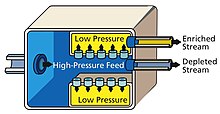
Its a sort of
multiple porous pot system!
The slightly 'lighter' 235UF6
molecules diffuse through the surface of the porous tubes on average
a tiny bit faster than the heaver' 238UF6
molecules and gradually the ratio changes in favour of U-235
hexafluoride in the enriched stream/
(b) Gas
centrifuge
 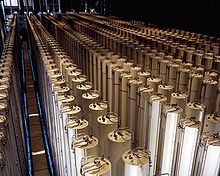 This enrichment process now employs huge gas
centrifuge system to separate the 'lighter' 235UF6
molecules from the heavier 238UF6 molecules
(less energy). This enrichment process now employs huge gas
centrifuge system to separate the 'lighter' 235UF6
molecules from the heavier 238UF6 molecules
(less energy).
The heavier molecules of 238UF6 are spun out
in a rotating cylinder to the outer region of the chamber,
and retained, with the help of slower diffusion in reverse (left
diagram)
The lighter molecules of 235UF6
tend to concentrate a little bit
more towards the centre of the drum, again helped by their natural
process of a higher rate of diffusion. The very slightly enriched 'central' mixture is then fed
into the next rotating drum.
This is repeated many times in
many cylinders (diagram above right) to
complete the uranium enrichment process.
The enriched UF6 is chemically
processed back to uranium metal and used for fuel rods in nuclear
reactors, in which plutonium is produced, this is then extracted for
use as superior nuclear fuel rods or converted to weapon grade
plutonium for nuclear armed missiles.
|
 23e. Fick's
1st Law of Diffusion 23e. Fick's
1st Law of Diffusion
ROD =
rate of diffusion of specific substance
ROD
difference in
concentration x surface area /
diffusion distance
ROD
∆c x a / d
ROD = net rate of particle transfer down a
diffusion gradient.
∆c =
difference in concentration from the top to the
bottom of the diffusion gradient (i.e. from the higher region to the
lower region in terms of concentration.
a = area over which this net rate of diffusion is
taking place
d = 'horizontal' distance over which the diffusion
takes place (width of gradient)
This means the net rate of material
transfer is increased by:
- increasing the difference
in concentrations
- increasing the surface are
through which diffusion takes place
- decreasing the distance
over which the concentration gradient is active i.e. the
distance the diffusing particles (molecules or ions) have to
travel.
These diffusion factors are
VERY important for various biological situations (links
below)
|
Biology links to diffusion situations
Transport
links e.g. movement of water and nutrients by diffusion
(1)
Introduction to diffusion and demonstration experiments
and
its importance in biology
(2)
A particle model and factors
affecting the rate of diffusion and Fick's Law of diffusion
(3)
The action of
partially permeable cell
membranes - selective diffusion and examples
(4)
Osmosis - examples and explanation
(7)
Active transport - explanation of why needed and examples
explained
(8)
A quick comparison of diffusion, osmosis and active transport
Gas exchange
by diffusion links
2.
Introduction to exchange surfaces in cells and
organs
3.
Gas exchange in
the human lungs by diffusion, comments on breathing, COPD and ventilators
4.
Gas exchange and the structure of fish gills
5.
The function of villi in the exchange
surface of the small
intestine
Key points about Graham's Law of Diffusion
Graham’s law of diffusion states
that the rate of diffusion (or effusion) of a gas is inversely proportional
to the square root of its molar mass.
This means lighter gases diffuse faster
than heavier gases.
The Law
- Formulated by Thomas Graham (1848).
- Expressed mathematically:
|
r1 |
|
√d2 |
|
√M2 |
|
––– |
= |
–––– |
= |
–––– |
|
r2 |
|
√d1 |
|
√M1 |
where 1 represents the relative rate of
diffusion, density and molecular mass of gas 1
relative to
where 2 represents the relative rate of
diffusion, density and molecular mass of gas 2
- A couple of practice calculation questions
for you next.
Practice examples
using molar mass
Example 1: Comparing Hydrogen and Oxygen
- Molar mass of H2 = 2 g/mol
- Molar mass of O2 = 32 g/mol
- If you do the calculation
you should find hydrogen diffuses 4 times faster than
oxygen.
Example 2: Helium versus Carbon Dioxide
- Molar mass of He = 4 g/mol
- Molar mass of CO2 = 44 g/mol
- Again, if you do the calculation
you should find helium diffuses about 3.3 times faster than
carbon dioxide.
Real-Life
Applications of Graham's Law of diffusion
- Smell spreading:
Perfume diffuses quickly because lighter molecules spread faster.
- Respiration:
Oxygen diffuses into blood faster than heavier gases.
- Industrial separation:
Used in separating isotopes (e.g., uranium enrichment).
- Scuba diving:
Explains why helium is used in breathing mixtures—it diffuses faster and
reduces risk of nitrogen narcosis.
Student Exam Tips
in using Graham's Law of diffusion
- Always use molar mass (g/mol),
not density, unless density is given.
- Remember: lighter gases diffuse
faster.
- State assumptions: constant temperature
and pressure.
- In multiple-choice, check if the question
asks for relative rate or absolute rate.
Typical
Misconceptions about Graham's Law of diffusion
- Thinking diffusion depends on gas
volume or pressure — it depends on molar mass.
- Forgetting to take the
square root in calculations.
- Assuming heavier gases cannot
diffuse — they do, but more slowly.
- Mixing up diffusion (mixing of
gases) with effusion (escape through a tiny hole).
Learning objectives for diffusion
Be able to explain how
diffusion takes place.
Be able to quote Graham's
Law of diffusion.
Be able to do relative
rates of diffusion calculations using the Graham's Law formula in terms
of gas density or molecular mass of the molecules.
Using Graham's law of
diffusion be able to explain the observations in experiments like the
porous pot demonstrations.
All my
UK GCSE level (~US grade 8-10) school chemistry revision
notes
All my UK advanced level (~US grades 11-12)
pre-university chemistry revision notes
This is a BIG
website, you need to take time to explore it [ SEARCH
BOX]
Email doc
brown - comment? query?
  Website
content © Dr Phil Brown 2000+. All copyrights reserved on Doc
Brown's Chemistry revision notes, images, quizzes, worksheets etc.
Copying of website material is NOT permitted.
GCSE level and advanced pre-university level
revision notes. Detailed
notes on the states of matter and their properties.
Based on the syllabus-specifications for students taking the IGCSE/GCSE
level physics examinations summary revision notes and key points about
Explaining Graham's Law of diffusion and calculating relative rates
of diffusion of gases,
for students taking the WJEC advanced
A level chemistry, CCEA advanced A level chemistry, Cambridge CIE
advanced A level chemistry, AQA advanced A level chemistry, Edexcel
advanced A level chemistry, OCR advanced A level chemistry, Salters
advanced A level chemistry, IB advanced A level chemistry, US grade
11-12 K12 AP Honors chemistry courses Website
content © Dr Phil Brown 2000+. All copyrights reserved on Doc
Brown's Chemistry revision notes, images, quizzes, worksheets etc.
Copying of website material is NOT permitted.
GCSE level and advanced pre-university level
revision notes. Detailed
notes on the states of matter and their properties.
Based on the syllabus-specifications for students taking the IGCSE/GCSE
level physics examinations summary revision notes and key points about
Explaining Graham's Law of diffusion and calculating relative rates
of diffusion of gases,
for students taking the WJEC advanced
A level chemistry, CCEA advanced A level chemistry, Cambridge CIE
advanced A level chemistry, AQA advanced A level chemistry, Edexcel
advanced A level chemistry, OCR advanced A level chemistry, Salters
advanced A level chemistry, IB advanced A level chemistry, US grade
11-12 K12 AP Honors chemistry courses
INDEX of all my notes on the states of matter
|
|

 ENTER
chemistry words e.g. topic, module, exam board,
formula, compound, reaction, structure, concept, equation, any 'phrase',
homework question! anything of chemical interest, like your latest homework question!
or anything
of scientific interest! This is a very comprehensive Google
generated search of my website.
ENTER
chemistry words e.g. topic, module, exam board,
formula, compound, reaction, structure, concept, equation, any 'phrase',
homework question! anything of chemical interest, like your latest homework question!
or anything
of scientific interest! This is a very comprehensive Google
generated search of my website.