|
GCSE level Physics:
Section 8 Static electricity: Part 8.4
More examples of
static electricity and its effects in the home
Ways of combating effects of static electricity
[Author
©
Dr WP Brown PhD:
Doc Brown's physics exam revision notes suitable for students of UK
IGCSE & GCSE level physics courses, ~ US grades 9-10 physics,
updated Feb 18th 2026 *]
[KEY
POINTS and learning objectives for this page, after initial notes]
[email doc b
query? comment?]
*
[privacy-policies-disclaimer]
*
]SEARCH doc b's
website]
INDEX of physics notes on
static electricity, electrostatics & electric fields
Lots of scenarios e.g. car builds up static
from friction. nylon clothes crackle!, antistatic agents to reduce effects of
static electricity. refuelling and pipes of flammable liquids petrol stations,
fine powders can ignite from friction effects, examples of static electricity
effects in the home use of anti-static agents coatings as additives in materials
like clothes, dusting surfaces charges them and dust collects, dust builds up on
charged objects like TV, balloon on ceiling experiment, carpets can build up
static electricity etc. etc.
For more on uses see Part
8.5
Some uses of static electricity effects - e.g. paint
spraying, particle anti-pollution, photocopier
8.4 (A) More examples of
static electricity and its effects in the home
As already mentioned, whenever certain
synthetic fibre
clothes rub up against each other, the friction between the surfaces can
generate static electricity which can then discharge causing tiny sparks or tiny
shocks.
This can cause clothing to stick to you as 'prickling effects' from the
tiny electrical discharges.
Nylon clothes
are susceptible to this creation and build-up of static electric charge.
Polished surfaces to make them look clean
and shiny also generates static charge on the surface and attracts fine dust
particles e.g. on table tops.
High voltage equipment can create static
charge e.g. dust collects on TV and computer screens.
You can rub a
balloon on your sweater to give the rubber
surface a static charge, it can the induce an opposite charge on the surface of
a ceiling and so it can stick there!
Note that before the rubbing
together, both objects are electrically neutral, but after rubbing the
two together ....
if the balloon loses electrons to the
sweater, the balloon carries a positive charge, therefore the sweater
will induce a negative static charge on the ceiling surface by attracting
electrons, and the balloon sticks to the ceiling.

but, usually, the rubber balloon
carries a negative charge, gaining electrons from the sweater rubbing.
The balloon will therefore induce a positive
static charge on the ceiling surface by repelling electrons.
So attraction of opposite charges
attract, and the balloon sticks to the ceiling!
This is known as
attraction by induction,
and will do the same to your hair, which is attracted to the balloon!
When you run a
comb through your hair
electrons can be transferred to the comb giving it a negative static charge.
Both the comb and hairs acquire a
static charge.
It
can then pick up bits of paper (see earlier section). Your hairs might also be
attracted to the comb instead of staying in place!
When you walk on a
vinyl floor or one covered
with a nylon carpet you 'charge up' because of friction between you and the
carpet, which can result in getting an electrostatic shock by touching a
conducting material such as a metal door handle, water tap or even another
person!
e.g. If you touch a water pipe (automatically
earthed) after walking on a floor covered with an insulating material like
synthetic carpet or vinyl tiles you may experience a small electric shock from
the build up of static electricity on your clothing.
Many electrically insulating surfaces
like plastic or wood, when polished, become charged when rubbed with a dusting
cloth.
Therefore, polished surfaces readily
attract the dust back again!
Some dusting brushes are designed to
be charged, and induce a charge in dust particles to attract and collect
them.
Anti-static spray coatings are made from
a conducting polymer dissolved in a solvent made from deionized water and
alcohol.
When the solvent evaporates, it
leaves behind a very thin conducting skin on the surface of the object
that drains any static charge away and prevents further static build-up.
You can also get a cloth that does
the same job.
INDEX physics notes on static
electricity - electrostatics & electric fields
For more on uses see Part
8.5
Some uses of static electricity effects - e.g. paint
spraying, particle anti-pollution, photocopier
Section 8 Static electricity: Part
8.4 (B)
More
on the nuisance and dangers of static electricity from friction between material
surfaces - use of antistatic agents to counteract the effects of 'static'
8.4 (B) More
on the nuisance and dangers of static electricity
As already mentioned in
Part 3, any object connected to
the 'earth' by a conductor (earthing charged objects) then any
static electricity can be safely discharged.
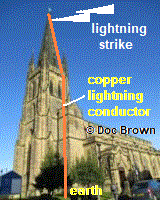 The most dramatic example is a
lightning conductor! The most dramatic example is a
lightning conductor!
As previously described, lightning is
a very powerful and potentially dangerously destructive discharge of static
electricity. Apart from their obvious danger to human beings, lightning strikes
can seriously damage buildings, especially tall ones, were the highest point is
nearest to the source of static charge.
For example church steeples have a strip
of copper from the peak of the spire running right down to be embedded in the
ground - earthed. When the lightning strikes, the discharged static electricity
heads for the most electrically conductive material, the copper strip, rather
than the insulating stone, and runs safely into the ground. Without the
lightning conductor the build up of energy at the top of the building is so
great it cause physical damage to stonework and set fire to roof timbers.
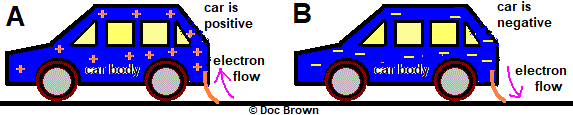
As a car,
or any other road vehicle, is moving fast through air, static charge can build
up on the body of the car through friction.
To avoid any irritating or dangerous
consequences, you can have a metal contact e.g. a copper strip in a plastic
sheath (brown strip on the diagram above) that electrically connects the metal
body of the car to the 'earth'.
This allows any static charge formed to drain
away.
If the car is positive the charge is 'neutralised' by electrons flowing
from the road (the 'earth') or if the car is negative, then the negative static
charge of electrons can be safely discharged to the road through the copper
strip.
Static charge is easily formed by a plastic
surface rubbing against another surface e.g. plastic vinyl floor tiles, nylon
comb through your hair, synthetic fibres in clothing, etc.
To minimise these
effects plastic additives called antistatic agents have been developed to
minimise the build up of static electricity.
To these plastic products special
molecules called anti-static agents are added to the polymer mixture from the
object/material is made.
These antistatic agents make the surface of the polymer
slightly conductive and enough to allow any static charge formed to be
discharged and so dispersed to give no noticeable effect.
You can uses
anti-static sprays to coat surfaces to increase the surface conductivity to reduce the problems of static
electricity - you can treat car seats in this way too.
Refuelling and filler pipes:
When road
vehicle fuel tanks at the petrol station, fuel tankers themselves, aircraft fuel
tanks etc. are being filled the friction of the flowing fuel against the pipe
hosing can create static charge.
Therefore, fuel delivery systems must be
(most importantly) earthed and anti-static liquid agents may be added to the
fuel to increase its electrical conductivity to drain away any potentially
static electricity.
The hose piping itself can be treated
with an anti-static agent to avoid the build up of static charge, that,
if discharged, may create a spark potentially causing a fire or explosion in an
air - petrol vapour mixture.
Static electricity can build up on the body
of an aircraft as it flies through the air at great speed, so a great friction
effect cannot be avoided.
Therefore the plane does become charged and this
static charge can interfere with communication systems.
Modern aircraft are fitted with
static dischargers, which moderate the amount of static charge that
builds up on the aircraft.
In a factory, machinery operators using high
voltage machines, stand on insulating mats or wear shoes with insulating soles
to stop any charge flowing through them to the Earth.
Protection against a static electricity
discharge must be in place where equipment is used in atmospheres where explosions could
occur eg inflammable gases or vapours or with high concentrations of oxygen
 Most of the situations I've described will be
familiar to most people, but how many of you realise the dangers of
very fine
combustible powders moving in the air! Most of the situations I've described will be
familiar to most people, but how many of you realise the dangers of
very fine
combustible powders moving in the air!
In the past there have been coal dust
(coal mine) and flour (flour mill) explosions due to the friction between moving
fine dust particles and the surrounding air.
 The fine powder particles have such
a large surface area for friction to take place that sufficient static charge can build up to create a
spark. The fine powder particles have such
a large surface area for friction to take place that sufficient static charge can build up to create a
spark.
The 'surface area rule' in chemistry kicks in (rates
of reaction factor) and rapid combustion ensues from the heat
generated, causing the powder and oxygen in the air to explode !!!
INDEX physics notes on static
electricity - electrostatics & electric fields
For more on uses see
Part 8.5
Some uses of static electricity effects - e.g. paint
spraying, particle anti-pollution, photocopier
|
Key points about
static electricity -
Information
sources for Doc Brown's key points: IGCSE-GCSE physics are based on
textbooks & syllabus-specifications for students taking the UK AQA, Edexcel,
OCR 21st Century Science, OCR Gateway science suite, WJEC, CCEA and CIE GCSE
physics 9-1 level science examinations
A comprehensive and
exam-board-aligned summary of static electricity
tailored for IGCSE/GCSE Physics students, covering examples,
dangers, anti-static agents, and revision tips
for WJEC, CCEA, CIE, AQA, Edexcel, and OCR.
Static Electricity: Summary Revision Notes
What is Static Electricity?
- Static electricity
is the build-up of electric charge on the surface of an
insulator.
- It occurs due to friction,
which causes electrons to transfer between materials.
- The object gaining electrons becomes
negatively charged, and the one losing electrons
becomes positively charged.
Examples in the Home
| Example |
Explanation |
| Balloon sticking to a wall |
Rubbing a balloon on hair
transfers electrons to the balloon. The negatively charged balloon
induces a positive charge on the wall, causing attraction. |
| Clothes clinging after
tumble drying |
Friction between clothes causes
charge build-up, making them attract each other. |
| Shock from door handle |
Walking on a carpet builds up
charge on your body. Touching a metal handle discharges it as a
spark. |
| Plastic comb picking up
paper |
Rubbing a comb through hair
charges it. It attracts neutral paper pieces due to induced charge. |
Dangers of Static Electricity
| Situation |
Risk |
| Fuelling aircraft or
tankers |
Friction between fuel and pipe
builds charge. A spark could ignite fuel vapour. |
| Lightning |
Charge builds in clouds and
discharges to Earth as a massive spark. |
| Explosive environments |
Sparks from static can ignite
flammable gases or dust. |
Anti-Static Agents and Safety Measures
| Method |
Purpose |
| Earthing
(Grounding) |
Connects charged
object to Earth using a conductor to safely discharge excess
electrons. |
| Anti-static
sprays |
Reduce charge
build-up on surfaces like carpets or electronics. |
| Humidifiers |
Moist air reduces
static build-up. |
| Conductive
materials |
Used in flooring or
clothing to prevent charge accumulation. |
| Bonding lines |
Connect fuel tankers
to Earth during refuelling to prevent sparks. |
Typical Exam Board Syllabus Content
|
Key Requirements |
| Charging by friction, uses and
dangers, earthing, examples like balloons and shocks. |
| Static electricity in daily life,
industrial uses, sparking, earthing, photocopiers, insecticide
sprayers. |
| Charging, forces between charges,
earthing, Van de Graaff generator, practical applications. |
| Everyday examples, dangers (e.g.
lightning), safe discharge methods, industrial uses. |
| Charging by friction, uses (e.g.
printers), dangers (e.g. explosions), safety measures. |
| Charging, attraction/repulsion,
uses in industry, dangers, prevention methods. |
Student Tips for Exams
- Use key terms:
friction, electrons, earthing, induced
charge, repel, attract.
- Explain mechanisms:
Don’t just say “it sticks”—explain how charge builds and causes
attraction.
- Draw diagrams:
Especially for balloon-wall, comb-paper, or Van de Graaff generator.
- Link to safety:
Always mention how earthing or anti-static agents prevent danger.
- Practice past questions:
Focus on explaining both uses and dangers with
examples.
Keywords, phrases and learning objectives
on static electricity
Be able to describe and explain examples of static electricity effects in the home
e.g. use of anti-static coatings, additives in materials like
clothing to reduce sparking from friction, explain why dusting
surfaces can cause dust to collect on charged objects like computer
and TV screens and explain why a rubbed balloon can stick on a
ceiling, and rubbing on
carpets can produce sparks - all reduced by the use of ant-static
agent chemicals.
Know and explain how to use antistatic agents to counteract effects of 'static'.
Be able to describe and explain the
nuisance and dangers of static electricity e.g. car builds up static from friction,
nylon clothes contain antistatic agents, danger of fire and explosion of refuelling filler pipes of flammable liquids
e.g. at petrol stations and fine powders can ignite - there have been
serious explosions in flour mills before safety standards were increased.
SITEMAP
Website content © Dr
Phil Brown 2000+. All copyrights reserved on Doc Brown's physics revision notes, images,
quizzes, worksheets etc. Copying of website material is NOT
permitted. Exam revision summaries and references to GCSE science course specifications
are unofficial.
INDEX physics notes on static
electricity - electrostatics & electric fields
Based on the syllabus-specifications
for students taking the IGCSE/GCSE level physics examinations summary
revision notes and key points on ways of combating effects of
static electricity for students taking the AQA
igcse/gcse physics notes on ways of combating effects of static
electricity , Edexcel gcse
physics notes on ways of combating effects of static
electricity , OCR 21st century GCSE
physics notes on ways of combating effects of static
electricity , OCR gateway
GCSE physics notes on ways of combating effects of static
electricity , WJEC gcse physics notes on ways of combating effects
of static electricity , CCEA
gcse physics notes on ways of combating effects of static
electricity for students taking CIE Cambridge igcse
physics, or any other GCSE or IGCSE level physics exams notes on
ways of combating effects of static electricity , useful for US grade 9-10 physics courses,
Explaining the importance of
anti-static sprays & agents
in GCSE level physics, What you need to know about anti-static sprays &
agents for
GCSE level
physics,
Explaining what is the use of anti-static sprays & agents knowledge in GCSE level physics, Examples of
anti-static sprays & agents explained
when studying GCSE level physics, What is
the significance of anti-static sprays & agents in GCSE level physics, Describing and
explaining the theory of anti-static sprays & agents when studying GCSE level physics, revision
notes for anti-static sprays & agents in exams, online exam help for
anti-static sprays & agents , revision notes for
anti-static sprays & agents , what do I need to learn about anti-static
sprays & agents for by GCSE physics exam?
revision summary for anti-static sprays & agents , help in teaching
anti-static sprays & agents , learning notes for anti-static sprays & agents ,
help to understand the anti-static sprays & agents topic in preparation GCSE physics exam
question, how to
prepare for questions involving anti-static sprays & agents in a GCSE physics examination?
For more on uses see
Part 8.5
Some uses of static electricity effects - e.g. paint
spraying, particle anti-pollution, photocopier
|
