|
GCSE level Physics:
Section 8 Static electricity:
Part 8.2
What is an electric field? Maps of repulsion & attraction of static charges -
rules on size of charge and distance apart
[Author
©
Dr WP Brown PhD:
Doc Brown's physics exam revision notes suitable for students of UK
IGCSE & GCSE level physics courses, ~ US grades 9-10 physics,
updated Feb 18th 2026 *]
[KEY
POINTS and learning objectives for this page, after initial notes]
[email doc b
query? comment?]
*
[privacy-policies-disclaimer]
*
]SEARCH doc b's
website]
INDEX of physics notes on
static electricity, electrostatics & electric fields
8.2A
What is an electric field?
Reminder of what the rules
are on bringing electrically charged objects together?
An electric field is created around any
particle or object that has an overall positive or negative electric charge.
Any pocket of static charge on an object,
when brought near another object that is also carrying a static electrical charge then one
of two things can happen.

When an electrically charged object is placed in an electric
field e.g. from another charged object, it will experience a force due to the
interaction of two electric fields.
The magnitude and direction of this force is determined by
three factors, which are all to do with the strength of the electric field.
Also note that both charged objects experience a force
e.g. both the objects Q and q move apart or come closer together.
1. Direction of the force
If the static charges are alike, two
positive or two negative charges, then a force of repulsion occurs
between the objects, pushing them apart.
This is called electrostatic repulsion,
a non-contact force.
If the static charges are different, a
positive and a negative charge, then a force of attraction occurs between
the objects, attracting them together.
This is called electrostatic
attraction, a non-contact force.
This non-contact force acts due to the presence of an
electric field around each object which do NOT have to be in contact with each
other.
You can demonstrate rule 1. by suspending
two different plastic rods of different static charges and bring them
towards each other e.g. two of the same charge brought near each other OR
two plastic rods of opposite charge.
Rule 2. The size of the charge
For oppositely charged objects, the greater the two electrical charges e.g.
Q+ and q-, the greater the force of attraction between the charged objects. The
strength of the electric field is increased by increase in the magnitude of
the charges.
If the two charges are of the same sign
(+ + or - -) then the greater the magnitude of the charges, the greater the
force of repulsion pushing them away from each other.
Rule 3. The distance between two charged
objects
For oppositely charged objects (+ve and
-ve), the smaller the distance between the two
static charges, Q+ and q-, the greater the force of attraction between the charged objects.
The strength of the electric field is increased by decreasing the distance
between the charges.
If the two charges are of the same sign
(+ + or - -) then the closer they are, the greater the force of repulsion
pushing them away from each other.
Footnote
on attractive force:
At
a higher level i.e. UK A level, the force of
attraction is proportional to
charge Q+ x charge q- / d2
Q+ and q- are the two
static electric charges and d the distance between the
centres of the two charges.
The same equation
applies for the repulsive force if both charges were +ve or -ve.
Electric charge is measured in coulomb
units, denoted by C
See
Calculation
of the charge passing through a point in a circuit Q = It
8.2B
More on electric fields - 'maps' of the electric field lines
Can we map out the field lines of a static
electric field (as with magnets!)?
An electrical field is created around any
electrically charged object.
The electric field of an object is the
region that will experience a force if a second charged object is moved into it.
The nearer you are to a charged object AND
the bigger its charge, the stronger
the electric field effect is.

The orientation of field lines around a charged object
The diagram above shows the direction of the
field lines in an electric field emanating ('spreading out') from two isolated
spherical objects, one positively charged Q, and one negatively charged
object q.
The lines of the electric force field go
from positive to negative and at right angles to the surface of the
charged object.
The closer together the field lines
are, the stronger the electric field - you can tell from the diagram the
field is strongest the closer to the centre of charge you get.
The diagram above forms the basis for showing
the electrical field around an object for an isolated positively charge object
and an isolated negatively charged object.
By convention the field lines run
from positive to negative as indicated by the added arrowheads.

Electrostatic force field diagrams when
charges interact
The above diagrams show the maps of field
lines for electrically charged objects when you get:
Note the electrostatic charge convention that
the field direction is from positive to negative.
(i)
ATTRACTION: when two oppositely
charged objects approach each other (+ve and -ve)
Here the field lines join up between
the two charged particles.
If the charged objects are free to
move towards each other, the field lines will strengthen, become closer together, as the
attractive force increases.
(ii)
REPULSION: when two objects of the
same charge approach each other (two +ve or two -ve).
Here the field lines do not join up,
but are pushed away from each other.
If the charged objects are free to
move apart, the field lines will weaken as they become further apart, and the attractive
force decreases.
The closer the field lines are together
the stronger the electrical field effect.
This happens as you get closer to any
charged object OR if the charge is increased, which also increases the
electric field strength.
You can see this as the field lines get
closer to the source of the static charge.
See also the three rules in the previous
section.
Note: The greater the potential
difference between the charges, and the closer the charge fields are, the
more likely you are to see the spontaneous discharge of the electrical
energy and a visible spark.
Parallel charged plates
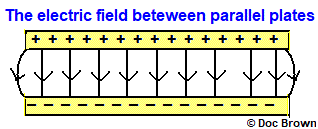 The electric field between parallel plates
The electric field between two oppositely
charged parallel plates is quite uniform with all the field lines parallel to
each other and all exactly at right angles to the surfaces of the plates.
Therefore the strength of the electric field is the same at any point between
the plates and will only differ at the ends of the plates where the field lines
become curved.
INDEX physics notes on static
electricity - electrostatics & electric fields
Key points about
static electricity - electric fields and charge size and distance factors
Information
sources for Doc Brown's key points: IGCSE-GCSE physics are based on
textbooks & syllabus-specifications for students taking the UK AQA, Edexcel,
OCR 21st Century Science, OCR Gateway science suite, WJEC, CCEA and CIE GCSE
physics 9-1 level science examinations
A comprehensive and
exam-board-aligned summary of electric fields, tailored for
IGCSE/GCSE Physics students across WJEC, CCEA, CIE, AQA, Edexcel, and OCR:
What Is an Electric Field?
An electric field is a region
around a charged object where another charge experiences a non-contact
electrostatic force.
- Created by charged objects
(positive or negative).
- The field exerts a force
on other charges placed within it.
- Direction
of the field is defined as the direction a positive test charge
would move.
Electric Field Lines: Visual Maps
Electric field lines are used to
represent the field:
| Charge Type |
Field Line Direction |
Field Line Pattern |
| Positive |
Outwards |
Radial (like sun rays) |
| Negative |
Inwards |
Radial (towards centre) |
| Opposite Charges |
From + to – |
Curved lines connecting them |
| Like Charges |
Away from each other |
Repelling, never crossing |
- Lines never cross.
- Closer lines = stronger field.
- Uniform field:
Between two parallel plates → straight, equally spaced lines from + to –.
Attraction and Repulsion
- Like charges repel,
opposite charges attract.
- These forces are non-contact
and act through the electric field.
- The force experienced
depends on:
- Size of the charges:
Larger charge = stronger field.
- Distance apart:
Closer = stronger force.
Rule of Thumb:
- Force proportional to 1 /
distance²
- Force proportional to charge size
Real-World Examples
- Van de Graaff generator:
Shows repulsion (hair standing up).
- Lightning:
Discharge due to strong electric fields between cloud and ground.
- Balloon and wall:
Balloon sticks due to induced attraction.
Exam Board Coverage
|
All major boards include the following concepts |
| Definition of electric field |
| Field line diagrams |
| Attraction and repulsion |
| Effect of charge size and distance
apart |
| Real-world examples (e.g. lightning) |
Student Tips for Exam Success
- Draw field lines
with arrows: away from +, toward –.
- Use correct terminology:
“non-contact force,” “field strength,” “radial field.”
- Explain interactions:
e.g. “The negative charge experiences an attractive force toward the
positive charge.”
- Link to real-world examples:
sparks, photocopiers, paint spraying.
- Don’t say “positive charge moves” unless
it’s a test charge in a field.
- Practice sketching:
isolated charges, opposite charges, parallel plates.
Keywords, phrases and learning objectives
on static electricity
- electric field diagrams and rules on charge size and distance apart
Be able to describe and explain what is an electric field of static electricity
is.
Be able to describe 'maps' of the field around an
static electric charge e.g. between two spheres or two plates.
Know the rules of repulsion and attraction of static charges
e.g. what happens when two charged objects interact.
Know the rules on force of repulsion or attraction
in terms of the size of
the static charge and the distance between the centres of the two
statically charged objects.
WHAT NEXT?
TOP of page
INDEX for physics notes on
STATIC ELECTRICITY
ALL my electricity and magnetism
notes
email doc
brown - comments - query?
INDEX of all my PHYSICS NOTES
Basic Science Quizzes for
UK KS3 science students aged ~12-14, ~US grades 6-8
Biology * Chemistry
* Physics for UK
GCSE level students aged ~14-16, ~US grades 9-10
Advanced Level Chemistry
for pre-university age ~16-18 ~US grades 11-12, K12 Honors
Find your GCSE/IGCSE
science course for more help links to all science revision notes
Based on the syllabus-specifications
for students taking the IGCSE/GCSE level physics examinations summary
revision notes and key points on electric field maps of repulsion &
attraction for students taking the AQA
igcse/gcse physics notes on electric field maps of repulsion & attraction, Edexcel gcse
physics notes on electric field maps of repulsion & attraction, OCR 21st century GCSE
physics notes on electric field maps of repulsion & attraction, OCR gateway
GCSE physics notes on electric field maps of repulsion & attraction, WJEC gcse physics notes on
electric field maps of repulsion & attraction, CCEA
gcse physics notes on electric field maps of repulsion & attraction for students taking CIE Cambridge igcse
physics, or any other GCSE or IGCSE level physics exams notes on
electric field maps of repulsion & attraction, useful for US grade 9-10 physics courses,
Explaining the importance of electric
field rules on how attractive force depends on quantity & distance
apart of charges
in GCSE level physics, What you need to know about electric field rules
on how attractive force depends on quantity & distance apart of
charges for
GCSE level
physics,
Explaining what is the use of electric field rules on how attractive
force depends on quantity & distance apart of charges knowledge in GCSE level physics, Examples of
electric field rules on how attractive force depends on quantity &
distance apart of charges explained
when studying GCSE level physics, What is
the significance of electric field rules on how attractive force depends
on quantity & distance apart of charges in GCSE level physics, Describing and
explaining the theory of electric field rules on how attractive force
depends on quantity & distance apart of charges when studying GCSE level physics, revision
notes for electric field rules on how attractive force depends on
quantity & distance apart of charges in exams, online exam help for
electric field rules on how attractive force depends on quantity &
distance apart of charges, revision notes for
electric field rules on how attractive force depends on quantity &
distance apart of charges, what do I need to learn about electric
field rules on how attractive force depends on quantity & distance
apart of charges for by GCSE physics exam?
revision summary for electric field rules on how attractive force
depends on quantity & distance apart of charges, help in teaching
electric field rules on how attractive force depends on quantity &
distance apart of charges, learning notes for electric field rules
on how attractive force depends on quantity & distance apart of
charges,
help to understand the electric field rules on how attractive force
depends on quantity & distance apart of charges topic in preparation GCSE physics exam
question, how to
prepare for questions involving electric field rules on how attractive
force depends on quantity & distance apart of charges in a GCSE physics examination?
SITEMAP
Website content © Dr
Phil Brown 2000+. All copyrights reserved on Doc Brown's physics revision notes, images,
quizzes, worksheets etc. Copying of website material is NOT
permitted. Exam revision summaries and references to GCSE science course specifications
are unofficial.
INDEX physics notes on static
electricity - electrostatics & electric fields
|
