|
GCSE level Physics exam revision notes:
Electromagnetism
Motor effect of electric current:
11.4 How a simple d.c.
DC electric
motor works, application of the motor effect
[Author
©
Dr Phil Brown PhD:
Doc Brown's physics exam revision notes suitable for students of UK
IGCSE & GCSE level physics courses, ~ US grades 9-10 physics
[electromagnetism - motor effect page updated
Feb 28th 2026 *]
[KEY
POINTS and learning objectives for this page, after initial notes]
*
[email doc b]
*
[privacy]
INDEX physics notes: motor
effect of an electric current & applications
[email doc b
query? comment?]
*
[privacy-policies-disclaimer]
*
]SEARCH doc b's
website]
11.4 A simple
d.c. electric
motor - an application of the motor effect
How does a simple
d.c. DC electric motor work?

The basics
of a simple d.c. electric motor
To understand how a simple dc electric motor
works consider the diagram above to get the idea.
Instead of a single linear wire,
consider placing a d.c. current carrying loop (or many turns of wire
loops) in the magnetic field of a permanent magnet (U shaped) or opposite
poles from two permanent magnets.
The wire is at 90o to the direction
of the magnetic field - lines of force in blue.
Now we apply Fleming's left-hand rule
because the same forces are in operation as for the single wire
demonstration.
I've drawn the rule and applied
it to both sides of the loop to show the directions the forces
produced operate.
The left side of the loop will
move downwards and the right side of the loop moves upwards giving
anticlockwise rotation.
This produces an anticlockwise
rotation movement - and that's quite simply, the basis of an
electric motor, but you will not get continuous rotation without
some further modifications and added 'bits' described below!

Explaining how a simple dc
electric motor works
However, as described previously, the
above
'diagram'
needed a few more bits to be a working electric motor!
The added 'bits' ....
are an axle (spindle) about which the coil can
freely rotate between the poles of a permanent magnet,
a split ring commutator that
swaps the contacts around every half-turn (swapping the
+/-polarity, swapping the direction of resulting force) and
keeps the rotation in the same direction, it
also enables
electrical contact to the external circuit, together with the
...
... brush contacts (of graphite block or copper
strip) which enable rotation movement to continue but still
maintain a complete electrical circuit - the 'brushes' sweep
over the surface of the contacts on the axle,
and of course a frame structure to hold all the
components in place!
The way the forces operate was explained in the
previous diagram, but I have repeated the application of Fleming's
left-hand rule to show the coil will rotate anticlockwise.
theoretically, when the
copper wire coil is vertical, the circuit is broken for a split
second, but the momentum of the coil carries the rotation a bit
further, the circuit is complete again, and continuous rotation
is conserved.
You can reverse the direction of
rotation either by either ..
(i) swapping the polarity of
the d.c. supply to change the direction of current flow,
and (ii) swapping the
magnetic poles of the permanent magnet to change the direction of the magnetic field.
A simple, but practical, working
model of a simple d.c. electric motor


Notice in the right-hand diagram the
rotation is now clockwise, but current flow is opposite in direction
compared to the previous diagram - so check it out with Fleming's
left-hand rule!
However, there are several
sources of energy loss - decreasing the efficiency of the
motor
(a) When the electric motor
starts running the current decreases a little from its
initial value.
As the current flows, the
thin wire coils act as a resistance, the coil heats up a
little as heat energy is lost: electrical energy ==> thermal
energy store of the motor and surroundings.
Since the temperature of
the coils increases, its resistance increases a bit more,
leading to a greater increase in wasted energy.
(b) Although this machine is
acting as an electric motor, simultaneously it acts as a
generator!
As the coil rotates in
the magnetic field it induces a current to flow in the
opposite direction.
See
12.
Generator effect, applications e.g. generators
generating electricity
How can you
make a simple dc (or any) electric motor more powerful?
There are three ways to do this, all
involve increasing the strength of the magnetic field ...
(i)
Increasing the number of turns
of wire in the coil.
The magnetic lines of force
'cut' through more wire per unit time.
(ii)
By winding the coil on a soft-iron armature to
increase the magnetic flux. through the coil.
The ion concentrates the lines
of force, so more lines of force are 'cut' through per unit
time.
(iii)
By making the field magnet as strong as
possible.
The stronger the magnet, the
greater the magnetic flux - the lines of force are closer together, so more lines of
force are 'cut' per time as the armature rotates.
(iv) Increasing the p.d.
across the coil to increase the current.
Increase the charge flow will
intensify and strengthen the magnetic field around the coil.
These factors apply to
any electric motor design.
These factors can be used
to increase the speed of rotation of the motor.
To make an electric motor
less powerful or slow its rotation down, (i) reduce the
current (by reducing the pd across the coils), (ii) reduce
the number of turns of wire coils and (iii) decrease the
strength of the magnet to reduce the magnetic flux density.
Factor (i) is used to
control the speed of an electric motor e.g. an electric car
or train. You can't really change any other factor in a
working machine!
Practical electrical motors
The d.c. motor described
above is pretty simple and very inefficient.
In more practical motors, the
magnetic pole pieces are curved in shape to give a more radial
magnetic field.
This means the coil is always
at right angles to the magnetic field - maximising the resultant
force from the interaction of the two magnetic fields.
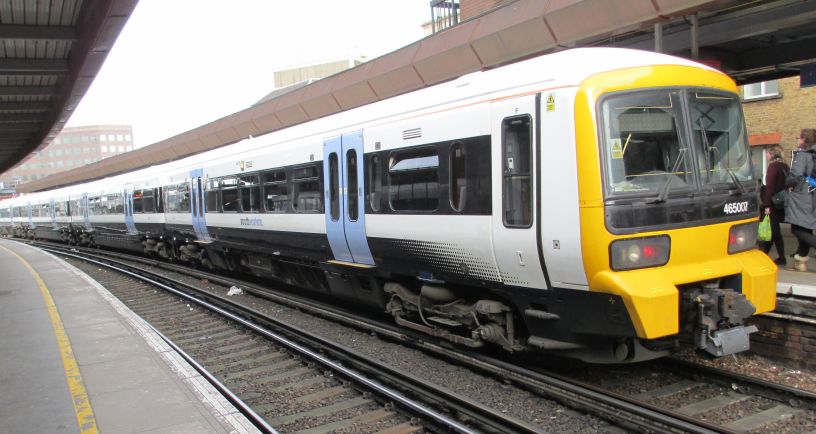
This electrical multiple unit train
in London has electric motors that are
powered by a 3rd rail system of 750 V d.c.
INDEX physics notes: motor
effect of an electric current and applications
Key points about electromagnetism
-
motor effect of electric current - simple DC motor
Information
sources for Doc Brown's key points: IGCSE-GCSE physics are based on
textbooks & syllabus-specifications for students taking the UK AQA, Edexcel,
OCR 21st Century Science, OCR Gateway science suite, WJEC, CCEA and CIE GCSE
physics 9-1 level science examinations
Here's a comprehensive and
exam-board-aligned summary on how a simple d.c. motor works
and the factors that control its power, tailored for
IGCSE/GCSE Physics students across WJEC, CCEA, CIE, AQA, Edexcel, and
OCR.
How a Simple D.C. Motor Works
Basic Principle of the simple d.c. motor
A d.c. motor converts
electrical energy into mechanical (rotational)
energy using the motor effect—the force
experienced by a current-carrying conductor in a magnetic field.
Key Components of the simple d.c. motor
- Coil of wire:
Carries current and is free to rotate.
- Permanent magnets:
Create a uniform magnetic field.
- Split-ring commutator:
Reverses current every half-turn to maintain continuous rotation.
- Carbon brushes:
Maintain electrical contact with the rotating coil.
Step-by-Step Operation of the simple d.c.
motor
- Current flows
through the coil, generating a magnetic field.
- This field interacts
with the magnetic field from the magnets.
- Motor effect
causes a force on each side of the coil (use
Fleming’s Left-Hand Rule).
- Opposing forces on either side of the
coil cause it to rotate.
- As the coil reaches vertical, the
split-ring commutator reverses the current.
- This keeps the rotation in the
same direction, allowing continuous spinning.
Factors Controlling the DC Motor Power
| Factor |
Effect on
Power/Speed |
| Current (I) |
More current = stronger magnetic
field = greater force = faster rotation |
| Magnetic field strength
(B) |
Stronger magnets increase the
force on the coil |
| Number of turns in the
coil |
More turns = greater total force
acting on the coil |
| Length of wire in field
(L) |
Longer wire in the magnetic field
= more force |
| Voltage of power supply |
Higher voltage increases current
(if resistance is constant) |
| Friction and load |
More friction or heavier load
reduces efficiency and speed |
These factors relate to the equation:
F = BIL
Where ( F ) is the force on the wire, (
B ) is magnetic flux density, ( I ) is current, and ( L ) is the length
of wire in the field.
See Part 11.3
Calculating the
size of the force produced by the motor effect
Typical Exam Board Specification Content
on the d.c. motor
|
Key Content |
| Motor effect, Fleming’s rule, d.c.
motor structure and function (HT only) |
| Construction and working of a d.c.
motor, split-ring commutator, factors affecting speed |
| Motor effect, Fleming’s rule, d.c.
motor operation |
| D.C. motor structure, magnetic
forces, commutator function, speed control |
| Motor effect, d.c. motor
explanation, practical applications |
| Magnetic effects of current, d.c.
motor explanation, factors affecting performance |
Student tips on the d.c. motor
- Master Fleming’s Left-Hand
Rule: Thumb = Force, First
finger = Field, Second finger = Current.
- Draw and label
a diagram of a simple d.c. motor—this is a frequent exam task.
- Explain the role of the
split-ring commutator—a
common 4–6 mark question.
- Use simulations or demos
to visualise how current and field strength affect rotation.
- Practice applying
( F = BIL ) in context—especially for higher-tier questions.
Keywords, phrases and learning objectives
on the motor effect in a simple d.c.
DC motor
Be able to interpret a diagram to explain how an d.c.
DC electric motor works.
Be able to describe some uses of an d.c. DC electric
motor.
WHAT NEXT?
TOP of page
INDEX physics notes on motor
effect of an electric current
ALL my electricity and magnetism
notes
email doc
brown - comments - query?
INDEX of all my PHYSICS NOTES
Basic Science Quizzes for
UK KS3 science students aged ~12-14, ~US grades 6-8
Biology * Chemistry
* Physics for UK
GCSE level students aged ~14-16, ~US grades 9-10
Advanced Level Chemistry
for pre-university age ~16-18 ~US grades 11-12, K12 Honors
Find your GCSE/IGCSE
science course for more help links to all science revision notes
Explaining the importance of explaining how
an a.c. electric motor works in GCSE
level physics, What you need to know about explaining how an a.c.
electric motor works for GCSE level
physics, Explaining the use of explaining how an a.c. electric motor
works knowledge in GCSE level physics,
Examples of explaining how an a.c. electric motor works explained when studying GCSE level physics, What is
the significance of explaining how an a.c. electric motor works in GCSE level physics, What is the use of
explaining how an a.c. electric motor works
in GCSE level physics Describing and explaining the theory of
explaining how an a.c. electric motor works when studying GCSE level physics, revision notes on
explaining how an a.c. electric motor works in exams, online help for
explaining how an a.c. electric motor works, revision notes for
explaining how an a.c. electric motor works,
what do I need to learn for explaining how an a.c. electric motor works? revision summary for
explaining how an a.c. electric motor works, help in
teaching explaining how an a.c. electric motor works, learning notes for
explaining how an a.c. electric motor works, help to pass the explaining
how an a.c. electric motor works exam, how to
prepare for the explaining how an a.c. electric motor works examination? Website
content © Dr Phil Brown 2000+. All copyrights reserved on Doc
Brown's Physics revision notes on explaining how an a.c. electric
motor works, images, quizzes, worksheets etc.
Copying of website material is NOT permitted Detailed
notes on explaining how an a.c. electric motor works. Based on the syllabus-specifications
for students taking the IGCSE/GCSE level physics examinations summary
revision notes and key points on explaining how an a.c. electric motor
works for students taking the AQA
igcse/gcse physics notes on explaining how an a.c. electric motor works, Edexcel gcse
physics notes on explaining how an a.c. electric motor works, OCR 21st century GCSE
physics notes on explaining how an a.c. electric motor works, OCR gateway
GCSE physics notes on explaining how an a.c. electric motor works, WJEC gcse physics notes on
explaining how an a.c. electric motor works, CCEA
gcse physics notes on explaining how an a.c. electric motor works for students taking CIE Cambridge igcse
physics, or any other GCSE or IGCSE level physics exams notes on
explaining how an a.c. electric motor works, useful for US grade 9-10 physics courses
SITEMAP
Website content © Dr
Phil Brown 2000+. All copyrights reserved on Doc Brown's physics revision notes, images,
quizzes, worksheets etc. Copying of website material is NOT
permitted. Exam revision summaries and references to GCSE science course specifications
are unofficial.
INDEX physics notes: motor
effect of an electric current and applications
|
