|
GCSE level exam revision notes on Evolution:
9.
What is
speciation?
What causes speciation? - old species and new species undergoing extinction or
evolving to survive?
[Author
©
Dr Phil Brown PhD:
Doc Brown's biology exam revision notes suitable for students of UK
IGCSE & GCSE level biology courses & ~ US grades 9-10 biology
[evolution page updated
Mar 11th 2026 *]
[email doc
b: comment? query?]
*
[privacy-policies-disclaimer] * ]SEARCH doc b's
website]
[Key
points and learning objectives for this page, after the main body of
notes]
Sub-index of biology notes on all aspects of EVOLUTION
(9)
Speciation - old and new species - extinction or
survival?
The current
situation and threat of continuing extinctions and use of gene banks and
seed banks
Definitions
A species is defined as a similar group of
organisms that can interbreed to reproduce to give fertile offspring.
Speciation is defined as the development-evolution of a
new species from a previous existing species
Speciation happens when populations off the same
species become sufficiently different genetically that they can no longer
successfully interbreed to produce fertile offspring.
However, if the two separated populations
can then successively reproduce, two new species have formed.
Rarely, but sometimes two species can
breed offspring, but the offspring will be infertile e.g.
A mule is the offspring of a male donkey
and a female horse. A horse has 64 chromosomes, and a donkey has
62. Mules have 63 chromosomes can be either male or female, but,
because of the odd number of chromosomes, mules can't reproduce.
Think off the sex cells (gametes), both have a half compliment
of the full set of genes. You can't have mule gametes with 31½
genes!
'Mechanism' - how does speciation happen?
A new species often arises as a result of
geographical separation:
e.g. speciation can occur via
isolation – two populations of a species become separated geographically.
This might be due to a
physical barrier like a mountain chain or islands well separated
in distance.
Floods and earthquakes can
isolate sections of a population.
Sub-species can develop even
amongst a group of islands in the same archipelago (as Darwin
noted).
In the two geographical regions,
the climate might be different, the other plants and animals may be
different - different ecosystems.
However, if each population can
survive, by the process of natural selection, two distinct species can
evolve.
(Or possibly one population remains the same, but the other has to
adapt to a different environment).
If two populations of the same species become
separated ..
and encounter different environmental
conditions, assuming neither population becomes extinct,
mutations will occur, and any advantageous
genes are passed on through successive generations,
over a long period of time, the beneficial
genotypes (alleles) and resulting phenotypes,
can change so much that a completely new species evolves.
The fossil record shows changes
that lead to the formation of new species and continues to this day.
Why genetically can this happen?
Genetic
variation – each population has a wide range of alleles that control their
characteristics.
Since the environment is
different in the separate geographical areas, different
advantages characteristics will become more common - individuals
better adapted will breed more successfully and pass their genes
on to their offspring.
Natural selection – in each population, the alleles that
control the characteristics which help the organism to survive are selected
and passed on to the next generation - 'survival of the fittest'.
Now the populations become so different that successful
interbreeding is no longer possible.
Therefore breeding continues
separately within each distinct population - in time increasing further
genetic distinction between the two populations, now different species.
Darwin noted good examples of
speciation on the Galapagos Islands.
He observed that different species of
finch, originally from the South American mainland, had become
isolated on different islands.
Here there would be different
food resources, so small adaptations had evolved in the finches
to deal with the various different foods that could sustain
bird-life.
This was shown by the evolution of different shaped
beaks to cope with cacti, insects, nuts and small seeds
Further
more, the finches selected different and appropriate habitats to
live, survive and reproduce - the right beak to go where the
right food supply is.
Extinction or survival
Many things can be derived from the fossil
record, and not just the structure of ancient organisms.
Some complex species have survived
unchanged for thousands/millions of years and some primitive
single-celled organisms maybe unchanged after billions of years.
However, in most cases two scenarios seem
to present themselves from the fossil record.
(i) Evolution has produced diverse and
successive and successful species, each one developing in
stages by slow evolutionary modifications - some more dramatic
than others.
e.g. a primitive horse to the modern
horse, humans from a species of ape,
some reptile dinosaurs evolved into
birds and some curious intermediate animals like the
Archaeopteryx
which had feathers like modern birds and a skeleton like
that of a small non-avian dinosaur.
Generally
speaking we are talking about the survival of the fittest in
a plant or animal's natural environment (i.e. most of this
page!), BUT ....
(ii) Many species have become extinct
- meaning none of them exist at all
The reasons are many, varied and often
complex.
Extinctions might be due to e.g. predation
- unable to compete for resources with an old/new predator, lack
of appropriate food supply, new disease like a mutated virus,
over hunting by man, pollution of environment by humans, climate
change AND sometimes coinciding with mass extinctions due to
some big catastrophic event.
e.g. the introduction of cats, dogs
and rats by early explorers to Pacific islands resulted in
the death of many animals including birds and turtles.
AND the extinction of dinosaurs due to
a large asteroid hitting Earth ~66 million years ago. It is
reckoned that it killed 3/4 of all the species of life on
Earth at the time.
The dust thrown up by the impact
would have considerably reduced the intensity of
sunlight, inhibiting photosynthesis in land plants,
algae etc. thus disrupting the start of many food
chains.
Herbivores would suffer lack of
food and this in turn affects the food chain of
carnivores.
The temperature would fall too
perhaps favouring the rapid development of warm blooded
mammals.
These kind of major events put extreme
pressures on the ability of species to survive - most don't.
To date, we think there have been five
mass extinctions.
Some appear to coincide with major
climatic change of the whole planet due to alternate periods
of warming and cooling - this can affect ocean currents as
well as the climate on land.
Plate tectonics has shifted the
position of continental plates from hot to cold regions and
vice versa - that's why the UK has huge coal deposits from
decayed forests that once grew near the equator!
Are we in the middle of a 6th mass
extinction due to human activity on Earth?
e.g. deforestation - reduction of
wildlife habitats,
global warming from rising carbon
dioxide levels from burning fossil fuels,
introduction of alien species into
a naturally balanced ecosystem,
world-wide pollution of air, land
and water - toxins tend to build up in food chains and
plastic litter is widespread,
use of agrichemicals is
devastating insect populations that pollinate many of
the world's most important crops, supplying most of the
world's food supply,
it is predicted by some
scientists that if bees go, we follow them!
so make sure your garden is
eco-friendly for bees and our other insect friends!
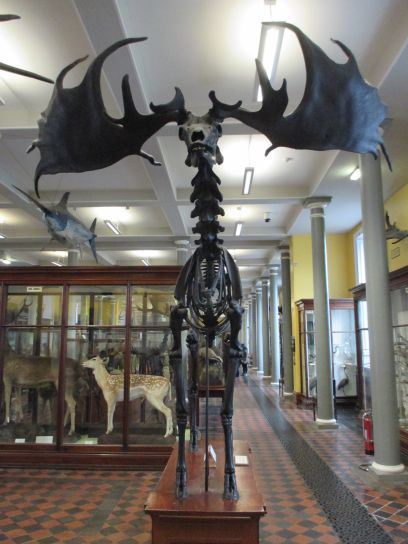
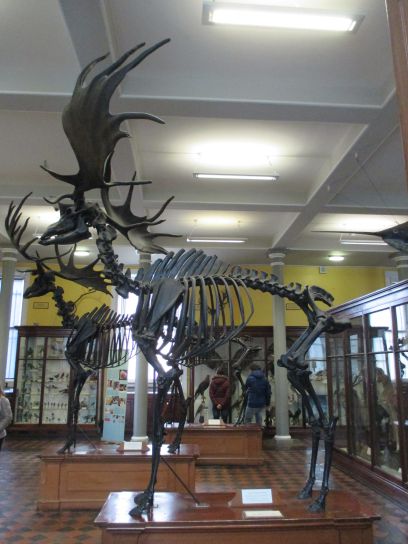
Giant Irish Deer (wrongly called the
'Irish Elk') skeletons, the largest species of deer to exist, wasn't
exclusive to Ireland and isn't an elk!
It died out in Ireland
11,000 years ago unable to cope with the post-glacial conditions of the
last ice-age after the ice retreated north.
(Exhibits in the Natural History Museum, Dublin, Ireland)
The current situation - extinction risks and
how it may affect us and gene banks
Extinction risks
Most organisms survive because they are well-adapted to compete
and reproduce in their environment.
BUT, if the environment changes in some way, some organisms might
struggle to compete with other organisms for the same resources they
need to reproduce and continues the species existence.
If changes are slow, then species can adapt to cope with a change
in the environment, overtime, new sub-species may evolve and even
new species.
Natural genetic variation in the gene bank of a
species is crucial, so within the population of a species, there
will be individuals 'slightly' better adapted to survive and
breed, while others less well adapted, will die out, but the
species existence is maintained.
This is why variation and biodiversity are so important.
However, species are most in danger of extinction if
environmental changes are rapid and these can include climate change
e.g. global warming or highly mechanised intensive farming -
particularly with overuse of pesticides (e.g. herbicides and
insecticides and loss of wildlife habitat (e.g. deforestation).
Species at risk of extinction are referred to as an
endangered
species of plants or animals.
If a whole species becomes unsustainable, it becomes
extinct,
none of the species survives.
Extinctions and the human
species!
We humans rely on plants and animals for food and other natural
resources for building materials, clothing, novel medicine
developments and fuel.
It is therefore important that we protect these useful organisms
and other non-useful organisms to maintain healthy ecosystems of biodiversity and bear in mind the countless organisms yet to be
discovered which also need to be protected from extinction in the
future.
Ecosystems are vulnerable if one species declines in numbers and
becomes extinct there will be knock-on effects on the food chains of
complex food webs.
Insects are essential pollinators for many crops as well as wild
growing plants. Modern farming methods have produced a rapid decline
in the number of pollinating bees.
Gene banks to prevent
extinctions
An important relatively modern development to protect species
from extinction is the use of gene banks.
If a species is endangered (or extinct in some circumstances) it
is possible to create healthy specimens of these species, maintain
biodiversity, but only under particular circumstances - refrigeration storage is important!
1. Plants - store seeds in seed banks
Healthy plant seeds contain viable genes and such
seeds can be germinated to create healthy plants.
Wild plant seeds are being collected and stored in
seed
banks at low temperatures to minimise the risk of
degradation of the organic material.
If the wild plant becomes extinct it can be
re-grown
using seeds from the seed bank.
2. Animal species - store sex cells
Sperm and egg cells (both sets of genes-chromosomes are need)
can be frozen and stored for future use to create animal
embryos.
Note that human sex cells more delicate the plant seeds,
so storage time and viability may be limited? There are also
ethical issues involved too e.g. whose sex cells are stored?
who has access to use these stored sex cells? Science
fiction can become science fact !!!
3. Prevention is better than cure!
(i) Endangered animal species in the wild can be captured and
reared in a safe environment in a habitat suitable for them to
survive and reproduce.
The offspring can be released back into their natural
habitat if conditions are suitable.
(ii) Prevent the destruction of habitats in the first place
to ensure biodiversity is maintained and all species survive
that would have survived before we destroyed their habitat.
Key points
Based on
the syllabus-specifications for students taking the AQA, Edexcel and OCR
GCSE level biology examinations (~US grades 9-10).
Key
ideas and more examples
Speciation and
Its Role in Evolution
Speciation is the process
by which new species form. It is a fundamental
mechanism of evolution, helping organisms adapt to
changing environments and leading to the diversity of life seen today.
What Is Speciation?
-
Speciation occurs when a
single ancestral species splits into two or
more distinct species.
-
For speciation to happen,
populations must become reproductively isolated,
meaning they can no longer interbreed.
-
Over generations, genetic
differences accumulate, resulting in a new species that
differs from the original one.
How Does Speciation
Happen?
There are several
mechanisms of speciation:
-
Allopatric
Speciation (Geographical Isolation)
-
A population becomes
physically separated by barriers such as mountains,
rivers, or oceans.
-
Each group evolves
independently, adapting to different environments.
-
Example:
Darwin’s finches on the Galápagos Islands evolved into
different species due to isolation.
-
Sympatric
Speciation (Reproductive Isolation Without Physical Barriers)
-
Occurs within the
same environment, but individuals become isolated
due to behavioral or genetic changes.
-
Example: Certain
plants evolve to bloom at different times, preventing
cross-pollination.
-
Parapatric
Speciation (Partial Isolation Across a Range)
-
Artificial
Speciation (Human-Induced)
-
Humans can accelerate
speciation through selective breeding (domesticated
animals, crops).
-
Example: Different dog
breeds have been selectively bred for size, speed, or temperament.
Extinction and
Survival—The Fate of Old and New Species
As species evolve, they
may either thrive or become extinct.
Causes of Extinction
-
Environmental
changes (climate shifts,
habitat destruction).
-
Competition
with new species for resources.
-
Predation or
disease affecting
populations.
-
Mass extinction
events, such as asteroid
impacts or volcanic eruptions.
Evolution for
Survival
-
If species can
adapt to environmental changes, they survive and may eventually
evolve into new forms.
-
Example: Early
horses were small forest dwellers, but over time, evolved into
larger, grassland species with single hooves.
Importance of
Speciation in Understanding Evolution
-
Explains
Biodiversity – Speciation
is the driving force behind the diversity of life on Earth.
-
Supports
Evolutionary Theory –
Provides proof that species change over time in response to natural
selection.
-
Predicts Future
Survival – Helps
scientists understand how organisms may adapt to climate change or human
impact.
-
Medical and
Agricultural Insights –
Studying speciation helps improve disease resistance in crops
and genetic research in medicine.
Understanding speciation
allows biologists to see how life continues to change, adapt,
and evolve—shaping ecosystems for millions of years.
Summary of learning objectives and key words or phrases
-
Be able describe and explain how speciation occurs in the
evolution of plants and animals.
-
How does speciation happen? and does it explain an
evolutionary cause of new species.
-
Be able to explain how the extinction of old species happens
and why better adapted species survive.
-
Know about the use of gene banks of seeds will help the
preservation of endangered species.
-
Demonstrate an understanding of
how speciation occurs as a result of geographic isolation.
-
A species is group of similar organisms
that can interbreed to give fertile offspring.
-
Speciation is the development of a new
species and can happen when populations of the same original species becomes
so different (genetically) that they can no longer interbreed to give
fertile offspring.
-
Speciation can occur via isolation – two
populations of a species become separated, eg geographically,
-
In the two geographical regions, the
climate might be different, the other plants and animals may be different.
-
However, if each population can survive,
by the process of natural selection, two distinct species can evolve (or
perhaps one population remains the same, but the other has to adapt to a
different environment).
-
Speciation: Know and understand that new species arise as a result of:
-
A species is group of similar
organisms that can interbreed to give fertile offspring.
-
Speciation is the development of
a new species and can happen when populations of the same original species
becomes so different (genetically) that they can no longer interbreed to
give fertile offspring.
-
Speciation can occur via isolation – two
populations of a species become separated, eg geographically,
-
In the two geographical regions,
the climate might be different, the other plants and animals may be
different.
-
However, if each population can
survive, by the process of natural selection, two distinct species can
evolve (or perhaps one population remains the same, but the other has to
adapt to a different environment).
-
Genetic
variation – each population has a wide range of alleles that control their
characteristics,
-
Natural selection – in each population, the alleles that
control the characteristics which help the organism to survive are selected
and passed on to the next generation - 'survival of the fittest'.
-
Speciation – the populations become so different that successful
interbreeding is no longer possible.
-
Therefore breeding continues
separately within each distinct population - in time producing further
genetic distinction.
WHAT NEXT?
TOP OF PAGE
INDEX
of biology notes on all aspects of EVOLUTION
Big website and use [SEARCH
BOX] below, maybe quicker than the indexes
INDEX of all my BIOLOGY NOTES
HOME PAGE of Doc Brown's Science
website
UK KS3 Science Quizzes for
KS3 science students aged ~11-14, ~US grades 6, 7 and 8
Biology * Chemistry
* Physics UK
GCSE level students aged ~14-16, ~US grades 9-10
Advanced Level Chemistry
for pre-university age ~16-18 ~US grades 11-12, K12 Honors
Find your GCSE/IGCSE
science course for more help links to all science revision notes
email doc
brown - comments - query?
Explaining importance of explaining
speciation, causes of speciation in evolution
in GCSE level biology, What you need to know about explaining
speciation, causes of speciation in evolution for
GCSE level
biology,
Explaining use of explaining speciation, causes of speciation in
evolution knowledge in GCSE level biology, Examples of explaining
speciation, causes of speciation in evolution
explained when studying GCSE level biology, What is the significance of
explaining speciation, causes of speciation in evolution in GCSE level biology, describing
explaining theory of explaining speciation, causes of speciation in
evolution when studying GCSE level biology, exam revision
notes for explaining speciation, causes of speciation in evolution, online help for understanding
explaining speciation, causes of speciation in evolution in GCSE
biology, what do I need to learn about explaining speciation, causes of
speciation in evolution? what do I need to know about
explaining speciation, causes of speciation in evolution for GCSE biology exams, how to prepare for questions on
explaining speciation, causes of speciation in evolution in GCSE
biology examination? explaining speciation, causes of speciation in
evolution for
syllabus-specifications
for students taking the IGCSE/GCSE level biology examinations, summary
revision notes key points on explaining speciation, causes of speciation
in evolution for students studying AQA
igcse/gcse biology notes on explaining speciation, causes of speciation in
evolution, Edexcel gcse
biology notes on explaining speciation, causes of speciation in
evolution, OCR 21st century GCSE
biology notes on explaining speciation, causes of speciation in
evolution, OCR gateway
GCSE biology notes on explaining speciation, causes of speciation in
evolution, WJEC gcse biology notes on explaining speciation, causes of
speciation in evolution, CCEA
gcse biology notes on explaining speciation, causes of speciation in
evolution, CIE Cambridge igcse
biology, notes on
explaining speciation, causes of speciation in evolution useful for US grade 9-10 biology student courses
SITEMAP Website content © Dr
Phil Brown 2000+. All copyrights reserved on Doc Brown's biology revision notes, images,
quizzes, worksheets etc. Copying of website material is NOT
permitted. Exam revision summaries and references to science course specifications
are unofficial.
|