 Which of the following statements best describes the arrangement of particles in a gas? [sm-1]
- Close together and stationary
- Close together and vibrating
- Far apart and moving slowly
- Very far apart and moving quickly
- Which of the following statements best describes the arrangement of particles in a solid? [sm-2]
- Close together and stationary
- Close together and vibrating
- Far apart and moving slowly
- Very far apart and moving quickly
- Which of the following statements best describes the arrangement of particles in a liquid? [sm-3]
- Close together and stationary
- Far apart and vibrating
- Close together and moving freely
- Very far apart and moving quickly
- Which of the following best describes what happens to the particles of water when it freezes? [sm-4]
- They gain energy and break up into atoms of hydrogen and oxygen,
- They gain energy and gain freedom to move about
- They lose energy and escape into the atmosphere
- They lose energy and lose freedom to move about,
- Which of the following best describes what happens to the particles of ice when it melts? [sm-5]
- They gain energy and break up into atoms of hydrogen and oxygen,
- They gain energy and gain freedom to move about
- They lose energy and escape into the atmosphere
- They lose energy and lose freedom to move about,
- Which of the following best describes what happens to the particles of water when it boils? [sm-6]
- They gain kinetic energy and increase their freedom to move without significant attraction
- They gain energy and gain freedom to move about
- They lose energy and escape into the atmosphere
- They lose energy and lose freedom to move about,
- Which of the following best describes what happens to the particles of water vapour when it condenses? [sm-7]
- They gain kinetic energy and increase their freedom to move without significant attraction
- They gain energy and gain freedom to move about
- They lose energy and are closer and less free to move around
- They lose energy and lose freedom to move about,
- Which of the following best describes what happens to the particles of water when it evaporates? [sm-8]
- The higher kinetic energy particles increase their freedom to move without significant attraction
- They gain energy and gain freedom to move about
- They lose energy and escape into the atmosphere
- They lose energy and lose freedom to move about,
 The table shows the melting points and boiling points of some substances. Which substance is a solid at 25oC? [sm-9]
[Substance] Melting Point oC and Boiling Point oC- -39 and 354
- 119 and 446
- 15 and 126
- -127 and -33
- The table shows the melting points and boiling points of some substances. Which substance is a liquid at 0oC? [sm-10]
[Substance] Melting Point oC and Boiling Point oC- -39 and 354
- 119 and 446
- 15 and 126
- -127 and -33
- The table shows the melting points and boiling points of some substances. Which substance is a gas at 0oC? [sm-11]
[Substance] Melting Point oC and Boiling Point oC- -39 and 354
- 119 and 446
- 15 and 126
- -127 and -33
- The table shows the melting points and boiling points of some substances. Which substance is a liquid at 30oC? [sm-12]
[Substance] Melting Point oC and Boiling Point oC- -39 and 10
- 119 and 446
- 15 and 126
- -127 and -33
 Air is confined in a glass bottle with a tight screw-top. When the bottle becomes warmer when heated with a hair-dryer, the pressure inside increases because the molecules of air? [sm-13]
- become bigger
- become smaller
- move faster
- move slower
- Air is in a glass bottle with a tight screw-top. When the bottle becomes cooler when placed in a refrigerator, the pressure inside decreases because the molecules of air? [sm-14]
- become bigger
- become smaller
- move faster
- move slower
- When the air in a room becomes warmer a hanging balloon blown up with air becomes bigger because the molecules of air? [sm-15]
- become bigger
- become smaller
- move faster
- move slower
- When the air in a room becomes cooler a hanging balloon blown up with air becomes smaller because the molecules of air? [sm-16]
- become bigger
- become smaller
- move faster
- move slower
- The table shows the melting points and boiling points of some substances. Which substance is a liquid at 20 oC? [sm-17]
[Substance] Melting Point oC and Boiling Point oC- -142 and -78
- -95 and 4
- -66 and 42
- 90 and 189
- The table shows the melting points and boiling points of some substances. Which substance is a solid at 20oC? [sm-18]
[Substance] Melting Point oC and Boiling Point oC- -142 and -78
- -95 and 4
- -66 and 42
- 90 and 189
- The table shows the melting points and boiling points of some substances. Which substance is a gas at -60oC? [sm-19]
[Substance] Melting Point oC and Boiling Point oC- -142 and -78
- -95 and 4
- -66 and 42
- 90 and 189
- The table shows the melting points and boiling points of some substances. Which substance is a liquid at -10oC and a gas at 10oC? [sm-20]
[Substance] Melting Point oC and Boiling Point oC- -142 and -78
- -95 and 4
- -66 and 42
- 90 and 189
 Which of the following graphs represents how the temperature of liquid varies as it becomes a solid? [sm-21]
- graph 1
- graph 2
- graph 3
- graph 4
- Which of the following graphs represents how the temperature of gas varies as it becomes a liquid? [sm-22]
- graph 1
- graph 2
- graph 3
- graph 4
- Which of the following graphs represents how the temperature of solid varies as it becomes a liquid? [sm-23]
- graph 1
- graph 2
- graph 3
- graph 4
- Which of the following graphs represents how the temperature of liquid varies as it becomes a gas? [sm-24]
- graph 1
- graph 2
- graph 3
- graph 4
- Which of the following graphs represents how the temperature of gas varies as it eventually becomes a solid? [sm-25]
- graph 1
- graph 2
- graph 3
- graph 4
- Which of the following graphs represents how the temperature of solid varies as it eventually becomes a gas? [sm-26]
- graph 1
- graph 2
- graph 3
- graph 4


Which of the following is true as a gas is changing to a liquid in condensation? [sm-27]- increase in particle order
- temperature rises
- particles gain more freedom
- energy change is endothermic
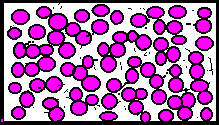
Which of the following is true as a gas is changing to a liquid in condensation? [sm-28]- decrease in particle order
- temperature rises
- particles lose freedom
- energy change is endothermic
Which of the following is true as a gas is changing to a liquid in condensation? [sm-29]- decrease in particle order
- temperature rises
- particles gain freedom
- energy change is exothermic

Which of the following is true as a liquid changes to a solid in freezing? [sm-30]- increase in particle order
- temperature falls
- particles gain freedom
- energy change is endothermic
Which of the following is true as a liquid changes to a solid in freezing? [sm-31]- decrease in particle order
- temperature stays constant
- particles gain freedom
- energy change is endothermic
Which of the following is true as a liquid changes to a solid in freezing? [sm-32]- decrease in particle order
- temperature falls
- particles lose freedom
- energy change is endothermic
Which of the following is true as a liquid changes to a solid in freezing? [sm-33]- decrease in particle order
- temperature falls
- particles gain freedom
- energy change is exothermic
Which of the following is true as a solid changes to a liquid in melting? [sm-34]- decrease in particle order
- temperature rises
- particles lose freedom
- energy change is exothermic
Which of the following is true as a solid changes to a liquid in melting? [sm-35]- increase in particle order
- temperature stays constant
- particles lose freedom
- energy change is exothermic
Which of the following is true as a solid changes to a liquid in melting? [sm-36]- increase in particle order
- temperature rises
- particles gain freedom
- energy change is exothermic
Which of the following is true as a solid changes to a liquid in melting? [sm-37]- increase in particle order
- temperature rises
- particles lose freedom
- energy change is endothermic
Which of the following is true as a liquid changes to a gas in boiling? [sm-38]- decrease in particle order
- temperature rises
- particles lose freedom
- energy change is exothermic
Which of the following is true as a liquid changes to a gas in boiling? [sm-39]- increase in particle order
- temperature stays constant
- particles lose freedom
- energy change is exothermic
Which of the following is true as a liquid changes to a gas in boiling? [sm-40]- increase in particle order
- temperature rises
- particles gain freedom
- energy change is exothermic
Which of the following is true as a liquid changes to a gas in boiling? [sm-41]- increase in particle order
- temperature rises
- particles lose freedom
- energy change is endothermic
Which of the following is true as a liquid changes to a gas in evaporation? [sm-42]- decrease in particle order
- temperature stays constant
- particles lose freedom
- energy change is exothermic
Which of the following is true as a liquid changes to a gas in evaporation? [sm-43]- increase in particle order
- temperature falls
- particles lose freedom
- energy change is exothermic
Which of the following is true as a liquid changes to a gas in evaporation? [sm-44]- increase in particle order
- temperature stays constant
- particles gain freedom
- energy change is exothermic
Which of the following is true as a liquid changes to a gas in evaporation? [sm-45]- increase in particle order
- temperature stays constant
- particles lose freedom
- energy change is endothermic
 When water vapour in a cloud is gradually cooled, rainwater is formed. This change of state is called? [sm-46]
- condensation
- distillation
- evaporation
- saturation
- Heat from the Sun changes water from liquid to a gas. This change of state is called? [sm-47]
- condensation
- distillation
- evaporation
- saturation
- Gases diffuse because they? [sm-48]
- are made of rapidly moving particles
- have low boiling points
- have a low density
- easily move as convection currents
- Liquids and dissolving solids diffuse because they? [sm-49]
- are made of moving particles
- have low boiling points
- have a low density
- easily move as convection currents
- The table below shows the melting points and boiling points of substances A to D. Which substance is a gas at 25oC? [sm-50]
[Substance] Melting point oC(mpt), Boiling Point oC(bpt)- mpt = -127o, bpt = -33 oC
- mpt = -39o, bpt = 354 oC
- mpt = 63o, bpt = 760 oC
- mpt = 119o, bpt = 446 oC
- The table below shows the melting points and boiling points of substances A to D. Which substance is a liquid at 25oC? [sm-51]
[Substance] Melting point oC(mpt), Boiling Point oC(bpt)- mpt = -127o, bpt = -33 oC
- mpt = -39o, bpt = 354 oC
- mpt = 63o, bpt = 760 oC
- mpt = 119o, bpt = 446 oC
- The table below shows the melting points and boiling points of substances A to D. Which substance is a solid at 100oC? [sm-52]
[Substance] Melting point oC(mpt), Boiling Point oC(bpt)- mpt = -127o, bpt = -33 oC
- mpt = -39o, bpt = 354 oC
- mpt = 63o, bpt = 760 oC
- mpt = 119o, bpt = 446 oC
- The table below shows the melting points and boiling points of substances A to D. Which substance is a solid at 100oC? [sm-53]
[Substance] Melting point oC(mpt), Boiling Point oC(bpt)- mpt = -127o, bpt = -33 oC
- mpt = -39o, bpt = 154 oC
- mpt = 99o, bpt = 140 oC
- mpt = 101o, bpt = 110 oC
- The table below shows the melting points and boiling points of substances A to D. Which substance is suitable to use in a thermometer that measures in the range 10oC to 90oC? [sm-54]
[Substance] Melting point oC(mpt), Boiling Point oC(bpt)- mpt = 0o, bpt = 100 oC
- mpt = -200o, bpt = 40 oC
- mpt = 20o, bpt = 350 oC
- mpt = -110o, bpt = 80 oC
- The table below shows the melting points and boiling points of substances A to D. Which substance is suitable to use in a thermometer that measures in the range -120oC to 20oC? [sm-55]
[Substance] Melting point oC(mpt), Boiling Point oC(bpt)- mpt = 0o, bpt = 100 oC
- mpt = -200o, bpt = 40 oC
- mpt = -40o, bpt = 350 oC
- mpt = -110o, bpt = 80 oC
- The table below shows the melting points and boiling points of substances A to D. Which substance is suitable to use in a thermometer that measures in the range 0oC to 100oC? [sm-56]
[Substance] Melting point oC(mpt), Boiling Point oC(bpt)- mpt = 0o, bpt = 100 oC
- mpt = -200o, bpt = 40 oC
- mpt = -40o, bpt = 350 oC
- mpt = -110o, bpt = 80 oC
- The table below shows the melting points and boiling points of substances A to D. Which substance is suitable to use in a thermometer that measures in the range -4oC to 50oC? [sm-57]
[Substance] Melting point oC(mpt), Boiling Point oC(bpt)- mpt = 0o, bpt = 100 oC
- mpt = -200o, bpt = 40 oC
- mpt = 40o, bpt = 350 oC
- mpt = -110o, bpt = 80 oC
- The rate of evaporation of a water does NOT depend on the? [sm-58]
- humidity of the surrounding air
- depth of the water
- surface area of the water
- temperature of the water
- Which is true about the rate of evaporation of water? [sm-59]
- it is speeded up on a humid day
- it is due to the escape of the most energetic particles
- heat is given out in the process
- it is slowed down in a breeze
- Which is true about the rate of evaporation of water? [sm-60]
- it is speeded up on a dry day
- it is due to the escape of the least energetic particles
- heat is given out in the process
- it is slowed down in a breeze
- Which is true about the rate of evaporation of water? [sm-61]
- it is speeded up on a humid day
- it is due to the escape of the least energetic particles
- heat is absorbed in the process
- it is slowed down in a breeze
- Which is true about the rate of evaporation of water? [sm-62]
- it is speeded up on a humid day
- it is due to the escape of the least energetic particles
- heat is given out in the process
- it is speeded up on a breezy day
- Which of these statements is true about evaporation? [sm-63]
- it is speeded up on a warm day
- it is due to the escape of the least energetic particles
- heat is given out in the process
- it is speeded up on a humid day
- The body is cooled down by sweating. This process mainly involves the heat transfer process of? [sm-64]
- conduction
- convection
- evaporation
- radiation
- Which of the following describes heat transfer due to evaporation? [sm-65]
- transfer due to the movement of volumes of gases or liquids
- transfer due to loss of energetic particles from the surface of a liquid
- transfer by infrared waves which can pass through air
- transfer due to the vibration of particles in contact with each other
- Which of the following best explains why gases diffuse throughout a container? [sm-66]
- there are no attractive forces between the particles of a gas
- gases have a low density
- gas particles move fast
- gas particles are very small
- Which of the following best explains why gases have a low density? [sm-67]
- the gas particles are very small
- the particles are far apart
- gas particles move fast
- the attractive force between particles are very weak


Which substance is likely to have a simple molecular structure? [cb-1]- melts at 17oC, insoluble in water, non-conductor of electricity either when solid or molten
- melts at 670oC, dissolves in water, non-conductor of electricity when molten, undergoes electrolysis in aqueous solution
- melts at 2600oC, dissolves in water, non-conductor of electricity when solid, undergoes electrolysis in aqueous solution
- melts at 1400oC, insoluble in water, good conductor of electricity either when solid or molten
-
Which substance is likely to have a giant ionic structure? [cb-2]- melts at 17oC, insoluble in water, non-conductor of electricity either when solid or molten
- melts at 2800oC, insoluble in water, non-conductor of electricity when molten or solid
- melts at 2600oC, dissolves in water, non-conductor of electricity when solid, undergoes electrolysis in aqueous solution
- melts at 1400oC, insoluble in water, good conductor of electricity either when solid or molten
-
Which substance is likely to have a metallic structure? [cb-3]- melts at 17oC, insoluble in water, non-conductor of electricity either when solid or molten
- melts at 2800oC, insoluble in water, non-conductor of electricity when molten or solid
- melts at 2600oC, dissolves in water, non-conductor of electricity when solid, undergoes electrolysis in aqueous solution
- melts at 1400oC, insoluble in water, good conductor of electricity either when solid or molten
-
Which substance is likely to have a giant covalent structure? [cb-4]- melts at 17oC, insoluble in water, non-conductor of electricity either when solid or molten
- melts at 2800oC, insoluble in water, non-conductor of electricity when molten or solid
- melts at 2600oC, dissolves in water, non-conductor of electricity when solid, undergoes electrolysis in aqueous solution
- melts at 1400oC, insoluble in water, good conductor of electricity either when solid or molten
-
Which substance is likely to have a simple molecular structure but form ions in aqueous solution? [cb-5]- melts at 17oC, reacts with water, non-conductor of electricity either when solid, molten or in water
- melts at 370oC, dissolves in water, non-conductor of electricity when molten or solid, solution conducts electricity
- melts at 2600oC, dissolves in water, non-conductor of electricity when solid, undergoes electrolysis in aqueous solution
- melts at 1400oC, insoluble in water, good conductor of electricity either when solid or molten
 A solution of sodium chloride conducts electricity because the? [cb-6]
- current breaks down sodium chloride into sodium ions and chloride ions
- ions formed from the water carry the current
- sodium ions and chloride ions are free to move and carry the current
- the free moving water molecules are good conductors
 An atom can turn into an ion if it? [cb-7]
- gains an electron
- loses a proton
- gains a neutron
- loses a neutron
- An atom can turn into an ion if it? [cb-8]
- gains a proton
- loses a proton
- gains a neutron
- loses an electron
- When a covalent bond is formed between atoms of different elements ? [cb-9]
- electrons are shared
- electrons are transferred
- protons are shared
- protons are transferred
 When an ionic bond is formed between atoms of different elements? [cb-10]
- electrons are shared
- electrons are transferred
- protons are shared
- protons are transferred
- Metal atoms form ions with a positive charge by? [cb-11]
- gaining protons
- gaining electrons
- losing electrons
- losing protons
- Non-metal atoms form ions with a negative charge by? [cb-12]
- gaining protons
- gaining electrons
- losing electrons
- losing protons
- Atoms of Group 7 of the Periodic Table are most likely to form ions with? [cb-13]
- a single negative charge by gaining one electron
- a single positive charge by losing one electron
- a double negative charge by gaining two electrons
- a double positive charge by losing two electrons
 Atoms of Group 1 of the Periodic Table are most likely to form ions with? [cb-14]
 - a single negative charge by gaining one electron
- a single positive charge by losing one electron
- a double negative charge by gaining two electrons
- a double positive charge by losing two electrons
- Atoms of Group 6 of the Periodic Table are most likely to form ions with [cb-15]
- a single negative charge by gaining one electron
- a single positive charge by losing one electron
- a double negative charge by gaining two electrons
- a double positive charge by losing two electrons
- Atoms of Group 2 of the Periodic Table are most likely to form ions with? [cb-16]
- a single negative charge by gaining one electron
- a single positive charge by losing one electron
- a double negative charge by gaining two electrons
- a double positive charge by losing two electrons
- Which electronic diagram is correct for the compound formed by combining a metal M, from Group 1, with a non-metal X from Group 7 of the Periodic Table? [cb-17]
-
- Which electronic diagram is correct for the compound formed by combining a metal M, from Group 1, with a non-metal X from Group 6 of the Periodic Table? [cb-18]
-
- Which electronic diagram is correct for the compound formed by combining a metal M, from Group 2, with a non-metal X from Group 6 of the Periodic Table? [cb-19]
-
- Which electronic diagram is correct for the compound formed by combining a metal M, from Group 2, with a non-metal X from Group 7 of the Periodic Table? [cb-20]
-
- Which electronic diagram is correct for the compound formed by combining a metal M, from Group 3, with a non-metal X from Group 6 of the Periodic Table? [cb-21]
-
- Which electronic diagram is correct for the compound formed by combining a metal M, from Group 3, with a non-metal X from Group 7 of the Periodic Table? [cb-22]
-
- Which of the following substances consists of an ionic lattice? [cb-23]
- high melting point, solid doesn't conduct electricity, aqueous solution conducts electricity
- high melting point, solid conducts electricity, insoluble in water
- low melting point, solid conducts electricity, insoluble in water
- low melting point, solid doesn't conduct electricity, aqueous solution doesn't conduct electricity
- What is an ion? [cb-24]
- an atom which has lost or gained electrons
- a negatively charged particle in the shells of an atom
- an uncharged particle in the nucleus of an atom
- a positively charged particle in the nucleus of an atom
-
Which of the following substances consists of a metal lattice? [cb-25]- high melting point, solid doesn't conduct electricity, aqueous solution conducts electricity
- high melting point, solid conducts electricity, insoluble in water
- low melting point, solid doesn't conduct electricity, insoluble in water
- low melting point, solid doesn't conduct electricity, aqueous solution doesn't conduct electricity
- A substance has an ionic structure. It conducts electricity when molten but not when solid. The substance could be? [cb-26]
- copper
- petrol
- ice
- sodium chloride
- Which of the following substances consists of small molecules? [cb-27]
- high melting point, solid doesn't conduct electricity, aqueous solution conducts electricity
- high melting point, solid conducts electricity, insoluble in water
- low melting point, solid conducts electricity, insoluble in water
- low melting point, solid doesn't conduct electricity, aqueous solution doesn't conduct electricity
- Molten or dissolved sodium chloride conducts electricity. The current is carried in the melt by? [cb-28]
- ions
- metal atoms
- molecules
- electrons
- Sodium chloride has a high melting point because it has? [cb-29]
- a giant covalent 3-dimentional structure
- many ions strongly attracted together
- molecules packed tightly together
- strong covalent double bonds
- Sodium chloride is a typical ionic compound formed by combining a metal with a non-metal. Sodium chloride will? [cb-30]
- conduct electricity when molten
- conduct electricity when solid
- have a low melting point
- consist of small NaCl molecules
- Sodium chloride is a typical ionic compound formed by combining a metal with a non-metal. Sodium chloride will? [cb-31]
- not conduct electricity when molten
- conduct electricity when dissolved in water
- have a low melting point
- consist of small NaCl molecules
- Sodium chloride is a typical ionic compound formed by combining a metal with a non-metal. Sodium chloride will? [cb-32]
- not conduct electricity when molten
- not conduct electricity when dissolved in water
- have a high melting point
- consist of small NaCl molecules
- Sodium chloride is a typical ionic compound formed by combining a metal with a non-metal.
Sodium chloride will? [cb-33]
- conduct electricity when solid
- not conduct electricity when dissolved in water
- have a low melting point
- consist of charged particles
- Sodium chloride is a typical ionic compound formed by combining a metal with a non-metal. Sodium chloride will? [cb-34]
- not conduct electricity when solid
- not conduct electricity when dissolved in water
- have a low melting point
- consist of NaCl molecules
- Sodium chloride is a typical ionic compound formed by combining a metal with a non-metal. Sodium chloride will? [cb-35]
- conduct electricity when solid
- will dissolved in water
- have a low melting point
- consist of NaCl molecules
-
A substance has a giant covalent structure and has a high melting point. The substance could be [cb-36]- aluminium
- copper
- poly(ethene)
- carbon (diamond)

 Solid iodine consists of I2 molecules
symmetrically arranged in a crystal lattice. Relatively high temperatures are needed to change iodine molecules into iodine atoms because the? [cb-37]
Solid iodine consists of I2 molecules
symmetrically arranged in a crystal lattice. Relatively high temperatures are needed to change iodine molecules into iodine atoms because the? [cb-37]- forces holding the atoms together in an iodine molecule are strong
- forces holding the molecules together in iodine are weak
- iodine is an element and a non-metal
- iodine is ionically bonded and the forces between ions are very strong
- Solid iodine consists of I2 molecules
symmetrically arranged in a crystal lattice. Only relatively low temperatures (e.g. gentle warming) are needed to change solid iodine into iodine vapour because the? [cb-38]
- forces holding the atoms together in an iodine molecule are strong
- forces holding the molecules together in iodine are weak
- iodine is an element and a non-metal
- iodine is ionically bonded and the forces between ions are very strong
- Potassium has an atomic number of 19. Which represents the electron configuration of the stable potassium ion K+? [cb-39]
-
- Calcium has an atomic number of 20. Which represents the electron configuration of the stable calcium ion Ca2+? [cb-40]
-
 Sulphur is a solid non-metallic element at room temperature, so it is? [cb-41]
- a brittle substance
- a good conductor of electricity
- a good conductor of heat
- a substance with a high melting point
- Sulphur is a solid non-metallic element at room temperature, so it is? [cb-42]
- easily bent into shape
- a poor conductor of electricity
- a good conductor of heat
- a substance with a high melting point
- Sulphur is a solid non-metallic element at room temperature, so it is? [cb-43]
- easily bent into shape
- a good conductor of electricity
- a poor conductor of heat
- a substance with a high melting point
- Sulphur is a solid non-metallic element at room temperature, so it is? [cb-44]
- easily bent into shape
- a good conductor of electricity
- a good conductor of heat
- a substance with a low melting point
 Copper is a metallic element so it is likely to be a? [cb-45]
- substance with a high melting point
- poor conductor of electricity
- substance with a low boiling point
- poor conductor of heat
- Copper is a metallic element so it is likely to be a? [cb-46]
- substance with a low melting point
- good conductor of electricity
- substance with a low boiling point
- poor conductor of heat
- Copper is a metallic element so it is likely to be a? [cb-47]
- substance with a low melting point
- poor conductor of electricity
- substance with a high boiling point
- poor conductor of heat
- Copper is a metallic element so it is likely to be a? [cb-48]
- substance with a low melting point
- poor conductor of electricity
- substance with a low boiling point
- good conductor of heat
- Copper is a metallic element so it is likely to be a? [cb-49]
- substance with a low melting point
- poor conductor of electricity
- substance with a shiny surface
- poor conductor of heat
- Copper is a metallic element so it is likely to be a? [cb-50]
- substance with a low melting point
- poor conductor of electricity
- substance easily hammered into shape
- poor conductor of heat
- To form an ion with a single positive charge, a metal atom must? [cb-51]
- gain an electron
- gain a proton
- lose an electron
- share an electron
- To form an ion with a single negative charge, a non-metal atom must? [cb-52]
- gain an electron
- gain a proton
- lose an electron
- share an electron
- Aluminium fluoride is an ionic compound. When this compound is formed from aluminium and fluorine? [cb-53]
- electrons are shared
- electrons are transferred
- protons are shared
- protons are transferred
- Water is a covalent compound. When this compound is formed from hydrogen and oxygen? [cb-54]
- electrons are shared
- electrons are transferred
- protons are shared
- protons are transferred
-
From four substances described below, which is most likely to be an ionic compound? [cb-55]- melting point 20oC, molten substance doesn't conduct electricity
- melting point 150oC, molten substance doesn't conduct electricity
- melting point 800oC, molten substance readily conducts electricity
- melting point 1500oC, molten substance is a poor electrical conductor
-
From four substances described below, which is most likely to consist of small molecules? [cb-56]- melting point 20oC, molten substance doesn't conduct electricity
- melting point 1150oC, molten substance conducts electricity
- melting point 480oC, molten substance readily conducts electricity
- melting point 1500oC, molten substance is a poor electrical conductor
-
From four substances described below, which is most likely to consist of a giant covalent structure? [cb-57]- melting point 20oC, molten substance doesn't conduct electricity
- melting point 1150oC, molten substance readily conducts electricity
- melting point 480oC, molten substance readily conducts electricity
- melting point 1500oC, molten substance is poor electrical conductor
- Fluorine (F) has an atomic number of 9. Which represents the electron arrangement of the fluoride ion (F-)? [cb-58]
-
- Magnesium (Mg) has an atomic number of 12. Which represents the electron arrangement of the magnesium ion (Mg2+)? [cb-59]
-
 Which electronic dot and cross diagram represents the compound formed when hydrogen (Q), at. no. 1 , combines with chlorine (X), Gp 7, at. no. 17? (only the outer shell o/x electrons are shown) [cb-60]
- diagram (6)
- diagram (2)
- diagram (4)
- diagram (1)
- Which electronic dot and cross diagram represents the compound formed when hydrogen (Q), at. no. 1 , combines with oxygen (X), Gp 6, at. no. 8? (only the outer shell o/x electrons are shown) [cb-61]
- diagram (3)
- diagram (4)
- diagram (7)
- diagram (1)
- Which electronic dot and cross diagram represents the compound formed when hydrogen (Q), at. no. 1 , combines with nitrogen (X), Gp 5, at. no. 7? (only the outer shell o/x electrons are shown) [cb-62]
- diagram (6)
- diagram (5)
- diagram (7)
- diagram (1)
- Which electronic dot and cross diagram represents the compound formed when hydrogen (Q), at. no. 1 , combines with carbon (X), Gp 4, at. no. 6? (only the outer shell o/x electrons are shown) [cb-63]
- diagram (3)
- diagram (5)
- diagram (7)
- diagram (8)
- Which electronic dot and cross diagram represents the compound formed when chlorine (Q), at. no. 17 , combines with carbon (X), Gp 4, at. no. 6? (only the outer shell o/x electrons are shown) [cb-64]
- diagram (3)
- diagram (5)
- diagram (7)
- diagram (8)


